Tech Titans And Online Education Orgs Team Up With The Open Education Alliance | TechCrunch


Google, AT&T and a host of online education organizations are forming an alliance to develop standards for career readiness. Spearheaded by Massively Open Online Course (MOOC) provider, Udacity, the Open Education Alliance will explore standards for how to prepare and evaluate graduates. The still-forming group of technology companies will help online education providers develop courses, tests, and certifications meant to supplement the use of a college degree in the hiring process.

See the full story: Tech Titans And Online Education Orgs Team Up With The Open Education Alliance | TechCrunch.

Great Web Tools | edtechteacher.org


In order to help educators integrate technology effectively, we have compiled a list of technology tools focused on learning goals consistent with the CRCD [collect-relate-create-donate] framework. Unlike other lists that promote “cool tools,” yet leave teachers wondering about purposeful educational integration, our list is driven by specific learning goals that promote critical-thinking, creativity, collaboration, and community-mindedness. We hope you will find our list useful.

What are your Learning Goals?

  1. I want my students to be able to create web based timelines.
  2. I want my students to create web based mind maps / graphic organizers.
  3. I want my students to publish their writing online for others to read.
  4. I want real-time, online discussion with my students.
  5. I want my students to search and evaluate web sites.
  6. I want to create guided research activities for my students.
  7. I want to connect my students to other students around the world.
  8. I want my students to create online portfolios.
  9. I want my students to create books, magazines, posters, or newsletters online.
  10. I want my students to record or edit audio.
  11. I want to use an interactive whiteboard effectively with my students.
  12. I want my students to create and edit maps.
  13. I want my students to draw or create comics on the Internet.
  14. I want to create tests, quizzes, and games online.
  15. I want my students to organize, bookmark and edit their research online.
  16. I want to find or create rubrics for multimedia projects.
  17. I want to connect to other teachers to share ideas and resources.

A comprehensive resource recommending a variety of tech according to each learning goal, as listed above. This is also a great resource for anyone looking for unique tech tools related to the activities listed.

techtools

via Great Web Tools | edtechteacher.org.

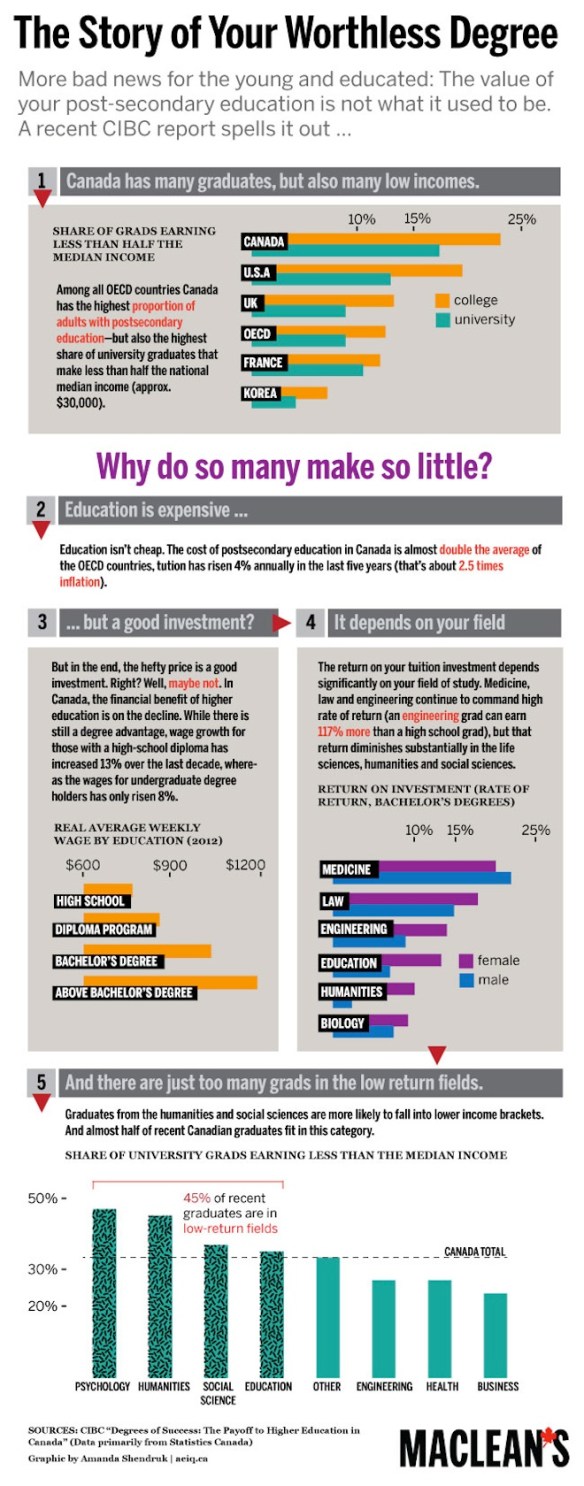
Degree or disagree: Your field of study matters [Infographic] | Macleans.ca


Degree or disagree: Your field of study matters – Blog Central, Show and Tell | Macleans.ca

Story of Your Worthless Degree

How You Too Can Transition from a Librarian to a Doctoral Student | Hack Library School


Editor’s note: This is a guest post by Abigail Phillips.

So, how do you, dear reader, know if you really want to get a PhD? If you are working as a public librarian or school media specialist, how do you know if academia is a good fit for you? What follows are some suggestions, tips, and advice from an ex-librarian turned academic for those thinking about entering a PhD program. Although my focus in this post is on potential doctoral students in Information Studies, this advice can be applied to any doctoral program.

via How You Too Can Transition from a Librarian to a Doctoral Student | Hack Library School.

University of Texas at Austin Online Class Aims to Earn Millions | WSJ.com


Two University of Texas at Austin professors this week launched their introductory psychology class from a makeshift studio, with a goal of eventually enrolling 10,000 students at $550 a pop and bringing home millions for the school.

The professors have dubbed the class a SMOC—Synchronous Massive Online Class—and their effort falls somewhere between a MOOC, or Massive Open Online Course, a late-night television show and a real-time research experiment. The professors lecture into a camera and students watch on their computers or mobile devices, in real time.

The class, which made its debut [August 29, 2013], is emblematic of just how quickly the once-static business model of higher education is shifting as technology gives students more options and forces schools and professors to compete for their attention.

See the full story: University of Texas at Austin Online Class Aims to Earn Millions | WSJ.com.

Alabama Legislator Bill Holtzclaw Calls On Schools To Ban Toni Morrison Book | Huffington Post


An Alabama legislator who does not support efforts to repeal the sweeping U.S. education initiative known as the Common Core Standards says he believes the reading list issued in conjunction with the standards needs to be revised.

State Senator Bill Holtzclaw (R-Madison) told Alabama Media Group this week that he believes The Bluest Eye, by Toni Morrison, should be banned from high school libraries, despite the fact that this book is on the Common Core Standard’s recommended reading list for 11th-graders. 

See the full story: Alabama Legislator Bill Holtzclaw Calls On Schools To Ban Toni Morrison Book | Huffington Post.

Links for Recent Pew Research News


Pew: 30% Of U.S. Adults Don’t Have Broadband; 10% Use Smartphones As Sole Internet Access; 20% Have Zilch | TechCrunch – August 26, 2013
Pew Research…releas[ed] the results of a survey that shows how one of the more advanced countries in the world, the U.S., is still not quite there in leading by example: 20% of U.S. adults are still without broadband or smartphones for internet access. And 3% of people in the country still using dial-up connections.

The below link is related the same Pew research results as the article above but provides discussion on a different perspective – the digital divide in America.  See the original Home Broadband 2013 Pew report – August 26, 2013.

Latest Pew Study Shows 70 Percent of U.S. Has Broadband. But Access Is Still Unequal | Wired.com – August 26, 2013
Pew’s results demonstrate that the digital divide is persistent, with close correlations between socioeconomic status and home Internet access. The report is also a reminder that policymakers use the words “high-speed broadband” to include everything other than dialup access, which is far too broad a definition.

Adult Trend Data | Pew Internet 
Latest data about device ownership by American adults up to end-May 2013.

Pew Study: More millennials are living with their parents than ever before | Stephen’s Lighthouse | August 22, 2013
According to a Pew poll, 36 percent of young adults are afflicted with Failure to Launch syndrome.

Teens say they generally rely on themselves to figure out how to manage their privacy online | Stephen’s Lighthouse – August 22, 2013
Teens say they generally rely on themselves to figure out how to manage their privacy online; Still, 70% of teens have at one time sought advice about how to manage their privacy online. See the Pew Internet report from August 15, 2013.

Teens and Mobile Apps Privacy | Pew Internet – August 22, 2013
As teens gain access to mobile devices, they have embraced app downloading. But many teen apps users have taken steps to uninstall or avoid apps over concern about their privacy. Location information is considered especially sensitive to teen girls, as a majority of them have disabled location tracking features on cell phones and in apps because they are worried about others’ access to that information.

Teens Haven’t Abandoned Facebook (Yet) | Pew Internet – August 15, 2013
When we released our “Teens, Social Media and Privacy” report in May, one thread of news coverage focused on teens’ “waning enthusiasm” for Facebook. This theme surfaced during our focus group discussions with teens and stood in contrast to the excitement that was associated with newer platforms like Instagram and Twitter.

Curious Brings Its “Learn Anything” Marketplace And Video Lesson Library To The iPad | TechCrunch


Perusing the Web, one quickly finds that learning platforms lean toward more academic subjects and mastery — online classes and courses — but what about more practical learning content and instruction? Sure, YouTube is rife with “how-to” videos, but separating the signal from the noise can take a lot of time.

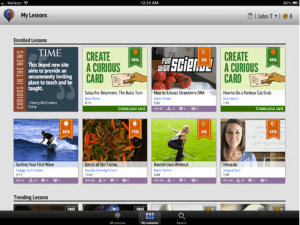
It’s this problem (or opportunity) that led Justin Kitch to launch Curious back in May…Kitch saw an opportunity to capitalize on the rise of video-based education and offer curious minds, hobbyists and lifelong learners a place to peruse and find how-to content on any subject.

Like a combination of Skillshare and Udemy, Curious essentially aims to be a marketplace of how-to videos, allowing those experts and those who want to teach with those eager to learn from them…in a way that’s more targeted, navigable and interactive than YouTube.

Curious for iPad and Curious on the web.

Curious

via Curious Brings Its “Learn Anything” Marketplace And Video Lesson Library To The iPad | TechCrunch.

LinkedIn Growing Up: Opens Up To High School Students Over 13, Launches Dedicated Pages For Universities Worldwide | TechCrunch


[T]oday LinkedIn made a bold move to start reaching out itself to this very lucrative, if fickle, audience: is beginning to promote itself to high school students (“13+ for most countries around the world” a spokesperson explains to me) and it has launched University Pages, dedicated pages for universities for people to add to their profiles and to reach out to people. LinkedIn hopes that both moves will not only expand the reach of how people use its site as their default anchor for resume-style information online. And also how it, too, could potentially tap into this user base to begin long-term relationships.

Both of these are getting rolled out globally, with the younger users starting to get accepted beginning September 12.

See the full story: LinkedIn Growing Up: Opens Up To High School Students Over 13, Launches Dedicated Pages For Universities Worldwide | TechCrunch.

Announcing National Learn to Code Day! | Ladies Learning Code


Ladies Learning Code is excited to announce our latest initiative designed to promote technology education in Canada: National Learn to Code Day!

On September 21, 2013 over 450 learners across Canada will attend simultaneous HTML & CSS workshops in nine cities across the country, plus hundreds more will join us for our first-ever online workshop! Learn more about our adult in-person and online Code Day workshops here, and more about our Kids Learning Code National “Learn to Code” Day workshops here.

via Announcing National Learn to Code Day! | Ladies Learning Code.

Ladies Learning to Code