Google wants you to download your web search history | Engadget #search


Wondering what you were searching for online a few years ago? You now have a (relatively) easy way to find out. Google has quietly trotted out an option to download your entire search history. So long as you searched using your Google account, you’ll have a permanent record.

via Google wants you to download your web search history | Engadget

Google Puts Online 10,000 Works of Street Art from Across the Globe | Open Culture


Circling Birdies by Cheko, Granada Spain

Since last we wrote, Google Street Art has doubled its online archive by adding some 5,000 images, bringing the tally to 10,000, with coordinates pinpointing exact locations on all five continents (though as of this writing, things are a bit thin on the ground in Africa). Given the temporal realities of outdoor, guerrilla art, pilgrims may arrive to find a blank canvas where graffiti once flourished.

A major aim of the project is virtual preservation. As with performance art, documentation is key. Not all of the work can be attributed, but click on an image to see what is known. Guided tours to neighborhoods rich with street art allow armchair travelers to experience the work, and interviews with the artists dispel any number of stereotypes. READ MORE: Google Puts Online 10,000 Works of Street Art from Across the Globe | Open Culture.

Google Cardboard Is The Right Virtual-Reality Gadget For Right Now. But What’s Next? | Fast Company


I’d like to try the Cardboard experience to compare to the Oculus Rift. I tried OR at Netspeed 2014, experiencing an under water universe (boring with unwieldy navigation) and a roller coaster (exciting; definitely created a unique, visceral experience that made me want to puke my guts out after). Looking forward to more virtual reality experiences as the tech and devices evolve.
Google Cardboard Is The Right Virtual-Reality Gadget For Right Now. But Whats Next? | Fast Company | Business + Innovation

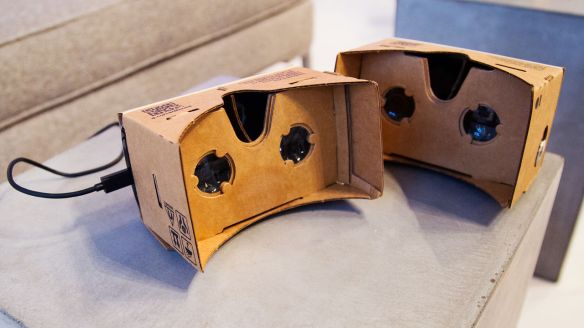
Google Cardboard has come a long way since Android honcho Sundar Pichai introduced it with a sheepish grin six months ago. The smartphone virtual reality viewer, made from folded-up cardboard with a pair of attached lenses—you supply an Android phone to provide computing power and a display—has shipped more than 500,000 units as of early December. (You can build your own Cardboard, or buy a ready-made version from not-quite-official sources for under $30.) Google has now added a Play Store showcase for the best Cardboard apps, and released a software development kit to spur even more VR app creation.

For a project that took mere weeks to throw together, Cardboard has done surprisingly well. But its success also puts it in an awkward position, somewhere between the oddball project that Cardboard appeared to be back in June and the serious business that prompted Facebooks $2 billion acquisition of Oculus VR in February. As virtual reality matures, is Cardboard prepared to mature with it?

READ MORE: Google Cardboard Is The Right Virtual-Reality Gadget For Right Now. But What’s Next? | Fast Company | Business + Innovation.


Top 30 Applications of Google Glass in Education [Interactive Infographic] | OpenColleges


The future is now. With Google Glass, teachers and students alike can display information in a smartphone-like hands-free format, while interacting with the Internet via natural language voice commands. With limitless possibilities at its fingertips, the education community can build closer working relationships with students, and allow children to get more involved with their learning experience. Open Colleges takes a look at how Google Glass might be used in education.

Click the link to EXPLORE all the possibilities illustrated within this interactive infographic: Top 30 Applications of Google Glass in Education  | OpenColleges


How Google Glass might be used in Education – An infographic by the team at Open Colleges

For the First Time Ever, Explore Angkor Wat With Google Street View | Travel | Smithsonian


[T]hose interested in exploring the wonder of Angkor don’t need to make a trek to Southeast Asia—and risk contributing to the damage of the site—to enjoy what the ruins have to offer. For the first time ever, Google Maps is granting users an up-close view of Angkor, through Google’s Street View project.

The move is an extension of Google Maps’ mission to make sure that its maps are the most accurate, comprehensive and useful available to users. While to most people, this might materialize in the form of directions—using Google Maps to get you from Point A to Point B— the company doesn’t see this as the limit for the product’s technology.

“Increasingly, if you look at the amount of power we have in our cellphones, the ability for those phones to know your location and customize an experience around you, they are becoming fairly good at making sure that people are able to explore the world around them,” says Manik Gupta, Google Maps Product Manager. “We want to make sure that we have the ability to share all these places with users all over the world.”

Read more: For the First Time Ever, Explore Angkor Wat With Google Street View | Travel | Smithsonian.

Middle Earth comes to life in epic Chrome experiment | Engadget


We’re go out on a limb here and say that the Venn diagram of Engadget fans and Tolkien fans looks something like this. So, we figure you’ll probably want to hear about a brand new Chrome experiment that brings various parts of Middle Earth to life, including the Trollshaw and Dol Guldur. It starts with a pretty simple interactive map, but from there you’re able to dive into several locations and learn about Hobbit lore through text, animations and audio. At the end of each lesson on Tolkien’s fantasy world, you’re challenged to complete a simple mini game that has you causing flowers to bloom or avoiding troll attacks. While the WebGL-powered games are pretty impressive, its the HTML5 audio and animations that are the real eye-candy here — doubly so since they work just as well on a phone or tablet as they do your desktop. As you swipe through slides in the story, camera angles change in coordination with your finger and characters dart across bridges. Honestly, even if you’re part of that tiny sliver in the diagram that can’t stand Tolkien, it’s worth checking out the latest Chrome Experiment, if only to remind yourself of the growing power of the web browser.

Middle Earth comes to life in epic Chrome experiment | Engadget

Canada’s parks and historic sites now on Google Street View | CBC News


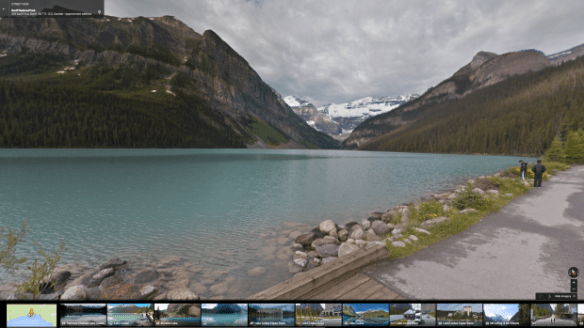
Google/Parks Canada

The Google Maps team visited Banff National Park and about 70 other Parks Canada sites this past spring and summer, collecting imagery using its Street View cars and on foot using its Trekker backpack technology. (Google/Parks Canada)

Hikes through spectacular national parks such as Banff and tours of historic sites such as the Viking settlement at L’anse au Meadows in Newfoundland are now available on Google Street View.

Google and Parks Canada announced today that more than 70 Parks Canada locations across the country can now be explored online.

“From planning a summer vacation to augmenting classroom lesson plans, the partnership between Parks Canada and Google will better connect Canadians to the amazing places and geography that defines this country,” wrote Parks Canada’s Michael White on the Google Canada blog.

Read: Canada’s parks and historic sites now on Google Street View | Technology & Science | CBC News.

Google Reveals Its 9 Principles of Innovation | Fast Company


Ever wonder what makes the Google the holy grail of productivity and creativity? There’s no magic in the drinking water at the Mountain View, CA company. The tech giant draws from what Google’s chief social evangelist, Gopi Kallayil, calls the nine core principles of innovation.

Kallayil shared his insights at this week’s San Francisco Dreamforce summit. Here are the nine rules that any enterprise, large or small, can adopt to steal Google’s innovative culture.

The principles:

  1. Innovation Comes From Anywhere
  2. Focus On The User
  3. Aim To Be Ten Times Better
  4. Bet On Technical Insights
  5. Ship And Iterate
  6. Give Employees 20 Percent Time
  7. Default To Open Processes
  8. Fail Well
  9. Have A Mission That Matters

Read more: Google Reveals Its 9 Principles of Innovation | Fast Company | Business + Innovation.

News: Education & Technology, Librarianship


Education & Technology

Librarianship

Are Digital Libraries A ‘Winner-Takes-All’ Market? OverDrive Hopes So | Forbes
“Schools and libraries in all forms are transitioning their spends from providing physical items that are being stored on shelves and branches to digital items — the fastest portion of their growth,” said Steve Potash  in a recent interview. Potash is President and CEO of OverDrive, the Cleveland-based provider of technology for managing and distributing digital content for lending libraries.

Gross: Fifty Shades of Grey goes viral – literally | theguardian
Library copies of the bestselling sadomasochistic romance were found to carry traces of herpes and cocaine.

Make Google behave: techniques for better results | Karen Blakeman