It’s Wildlife Photographer vs. Wikimedia in who has the rights to a photograph taken by an ape.
READ MORE: “Monkey Selfie” is Making Everyone Bananas! | Information Space

It’s Wildlife Photographer vs. Wikimedia in who has the rights to a photograph taken by an ape.
READ MORE: “Monkey Selfie” is Making Everyone Bananas! | Information Space
I’m often asked where to go to find high-quality and hi-resolution still images for reuse so I’ve put together this guide. There have been several new image collections that have opened up to the public just within the past year that not many people are aware of yet, but they offer access to thousands, or in some cases millions of outstanding photographs that can be downloaded for free. Here’s a quick guide to finding those collections.
READ MORE: A Guide to Little-Known Image Collections with Millions of Free, Hi-Res Images | OEDB.org.

Compared to searching for text, searching for images is super hard. But a new way to index and navigate through averaged images—those blurry composites that pull together millions of images into one—could radically change the way that we search for photos or products online.
READ MORE: This Clever Image Search Could Change The Way You Find Pictures Online | Gizmodo
Researchers are developing technology that can adjust an image on a display so you can see it clearly without corrective lenses. READ: Display Technology Makes Reading Glasses Unnecessary | MIT Technology Review.
Yahoo has released a massive data set of Flickr images and videos that are free to share under their copyright licenses. Yahoo believes the data set, which comprises 99.3 million images and 0.7 million videos, is one of the largest public multimedia data sets ever released. The data set, which promises to be a boon to computer vision researchers, contains metadata including title, description, camera type, and tags. About 49 million of the images are also geotagged. Yahoo is collaborating with the Lawrence Livermore National Laboratory to provide compute resources through the lab’s supercomputer to help researchers analyze the data.
via 100 Million Flickr Images for Download | Center for Data Innovation
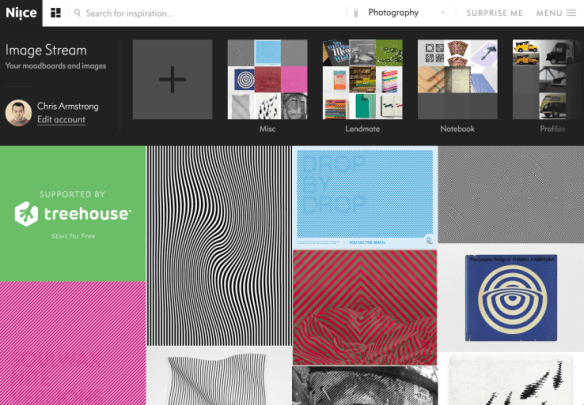
Every now and again I’m pitched a startup that I “get” instantly because it addresses a problem I’ve faced in the past and solves it in a simple, laser-focussed way. Niice is one such startup. It’s created a tool aimed at designers who need to create moodboards — a collection of inspirational images — in order to seed the creative process. The cloud-based moodboard-making service quietly launched a freemium version earlier this week.
Part image search engine, part image collection creator, Niice lets you search for images within its preselected image sources consisting of design galleries and various image communities on the web. The idea is to save designers having to trawl through bookmarked sites or rely solely on something like Google image search, as well exposing them to images they might not otherwise come across.
READ MORE: Niice Is A Beautifully Simple Tool To Create Moodboards | TechCrunch.
portland-based photographer jim golden delivers a hearty dose of nostalgia in his series ‘relics of technology’, comprising animated gifs and still life images. geometrically placed in a palette of vintage tones, the documented objects are society’s ‘technological’ media devices from the past, brought to life in a collection of moving images
See all the images: jim golden animates vintage devices for relics of technology | designboom

The Getty Research Institute has just added more than 77,000 high-resolution images to the Open Content Program from two of its most often-used collections.
The largest part of the new open content release—more than 72,000 photographs—comes from the collection Foto Arte Minore: Max Hutzel photographs of art and architecture in Italy. Foto Arte Minore represents the life’s work of photographer and scholar Max Hutzel (1911–1988), who photographed the art and architecture of Italy for 30 years. In recent years, the interdisciplinary use of these photographs has exposed their historiographic significance and their unrealized research potential.
Read more: 77,000 Images of Tapestries and Italian Monuments Join the Open Content Program | The Getty Iris.
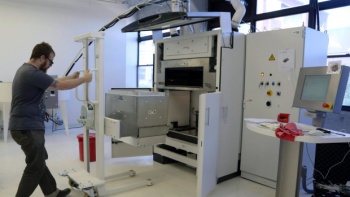
McGill University’s new 3D printer could produce 2000 copies of the same object before you’d finally spot them without a microscope.
If you thought the tech industry had a strange habit of miniaturizing everything, know that the print industry is now fully capable of catching up in that department. Canadian researchers at McGill University recently put a new microscopic 3D printer through its paces by producing a 0.011 by 0.014 millimeter National Geographic Kids cover, along with a map of Canada measured in micrometers. Obviously these images are impossible to view normally and could only be seen with the aid of a screen projecter. In fact, the magazine printout is so miniscule that if you made 2000 copies, you’d have just enough to cover a single grain of salt.
Read more: 3D Printer Creates Magazine Cover Smaller Than A Grain of Salt | The Escapist.

 infophile