
Library of Congress Reports 75% of Silent Films Lost Forever | Mashable


Full Post

A conclusive study by the Library of Congress reports that only 1,575 of the nearly 11,000 films produced during the silent era still exist in their complete form. The study was commissioned by the National Film Preservation Board and written by historian and archivist David Pierce.

It’s not just obscure films of little interest that are lost: Lon Chaney’s London After Midnight – directed by Freaks auteur Tod Browning — is mostly gone (although it can be reconstructed scene for scene using still photographs), 20 Clara Bow films, The Patriot, directed by Ernst Lubitsch, the adaptation of Edna Ferber’s So Big starring Colleen Moore, and many more are just gone forever.

There are myriad reasons for this. Many of these movies were filmed on nitrate, which deteriorates rapidly and is also highly flammable. In 1935, Fox Studios lost its entire film catalog in a fire, hundreds more were lost in a 1967 fire at MGM studios, in 1978, The Eastman House lost 329 nitrate prints of silent films in another fire. Also, many of the studios just did not invest in preserving these films until it was too late for many of them. Before the advent of television and home video, studios just really didn’t see the point in keeping them around for future release. Notable exceptions are the works of D.W. Griffith, Charlie Chaplin and Mary Pickford, who all took it upon themselves to have their films preserved.

However, one reason that doesn’t seem to be popping up in any of the articles about this is the fact that many of these films were intentionally destroyed. The 1917 version of Cleopatra, starring Theda Bara, was not just lost to time, it didn’t just disintegrate. The two remaining copies of the film were set on fire, purposely, along with most of her other films by Fox Studios after the Hays Code went into effect – as they were deemed too risque for the new rules. Though she made more than 40 movies throughout her career, only about three and a half exist today. Which is only slightly better than the fate of her cinematic rival Valeska Surrat, whose entire oeuvre is lost forever.

The first “lost” film was actually one of the films responsible for the introduction of the code in the first place. Convention City — a slightly raunchy comedy starring Joan Blondell, Dick Powell and Mary Astor — was completely destroyed by Warner Brothers after causing a boatload of controversy. There are, of course, rumors that a cut of the film may exist in Britain, but it’s yet to be found.

Not only were many pre-code films destroyed, many of those that weren’t were sealed up in a vault in 1934, and did not see the light of day until the 1950′s during the television era. However, because said pictures were not “up to code,” many were hacked up and re-edited, the original versions lost forever.

Pre-code Hollywood is especially important from a feminist point of view, because it was basically a golden age of female empowerment. Which, quite frankly, is a lot of the reason the government put the kibosh on it. Luckily, people like David Pierce are working to hold onto the ones we do have, and searching for others that may be stored in random old attics throughout the country.
Device & Conquer: SLJ’s 2013 Tech Survey | The Digital Shift


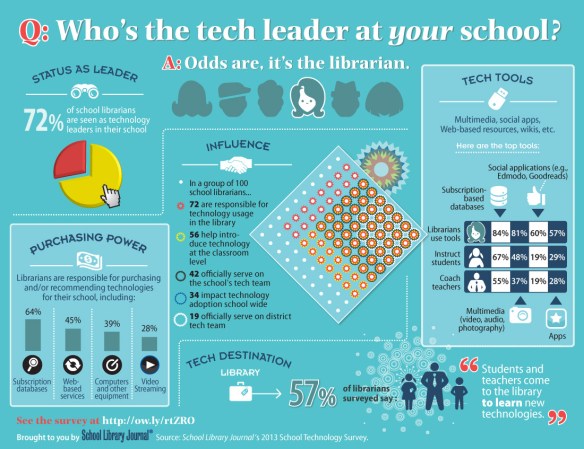
As education technology has evolved, so, too, have the kinds of digital tools that school librarians use with their students, as shown in School Library Journal’s 2013 School Technology Survey. Handheld tablets and devices are coveted items for classroom and instructional use, along with access to online sites and apps that school librarians believe can revolutionize the way they instruct—and the way students learn. More than 750 school librarians responded to SLJ’s survey, representing K–12 public and private schools across the country. According to the data, school librarians make the most of what they have, learning one day and sharing that knowledge the next. They not only make tech tools available for students and teachers, but teach them how to use the tools as well.

Read More: Device & Conquer: SLJ’s 2013 Tech Survey | The Digital Shift.

School Library Journal’s 2013 School Technology Survey


Readworthy: Education & Technology, Librarianship


Education & Technology

Librarianship

The Best of Internet Librarian 2013 | Ellyssa Kroski | OEDB.org


Every year there are two amazing conferences focusing on information technology and libraries hosted by Information Today – Computers in Libraries and Internet Librarian. They feature the field’s top innovators sharing their insights, recent project experiences, and practical tips. If you couldn’t make this year’s event, here are 10 stellar presentations that will catch you up:

Presentation topics:

  • Managing Devices & Gadgets
  • Open Source Solutions & Apps
  • Project Management
  • Tech Tools for Engaging Communities
  • Usability Testing: On Board & On a Shoestring
  • Using Web Analytics for Site Improvement
  • Super Searcher Secrets
  • The New State of Search: Google, Discovery, & Apps
  • Clarifying Copyright for the Classroom Teacher
  • Embedded Librarianship With Google Docs

Access them here: The Best of Internet Librarian 2013 | Ellyssa Kroski | OEDB.org.

American Library Association Defends Banned Mexican American Studies Courses | Mashable


Librarians do not approve of Arizona’s battle against Mexican American Studies.

A group of 10 educational organizations, including the American Library Association, filed an amicus brief Monday in support of the lawsuit against Arizona Superintendent of Public Instruction John Huppenthal for quashing a controversial Mexican American Studies curriculum in Tucson. Some 48 teachers from across the country filed a second amicus brief defending the banned courses.

The educators argue that in passing legislation aimed at shutting down a progressive Mexican American Studies program, Arizona Republicans were guided by political goals rather than pedagogical ones.

Read: American Library Association Defends Banned Mexican American Studies Courses | Mashable.

Staying Connected as a Distance Learner | Hack Library School


When I applied for my MLS a few years ago, the realities of the working world had me dreaming of a retreat from the outside world in the arms of academia.  I pictured days spent in stimulating classes and evenings immersed in my studies, totally plugged into the world of libraries and library science at all times. I would specialize in something fantastic, meet tons of like-minded people, and not have to report to a desk job every day.  Student loan debt be damned, I wanted an escape.

Shortly after hitting “send,” life intervened.  Between a 500+ mile move, a new job with just enough travel to make night classes impossible, and sheer economic reality, it quickly became apparent that escaping into classes and living off student loans for two years was just not going to happen. Two years and two deferments later, I find myself almost finished with my first semester in the University of Maryland College Park’s online MLS program.

I’m happy with my decision to switch to the online program, but I do sometimes feel that I’m missing out on the intangible benefits of face-to-face learning.  My day job has NOTHING to do with libraries, so I don’t get the water cooler chitchat, the special programming posters in the hallway, the classroom tangents that have nothing to do with that day’s planned discussion but are oh-so-valuable.  I get online class discussion boards, and nothing more.  Not quite the immersive experience I had in mind when I sent in my application, and an easy recipe for low motivation.  So to keep myself from feeling totally cut off, I’ve come up with a few strategies to get my library buzz. Read more: Staying Connected as a Distance Learner | Hack Library School.

The Book as App: Multi-Touch Ebooks and Their Future in Libraries | Nicole Hennig


News: Education & Technology, Librarianship


Education & Technology

Librarianship

Are Digital Libraries A ‘Winner-Takes-All’ Market? OverDrive Hopes So | Forbes
“Schools and libraries in all forms are transitioning their spends from providing physical items that are being stored on shelves and branches to digital items — the fastest portion of their growth,” said Steve Potash  in a recent interview. Potash is President and CEO of OverDrive, the Cleveland-based provider of technology for managing and distributing digital content for lending libraries.

Gross: Fifty Shades of Grey goes viral – literally | theguardian
Library copies of the bestselling sadomasochistic romance were found to carry traces of herpes and cocaine.

50 year after JFK’s death, new website asks people to share their stories about his legacy | The Washington Post


There’s no shortage of places for people to share memories of where they were 50 years ago when they found out John F. Kennedy had been assassinated. But a website debuting Monday aims to take the focus from past to future by asking people of all ages — even those who weren’t alive when Kennedy died — to share their thoughts about how he has inspired them.

The website is part of the JFK Library and Museum’s commemoration of the 50th anniversary of JFK’s death, which is Friday. The museum also plans a new exhibit of never-before-displayed items from his three-day state funeral, including the flag that draped his casket and notes written by first lady Jacqueline Kennedy.

Visitors to the “An Idea Lives On” site can explore an interactive video that includes NASA Commander Chris Cassidy, former Massachusetts Gov. Michael Dukakis, comedian Conan O’Brien, Freedom Rider Charles Person and others talking about Kennedy’s lasting impact.

Read more: 50 year after JFK’s death, new website asks people to share their stories about his legacy | The Washington Post.

Making Your Library Promotion Pop | April Aultman Becker