
Pew Social Media Study: 30% Of The U.S. Gets News Via Facebook; Reddit Has The Most News-Hungry Regular Users | TechCrunch


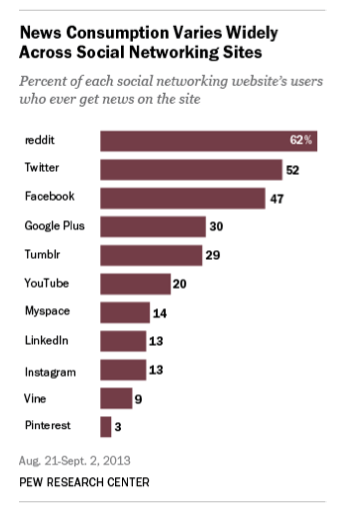
The Pew Research Center is today releasing comparative numbers looking at how U.S. adults use social networking sites to read news (a follow-on from earlier research focusing on two specific sites, Facebook and Twitter).

This is significant for a couple of reasons. Social media sites have become a key component of how many news organizations today are looking to reach consumers as old-media forms like printed editions continue to decline. In turn, social media sites are turning news a way of attracting more eyeballs to improve their own ad-based businesses. That is to say, news and social media are dancing partners that are still working out how to move in the same direction without stepping on each other’s feet, and this survey is one indicator of how well the public is receiving that.

Read more and see all the charts: Pew Social Media Study: 30% Of The U.S. Gets News Via Facebook; Reddit Has The Most News-Hungry Regular Users | TechCrunch.
Pew: News Consumption

Books, libraries, and the changing digital landscape | Pew Research Center


How libraries are dealing with the changing technological environment, as well as the larger context of Americans’ reading and library habits, and what they expect from libraries in the future.

The Secrets Of A Memorable Infographic | Co.Design


Human memory is very fallible, but lately cognitive scientists have found that our minds capture much more visual detail in a moment than once believed. A 2008 paper reported that people who saw thousands of images for three seconds each over five hours later identified ones they’d seen over similar alternatives with nearly 90% accuracy. They didn’t just remember that they’d seen a cracked egg, they remembered that its egg white had formed a perfectly round puddle.

In other words, when we do retrieve a memorable image, a surprising amount of information comes with it, like a burr stuck to a sweater. That insight could have big implications for people who use visualizations in their everyday lives–graphic designers, for instance, or anyone on Tumblr. Above all, it suggests that memorability alone might enhance an infographic’s effectiveness. But it also prompts a question: How does an image become memorable in the first place?

Read: The Secrets Of A Memorable Infographic | Co.Design | business + design.

News: Books & Publishing, Music & Film


Books & Publishing

‘City on Fire,’ a Debut Novel, Fetches Nearly $2 Million | TNYT
Donna Tartt’s novel “The Goldfinch” has 771 pages. “The Luminaries” by Eleanor Catton, winner of the 2013 Man Booker Prize, is 834 pages long. And then there is “City on Fire,” the 900-page debut novel that took the publishing industry by storm last week. It was even more evidence that the long novel is experiencing a resurgence, as a dozen publishers competed for the rights to release the book, set in New York City in the 1970s.

Music & Film

Hey MPAA, Why Are PG-13 Movies More Violent Than R-Rated Ones? | Flavorwire
A new study from the Annenberg Public Policy Center finds something more disturbing: though initial PG-13 films contained about as much gun violence as G or PG-rated pictures, “since 2009, PG-13-rated films have contained as much or more violence as R-rated films” (emphasis mine). And hey, funny story, that rise matches gun violence off-screen too.

Super Searcher Tips | Mary Ellen Bates


Study: What You Would Be Doing If You Spent Less Time Online | The Atlantic


Most of us have heard our parents or grandparents complain that the digital age has corrupted the youth and taken them away from doing “better things.” Whether or not this is an accurate assessment, no one had ever really figured out how much our computer time cuts into other activities—at least not until now. New research from Scott Wallsten, an economist at the Technology Policy Institute in Washington, D.C., attempts to show exactly what Americans are missing out on because they’re glued to their computer screens.

Wallsten limits his study to “online leisure,” or time spent online doing things like combing social networks, browsing for non-work purposes, instant messaging, etc. (Online games—even though they can take up a lot of leisure time—are excluded because of the way the data Wallsten used are collected by the US Census Bureau. Despite the data’s shortcomings, Wallsten finds that online leisure time still crowds out other activities.)

See the charts and read more: Study: What You Would Be Doing If You Spent Less Time Online – Simone Foxman | The Atlantic.

Networked Worlds & Networked Enterprises | Pew Research Center


Networked Worlds & Networked Enterprises
Lee Rainie, Director of the Pew Research Center’s Internet Project, shows how the large, loosely knit social circles of networked individuals expand opportunities for learning, problem solving, decision making, and personal interaction.

The new social operating system of “networked individualism” requires us to develop networking skills and strategies, work on maintaining ties, and balance multiple overlapping networks. The “triple revolution” that has brought on this transformation: the rise of social networking, the capacity of the Internet to empower individuals, and the always-on connectivity of mobile devices.

Drawing on extensive evidence, Rainie examines how the move to networked individualism has driven changes in organizational structure, job performance criteria, and the way people interact in workplaces. He presents a glimpse of the new networked enterprise and way of working.


IBM Software Learns Your Personality, Could Tailor Ads Accordingly | MIT Technology Review


Trying to derive a person’s wants and needs—conscious or otherwise—from online browsing and buying habits has become crucial to companies of all kinds.

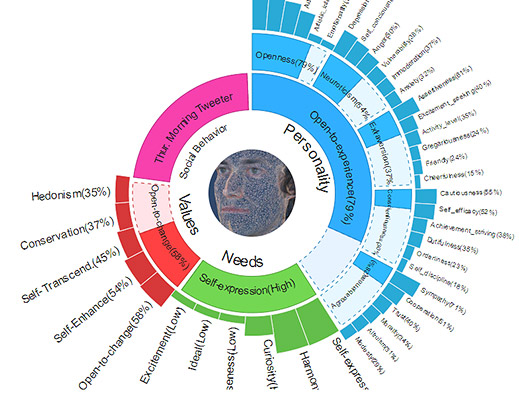
Now IBM is taking the idea a step further. It is testing technology that guesses at people’s core psychological traits by analyzing what they post on Twitter, with the goal of offering personalized customer service or better-targeted promotional messages.

Read more: IBM Software Learns Your Personality, Could Tailor Ads Accordingly | MIT Technology Review.

IBM Personality Analysis


Pew Research


Twitter a news source? Not so much | CNET
A new Pew survey shows only 16 percent of US adults use Twitter and only 8 percent use the social network for news. But these users tend to be young, educated, and wealthy.

The State of Digital Divides
Lee Rainie, Director of the Pew Research Center’s Internet Project, presented the project’s latest findings about who has and doesn’t have access to the internet, broadband, and cell phones. He noted that some of the factors associated with non-use of technology are age, household income, educational attainment, community type, and disability. He also cited findings about why people say they do not use the internet.

Electronic printable ink developed by scientists | Telegraph


An electronic ink that can be printed on a laser and then conducts electricity has been developed by scientists.

The graphene-based ink was used to make a small plastic keyboard by researchers at the University of Cambridge, who found the one atom-thick material could be used to make cheap, printed electronics.

It could be used in the future for people who need heart monitors, as they could be embed onto clothes, or for tracking luggage in an airport to ensure it is loaded on to the correct plane.

The graphene-based ink has a number of interesting properties, including flexibility, optical transparency, and electrical conductivity.

via Electronic printable ink developed by scientists | Telegraph.