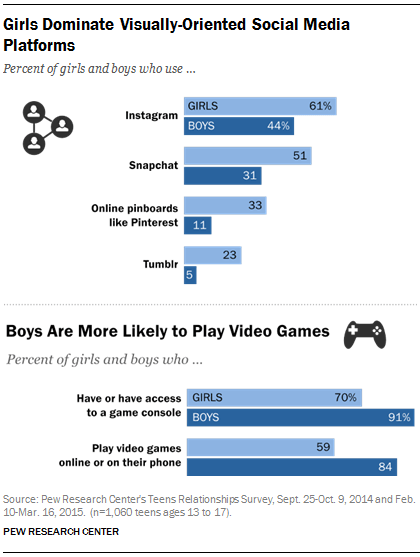
Read the summary here: Teens, Social Media & Technology Overview 2015 | Pew Research Center’s Internet & American Life Project
You’re taught about history, science, and math when you’re growing up. Most of us, however, aren’t taught how to identify or deal with our own emotions, or the emotions of others. These skills can be valuable, but you’ll never get them in a classroom.
Emotional intelligence is a shorthand that psychological researchers use to describe how well individuals can manage their own emotions and react to the emotions of others. People who exhibit emotional intelligence have the less obvious skills necessary to get ahead in life, such as managing conflict resolution, reading and responding to the needs of others, and keeping their own emotions from overflowing and disrupting their lives. In this guide, we’ll look at what emotional intelligence is, and how to develop your own.
READ MORE: Emotional Intelligence: The Social Skills You Weren’t Taught in School | LifeHacker
The gap between boys’ and girls’ respective reading abilities has been getting a lot of attention lately, but the trend itself is not new.
Girls have been better readers than boys for a long, long time, according to a report released Tuesday by the Brown Center on Education Policy at the Brookings Institution. The annual report analyzes three topics in contemporary education through the lens of up-to-date research. This year, the report looked at the effectiveness of the Common Core state standards, the relationship between student engagement and academic achievement, and the gender gap in reading.
READ MORE: Young Girls Are Much, Much Better Readers Than Boys, And Have Been For A Long Time | Huffington Post
The 5 Biases Pushing Women Out of STEM http://t.co/s8WbkR7hO5 pic.twitter.com/uVpasAayy2
— Harvard Biz Review (@HarvardBiz) March 24, 2015
What professional roles do you play as a librarian/information professional? How have they changed during your career? And perhaps most important, how do you see them changing and evolving in the future?
These issues are discussed in an intriguing recent article in New Library World, “A systematic literature review informing library and information professionals’ emerging roles.” Evgenia Vassilakaki and Valentini Moniarou-Papaconstantinou, of the Library Science & Information Systems Department of TEI of Athens, Greece, uncovered their findings from peer-reviewed literature published between 2000 and 2014.
Although a variety of libraries were included, the authors state that “the majority of the literature focused on academic libraries.” All of the papers are in English, and “the majority of studies reported on research conducted in the United Kingdom and North America.”
Their findings have implications given the changes taking place in work, society and education, and how those changes affect our institutions. Six emerging roles were discovered, all of which would seem to be applicable within many types of libraries and information centres…READ MORE: Emerging roles and possible futures for librarians and information professionals | Emerald Group Publishing
This article presents the outcomes of a typological analysis of Web 2.0 learning technologies. A comprehensive review incorporating over two thousand links led to identification of 212 Web 2.0 technologies that were suitable for learning and teaching purposes. The typological analysis then resulted in 37 types of Web 2.0 technologies that were arranged into 14 clusters. The types of Web 2.0 learning technologies, their descriptions, pedagogical uses and example tools for each category are described, arranged according to the clusters. Results of this study imply that educators typically have a narrow conception of Web 2.0 technologies, and that there is a wide array of Web 2.0 tools as yet to be fully harnessed by learning designers and educational researchers.
READ MORE: A Typology of Web 2.0 Learning Technologies | EDUCAUSE.edu

Scrolls that were damaged, but not destroyed, in the eruption of Mount Vesuvius may now be read for the first time in nearly two millennia.
READ MORE: X-ray reveals the secrets of burned Vesuvius scrolls | CNET
Take a moment to think about the last time you memorized someone’s phone number. Was it way back when, perhaps circa 2001? And when was the last time you were at a dinner party or having a conversation with friends, when you whipped out your smartphone to Google the answer to someones question? Probably last week.
Technology changes the way we live our daily lives, the way we learn, and the way we use our faculties of attention — and a growing body of research has suggested that it may have profound effects on our memories (particularly the short-term, or working, memory), altering and in some cases impairing its function.
The implications of a poor working memory on our brain functioning and overall intelligence levels are difficult to over-estimate…READ MORE: How Technology Is Warping Your Memory | HuffPo
You’ve heard that using screens before bedtime can mess with your sleep, but new research suggests the problem is even more serious.
Reading from an iPad before bed not only makes it harder to fall asleep, but also impacts how sleepy and alert you are the next day, according to new research from Brigham and Womens Hospital in Boston, Massachusetts. The study, published in the journal Proceedings of the National Academy of Sciences on Monday, said the findings could impact anyone who uses an eReader, laptop, smartphone, or certain TVs before bed.
The new research supports conclusions from older studies, which have also found that screen time before sleep can be detrimental.
READ MORE: Reading On A Screen Before Bed Might Be Killing You | HuffPo
While most of the evidence has been largely anecdotal, the idea that a mentor can help guide you along a better path in life is hard to argue against. Now, a large study from North Carolina State University seems to support the claim that, yes, having a mentor at a young age can lead to better, more-fulfilling employment later on.
READ MORE: Study: Children With Mentors Find Happier, More Fulfilling Careers | Fast Company | Business + Innovation.
 infophile