
Thanks to the internet, it has never been easier to steal other people’s work. There’s also a high risk you’ll be found out. So why do it? Rhodri Marsden goes in search of a little originality…via The big steal: rise of the plagiarist in the digital age | Technology | The Guardian.
Tag Archives: technology
Zuckerberg and Musk back software startup that mimics human learning | theguardian.com
San Francisco startup Vicarious aims to create ‘a computer that thinks like a person except it doesn’t need to eat or sleep’. via Zuckerberg and Musk back software startup that mimics human learning | Technology | theguardian.com.
A.I. XPRIZE: Can A Robot Deliver A TED Talk Worthy Of A Standing Ovation? | International Business Times

Imagine if Samantha from the movie “Her” could deliver a dynamic, engaging and totally human TED Talk. That’s what the nonprofit hopes will be a reality in the near future. TED wants to find out if an artificial intelligence can deliver a talk that wows the audience at a future conference.
During the TEDActive 2014 conference on March 20, Chris Anderson, curator of TED, and Peter Diamandis, founder of the XPRIZE, announced the formation of the A.I. XPRIZE where the winner will receive a lucrative award for delivering a talk that receives a standing ovation. READ MORE
LEGO Car Fueled by Air Drives Into History | PCMag.com
What started more than 60 years ago as a children’s building-block toy has turned into a technological tool, most recently used to design a plastic car fueled by air.
More than 500,000 LEGO bricks were used to build Steve Sammartino and Raul Oaida’s “Super Awesome Micro Project”: a drivable LEGO car. Read more: LEGO Car Fueled by Air Drives Into History | News & Opinion | PCMag.com.
Eye Cells Made with Ink-Jet Printer | MIT Technology Review
The ability to print retinal cells could lead to new therapies for retinal disorders such as macular degeneration…Researchers at the University of Cambridge used a standard ink-jet printer to form layers of two types of cells taken from the retinas of rats, and showed that the process did not compromise the cells’ health or ability to survive and grow in culture. Ink-jet printing has been used to deposit cells before, but this is the first time cells from an adult animal’s central nervous system have been printed.
Read more: Eye Cells Made with Ink-Jet Printer | MIT Technology Review.
Finally, a Digital Library of Bizarre Human Bones From the Middle Ages | Gizmodo

A spinal column with fused vertebrae. The bones of a woman with advanced syphilis. Skeletons deformed by rickets and leprosy. A fascinating online library of deformed bones from the Middle Ages goes live today—and while I didn’t even realize such a thing existed, now I can’t imagine living without it. God bless technology.
The Digit[ised] Diseases website is run by the Royal College of Surgeons in London. It brings together 3D scans of over 1,600 bone specimens taken from patients with debilitating and disfiguring conditions like rickets and leprosy, and makes them free for the public to browse. Bored on a Monday morning? Gawk at this deformed spinal column or marvel at this alien-like skull with an enlarged cranium. In the scientists’ own words, “it does not resemble any known hominid species.” Cool!
Read: Finally, a Digital Library of Bizarre Human Bones From the Middle Ages | Gizmodo
Which Programming Language Should I Learn First? | LifeHacker
Dear Lifehacker,
With all the buzz about learning to code, I’ve decided to give it a try. The problem is, I’m not sure where to start. What’s the best programming language for a beginner like me?
Signed,
Could-Be Coder
Dear Could-Be,
That’s probably one of the most popular questions from first-time learners, and it’s something that educators debate as well. The thing is, you can ask ten programmers what the best language is to get your feet wet with and you could get ten different answers—there are thousands of options. Which language you start with depends not only on how beginner-friendly it is, though, but also the kind of projects you want to work on, why you’re interested in coding in the first place, and perhaps also whether you’re thinking of doing this for a living. Here are some considerations and suggestions to help you decide.
Read the answer: Which Programming Language Should I Learn First? | LifeHacker?
Palette’s modular controller brings dials and sliders to your laptop (hands-on) | Engadget

Palette co-founder Calvin Chu has a problem with how people work. “Creative professionals spend so much of their time on the computer, and at the moment, they still use a very generic one-size-fits-all keyboard and mouse interface.” It doesn’t make sense, he says — photographers, gamers, film editors, musicians and accountants all using the same interface? Surely there is a better way. “It should be specialized and made for your needs, and that’s where we came up for the idea for Palette.” Palette is Chu’s answer to a world that’s discarded tactile dials and switches for keyboards, mice and touch screens. It’s a modular collection of buttons, sliders and potentiometers that can be programmed to do almost anything on your PC. We took a look at an early prototype of the customizable controller to reacquaint ourselves with the tactile world.
Read: Palette’s modular controller brings dials and sliders to your laptop (hands-on) | Engadget
Device & Conquer: SLJ’s 2013 Tech Survey | The Digital Shift
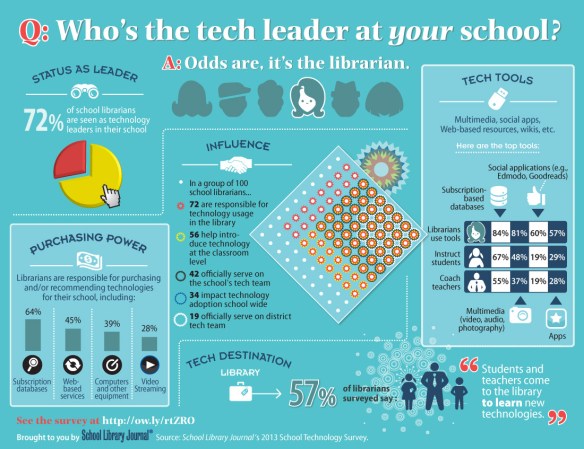
As education technology has evolved, so, too, have the kinds of digital tools that school librarians use with their students, as shown in School Library Journal’s 2013 School Technology Survey. Handheld tablets and devices are coveted items for classroom and instructional use, along with access to online sites and apps that school librarians believe can revolutionize the way they instruct—and the way students learn. More than 750 school librarians responded to SLJ’s survey, representing K–12 public and private schools across the country. According to the data, school librarians make the most of what they have, learning one day and sharing that knowledge the next. They not only make tech tools available for students and teachers, but teach them how to use the tools as well.
Read More: Device & Conquer: SLJ’s 2013 Tech Survey | The Digital Shift.
Readworthy: Education & Technology, Librarianship
Education & Technology
- Twenty tips for interpreting scientific claims | nature
- Inkling’s E-Books Put the Consumer in Charge | Mashable
- The 15 Best Websites, According to Redditors | Mashable
- Striking Back Against Censorship | WordPress has a new censorship policy.
- Tech sector hiring more women, data shows… or is it? | CNET
- Apple Doesn’t Want to Pay the Feds’ E-Book Lawyer $70,000 a Week | AllThingsD
- Google building Spark, a Web-based development tool | CNET
- E-books ‘too pricey for 16-24 market’ | The Bookseller
Librarianship
- Concordia opens Mordecai Richler Reading Room | Quill & Quire
- Books are still most durable way to store information | Salon
- OverDrive Rolls Out “Netflix-like” Streaming Video Pilot for Libraries and Schools | The Digital Shift
- The Totally Awesome Way Some Libraries Are Tackling Hunger | HuffPo
- Libraries Change Lives | HuffPo
- Archive of General Wolfe’s personal letters is coming to Canada | Globe & Mail
 infophile