A Brilliantly Simple Design Transforms Old Boxes Into School Desks And Bags | Co.Exist


Most schools in rural India can’t afford basic supplies like desks, and most of the students attending them can’t afford backpacks. The Bombay-based nonprofit Aarambh worked with designers to come up with an ingenious solution to both problems: Their simple stencil transforms old cardboard boxes into a convertible desk and school bag.

READ MORE: A Brilliantly Simple Design Transforms Old Boxes Into School Desks And Bags | Co.Exist | ideas + impact.

‘Hour of Code’ Offers Free Coding Lessons | PCMag.com


Code.org today launched a massive campaign aimed at encouraging kids to learn computer programming.

Kicking off Computer Science Education Week, the nonprofit organization joined forces with supporters like Google, Microsoft, Amazon, Apple, Bill Gates, Mark Zuckerberg, Reid Hoffman, and Jack Dorsey to get students, teachers, and parents excited about coding.

The “Hour of Code” initiative, first announced in October, provides an interactive introduction through online tutorials. Are you just a beginner looking to learn the basics, or have you already mastered one coding language and want to pick up another? Visit Code.org to find coaching on building apps and Web pages, programming robots, and more.

Read: ‘Hour of Code’ Offers Free Coding Lessons | News & Opinion | PCMag.com.

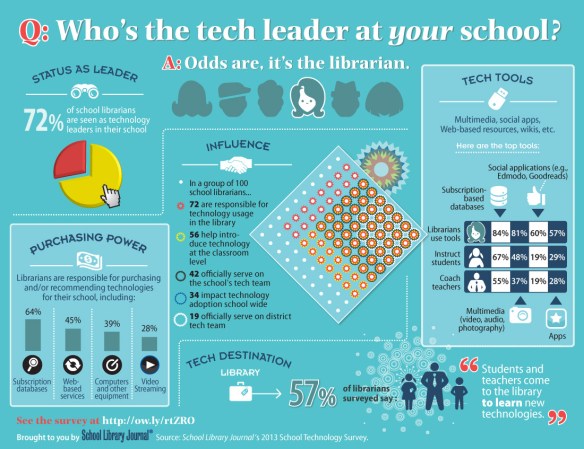
Device & Conquer: SLJ’s 2013 Tech Survey | The Digital Shift


As education technology has evolved, so, too, have the kinds of digital tools that school librarians use with their students, as shown in School Library Journal’s 2013 School Technology Survey. Handheld tablets and devices are coveted items for classroom and instructional use, along with access to online sites and apps that school librarians believe can revolutionize the way they instruct—and the way students learn. More than 750 school librarians responded to SLJ’s survey, representing K–12 public and private schools across the country. According to the data, school librarians make the most of what they have, learning one day and sharing that knowledge the next. They not only make tech tools available for students and teachers, but teach them how to use the tools as well.

Read More: Device & Conquer: SLJ’s 2013 Tech Survey | The Digital Shift.

School Library Journal’s 2013 School Technology Survey


What Teens, Screens and Digitally Divided Attention Spans Mean for Learning [Infographic] | The LAMP


What Teens, Screens and Digitally Divided Attention Spans Mean for Learning

What Teens, Screens and Digitally Divided Attention Spans Mean for Learning [Infographic] | The LAMP

9 Things You Need To Know About Teens, Technology & Online Privacy | Pew Research


Amanda Lenhart presented nine major themes from the Project’s five-report series on Teens and Online Privacy. In a talk delivered to the Family Online Safety Institute’s annual conference on November 7th, Amanda examined youth’s social media diversification and sharing practices, privacy choices, and the ways that youth concepts of privacy differ from adults.

‘Big Disconnect’ Offers Guidance for Parents in a Tech-Crazed World | PBS


Did you hear the one about the 7-year-old boy who opened a Wii on Christmas morning and when his parents finally checked on him, he’d played for 18 hours? Or the one about the 13-year-old girl who accidentally “butt-dialed” an old acquaintance whose number now belonged to a transsexual prostitute, who then launched a vendetta against the girl? Catherine Steiner-Adair, a psychologist whom parents seem to call whenever there’s a digital/psychological crisis at home, has heard all these stories and more, and shares them in “The Big Disconnect: Protecting Childhood and Family Relationships in the Digital Age.”

A new policy statement issued by the American Academy of Pediatrics on October 28 recommends parents control the quantity and content of the media their children consume, keep tech gadgets out of kids’ bedrooms, and model good behavior for kids by limiting their own tech use. Steiner-Adair advises the same limits, and backs these up with examples from the children and families she works with as a counselor. Here are the key lessons “The Big Disconnect” taught me, and the grades I’d give myself for how well I’m handling tech at each age.

Read: ‘Big Disconnect’ Offers Guidance for Parents in a Tech-Crazed World | Mediashift | PBS.

5 Reasons to Teach Kids To Code [Infographic] | Kodable


5 Reasons to Teach Kids To Code | Kodable

5 reasons to tech kids to code

Screw Teaching Your Kids–Get This Robot Instead | Co.Labs


Gupta set out to find a way to teach very young children the basics of coding–sequences of instructions, subroutines, events, conditional statements–in a playful way. Today Play-i launched a crowdfunding campaign to raise $250,000 to manufacture two kid-friendly robots called Bo and Yana, which teach high-level programming concepts to children as as young as five.

Read more: Screw Teaching Your Kids–Get This Robot Instead ⚙ Co.Labs ⚙ code + community.

Libraries Play A Central Role in Connected Learning | The Digital Shift


The Internet offers today’s youth unprecedented opportunities to connect with peers and seek knowledge in almost any area of interest—and libraries are uniquely positioned to play a central role in this learning, according to Mimi Ito, professor and cultural anthropologist at the University of California, Irvine, and principal investigator for Connected Learning, a new education model funded by the MacArthur Foundation’s Digital Media and Learning Initiative.

Read: Libraries Play A Central Role in Connected Learning | The Digital Shift

Facebook Lowers Age Rule to Allow Teens to Post Publicly | Mashable


Facebook is giving its teenage users a public voice on the platform. For the first time, beginning Wednesday, users between the ages of 13 and 17 will be able to post publicly and obtain followers of their profiles.

Previously, teens using Facebook were only able to share content with friends, friends of friends and custom groups like “family.” Now, they can choose to share posts to anyone on Facebook, just like users 18 and older.

via Facebook Lowers Age Rule to Allow Teens to Post Publicly | Mashable.