
School, academic, and public librarians often cite collaborative partnerships as one of the greatest challenges of the profession—how do we invite collaboration, how do we nurture and sustain those partnerships, and how might those efforts translate into additional endeavors? Identifying common goals and cultivating trust are two fundamental building blocks in this process, but libraries and librarians being sensitive to the needs of the community, whether it is an individual, group, or organization, is also paramount.
Category Archives: Librarianship
This Scientist Uses The New York Times Archive To Eerily, Accurately Predict The Future | Co.Exist
The New York Times might be a widely respected chronicler of past events, but can we use it to divine the future? Kira Radinsky, a 27-year-old Israeli computer prodigy dubbed the “web prophet” says yes.
Radinsky, who appeared this year on MIT’s prestigious list of top 35 inventors under the age of 35 (previous winners include the likes of Mark Zuckerberg, Larry Page, and Sergey Brin), and who started university at the age of 15 and received her Ph.D. in computer science at 26, has developed a unique system which she claims has already predicted the first cholera epidemic in Cuba in many decades, many of the riots that started the Arab Spring, and other important world events.
The complex computer algorithms she wrote collect immense volumes of electronic data–most notably several decades of New York Times archives but also anything from Twitter feeds to Wikipedia entries–and processes it to extract little-known cause and effect patterns that can be used to predict future events.
Red more: This Scientist Uses The New York Times Archive To Eerily, Accurately Predict The Future | Co.Exist
Library of Congress Reports 75% of Silent Films Lost Forever | Mashable
Full Post
A conclusive study by the Library of Congress reports that only 1,575 of the nearly 11,000 films produced during the silent era still exist in their complete form. The study was commissioned by the National Film Preservation Board and written by historian and archivist David Pierce.
It’s not just obscure films of little interest that are lost: Lon Chaney’s London After Midnight – directed by Freaks auteur Tod Browning — is mostly gone (although it can be reconstructed scene for scene using still photographs), 20 Clara Bow films, The Patriot, directed by Ernst Lubitsch, the adaptation of Edna Ferber’s So Big starring Colleen Moore, and many more are just gone forever.
There are myriad reasons for this. Many of these movies were filmed on nitrate, which deteriorates rapidly and is also highly flammable. In 1935, Fox Studios lost its entire film catalog in a fire, hundreds more were lost in a 1967 fire at MGM studios, in 1978, The Eastman House lost 329 nitrate prints of silent films in another fire. Also, many of the studios just did not invest in preserving these films until it was too late for many of them. Before the advent of television and home video, studios just really didn’t see the point in keeping them around for future release. Notable exceptions are the works of D.W. Griffith, Charlie Chaplin and Mary Pickford, who all took it upon themselves to have their films preserved.
However, one reason that doesn’t seem to be popping up in any of the articles about this is the fact that many of these films were intentionally destroyed. The 1917 version of Cleopatra, starring Theda Bara, was not just lost to time, it didn’t just disintegrate. The two remaining copies of the film were set on fire, purposely, along with most of her other films by Fox Studios after the Hays Code went into effect – as they were deemed too risque for the new rules. Though she made more than 40 movies throughout her career, only about three and a half exist today. Which is only slightly better than the fate of her cinematic rival Valeska Surrat, whose entire oeuvre is lost forever.
The first “lost” film was actually one of the films responsible for the introduction of the code in the first place. Convention City — a slightly raunchy comedy starring Joan Blondell, Dick Powell and Mary Astor — was completely destroyed by Warner Brothers after causing a boatload of controversy. There are, of course, rumors that a cut of the film may exist in Britain, but it’s yet to be found.
Not only were many pre-code films destroyed, many of those that weren’t were sealed up in a vault in 1934, and did not see the light of day until the 1950′s during the television era. However, because said pictures were not “up to code,” many were hacked up and re-edited, the original versions lost forever.
Pre-code Hollywood is especially important from a feminist point of view, because it was basically a golden age of female empowerment. Which, quite frankly, is a lot of the reason the government put the kibosh on it. Luckily, people like David Pierce are working to hold onto the ones we do have, and searching for others that may be stored in random old attics throughout the country.
Device & Conquer: SLJ’s 2013 Tech Survey | The Digital Shift
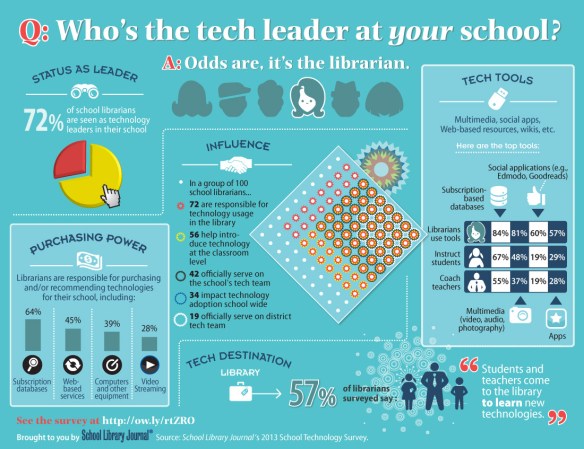
As education technology has evolved, so, too, have the kinds of digital tools that school librarians use with their students, as shown in School Library Journal’s 2013 School Technology Survey. Handheld tablets and devices are coveted items for classroom and instructional use, along with access to online sites and apps that school librarians believe can revolutionize the way they instruct—and the way students learn. More than 750 school librarians responded to SLJ’s survey, representing K–12 public and private schools across the country. According to the data, school librarians make the most of what they have, learning one day and sharing that knowledge the next. They not only make tech tools available for students and teachers, but teach them how to use the tools as well.
Read More: Device & Conquer: SLJ’s 2013 Tech Survey | The Digital Shift.
35 Free Live Webinars for Librarians in December | Ellyssa Kroski | OEDB.org
‘Tis the season for online learning, especially in the library field! December’s calendar is brimming with exciting and free learning opportunities for librarians looking for professional development. Check out this list of 35 gratis webinars, just in time for the holidays!
Read: 35 Free Live Webinars for Librarians in December | Ellyssa Kroski | OEDB.org.
Nelson Mandela dies at 95: Five touchstone film moments about his life | EW.com
Nelson Mandela passed away Thursday at the age of 95. Imprisoned from 1962 to 1990, the former South African president (1994-1999) fought to abolish apartheid and worked to end poverty. Known as “The Father of a Nation” the celebrated leader was the 1993 Nobel Peace Prize winner and received the U.S. Presidential Medal of Freedom, among many other honors.
It’s no surprise that his inspirational story has made its way to the big screen. In addition to the current film Mandela: Long Walk to Freedom, which is in theaters now, the South African leader has been the subject of several feature films and documentaries in recent years. Check out five iconic portrayals of Mandela in pop culture.
Read: Nelson Mandela dies at 95: Five touchstone film moments about his life | PopWatch | EW.com.
Readworthy: Books & Publishing, Music & Film
Books & Publishing
Harry Potter: Harry Potter and the Philosopher’s Stone voted UK’s favourite children’s book | theguardian.co.uk and The Best YA Novel of All Time bracket game: And the winner is… | EW. From mid-November Harry Potter Stamps Coming to USPS | BookRiot
- 100 Notable Books of 2013 | TNYT
- National Book Award Winners 2013 | HuffPo
- A Former Apple Executive’s Obsessive Search For Sherlock Holmes | Forbes
- Unseen JD Salinger stories leaked on to filesharing site | theguardian
- 5 Series You Probably Missed as a Kid (But Should Read as an Adult) | The Millions
- Everything I Knew About Dating I Learned From 19th Century Novels. Huge Mistake. | HuffPo
- Cary Elwes writing a book on making ‘The Princess Bride’ | LA Times
- Macmillan relaunches online teen platform | The Bookseller
- Ryan wins Guardian First Book Award | The Bookseller
- Dillon wins Best Book at Comic Awards | The Bookseller
- At NYU, Experts Debate Future of Book | PublishersWeekly
Music & Film
Readworthy: Education & Technology, Librarianship
Education & Technology
- Twenty tips for interpreting scientific claims | nature
- Inkling’s E-Books Put the Consumer in Charge | Mashable
- The 15 Best Websites, According to Redditors | Mashable
- Striking Back Against Censorship | WordPress has a new censorship policy.
- Tech sector hiring more women, data shows… or is it? | CNET
- Apple Doesn’t Want to Pay the Feds’ E-Book Lawyer $70,000 a Week | AllThingsD
- Google building Spark, a Web-based development tool | CNET
- E-books ‘too pricey for 16-24 market’ | The Bookseller
Librarianship
- Concordia opens Mordecai Richler Reading Room | Quill & Quire
- Books are still most durable way to store information | Salon
- OverDrive Rolls Out “Netflix-like” Streaming Video Pilot for Libraries and Schools | The Digital Shift
- The Totally Awesome Way Some Libraries Are Tackling Hunger | HuffPo
- Libraries Change Lives | HuffPo
- Archive of General Wolfe’s personal letters is coming to Canada | Globe & Mail
Video: official trailer for Kelley Armstrong’s Bitten TV series | Quill & Quire
Canadian cable network Space has released the official trailer for Bitten, a television-series adaptation of Kelley Armstrong’s 2001 debut novel.
Published by Random House Canada, Bitten follows Elena Michaels, a Toronto journalist who also happens to be the only existing female werewolf. The fantasy novel turned Armstrong into a best-selling author and kicked off her popular 15-title Women of the Otherworld series. Bitten premieres on Space Jan. 11
via Video: official trailer for Kelley Armstrong’s Bitten TV series | Quill & Quire
London book benches: are you sitting comfortably? | The Guardian
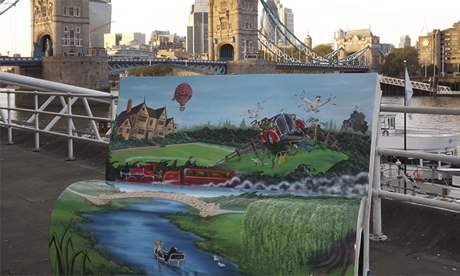
Visitors to London will able to enjoy books in a new way next summer – by sitting on them. Benches resembling giant open books, the volumes ranging from Kenneth Grahame’s Wind in the Willows to George Orwell’s 1984, will be installed at various sites in the capital for a stretch of 10 weeks.
Read: London book benches: are you sitting comfortably? | Books | The Guardian.
 infophile