Facebook Is Testing Software That Tracks Your Cursor’s Every Move | Gizmodo


Facebook’s analytics chief Ken Rudin recently opened up to The Journal about how the social network plans to track user behavior. Long story short, Facebook plans to track it very closely. At the moment, the company is testing software that would record everything from when a user’s Newsfeed is visible on the screen to how long a user hovers over a certain part of the page.

That’s right. Facebook wants to know exactly where you’re moving your mouse. At all times.

Read: Facebook Is Testing Software That Tracks Your Cursor’s Every Move | Gizmodo.

The Best (and Worst) Countries to Be a Woman | Harvard Business Review


The Best (and Worst) Countries to Be a Woman | Sarah Green | Harvard Business Review

Article in Full

The World Economic Forum has just come out with their latest data on global gender equality, and the short version could well be this old Beatles lyric: “I’ve got to admit it’s getting better. A little better, all the time. (It can’t get more worse.)”

I talked with Saadia Zahidi, a Senior Director at the WEF and their Head of Gender Parity and Human Capital. Yes, it’s getting better. Out of the 110 countries they’ve been tracking since 2006, 95 have improved and just 14 have fallen behind (a single country, Sweden, has remained the same). But that’s partly because in some places, there was nowhere to go but up.

And not everyone has improved at the same rates, or for the same reasons.

For instance, in Latin America, several countries surged ahead as more women were elected to political office. That was a trend in Europe, too – much of the improvement in Europe’s scores was due not to women’s increased workforce participation, but instead to the increasingly female face of public leadership. Although those numbers are still very low overall, increasingly women are being appointed (and somewhat more rarely, elected) to public office. “Looking at eight years worth of data, a lot of the changes are coming from the political end of the spectrum, and to some extent the economic one. So much of the [workforce] talent is now female, you would expect the changes to be on the economic front but that’s not what’s happening,” said Zahidi.

And sometimes equality is just another word for poverty. For instance, look at Malawi. They’re one of three sub-Saharan countries where women outstrip men in the workforce, with 85% of women working compared with 80% of men. (The other two are Mozambique and Burundi.) These are low-skilled, low-income professions — just 1% of each gender attends college, and Malawi is one of the world’s poorest countries. This is a bleak contextual picture… and yet Malawi is number one in the world in terms of women’s participation in the labor force.

Then there’s the Philippines. They’re ranked fifth in the world on gender parity because even though they rank 16th the world in terms of the percentage of women working, “the quality of women’s participation is high,” says Zahidi. Women make up 53% of senior leaders, the wage gap is relatively low, and they’ve had a female head of state for 16 out of the last 50 years – which, among other factors, makes them 10th in the world in terms of women’s political empowerment. They’ve also largely closed the gap on health and education. They, too, are a reminder that the WEF’s data tracks gender gaps – not development.

But there are a few lessons to be learned from the wealthy Nordic countries at the top of the heap. “The distance between them and the countries that follow them is starting to grow larger because of the efforts they’ve made,” says Zahidi, crediting their progressive policies on parental leave and childcare as examples of the infrastructure that makes it easier for women to participate in the workforce. When the WEF began doing this survey eight years ago, no countries were cracking the 80% mark in terms of women’s parity with men (where a perfect score is 100%). Now, some countries at the top of the list are up to 86%.

“Change can be much faster – or much slower – depending on the actions taken by leaders.”

I asked Zahidi about the across-the-board improvements. Were countries and companies learning from one another? Or were they each proceeding on their own? “This is not something that there’s generally been a lot of exchange on,” she conceded, “But one of the the things the World Economic Forum is trying to do is create that exchange.” They’ve developed a repository of best practices detailing how other companies and countries have overcome their gender gaps. Nowhere are women fully equal across all the realms the WEF tracks — health, education, the economy, and politics.

“To accelerate change, you need to have that sharing of information between companies,” she says. “Thus far, [progress] may not have been based on information exchange but it will have to be in the future — if we want to avoid reinventing the wheel.”

Where does your own country fit in? Take a look at the graphic below. The thick in the background shows the overall equality score – the 2006 score is in gray, and the 2013 improvement is indicated in light blue. (Countries that worsened or stayed the same are only in gray; countries that were not tracked in 2006 are only blue.) The narrow, darker blue line in the foreground indicates how much the country’s relative ranking has changed in the last seven years. Some countries have surged ahead, pushing other countries down on the list.


Gender_Parity_365_R

Evgeny Morozov on Why Our Privacy Problem is a Democracy Problem in Disguise | MIT Technology Review


As Web companies and government agencies analyze ever more information about our lives, it’s tempting to respond by passing new privacy laws or creating mechanisms that pay us for our data. Instead, we need a civic solution, because democracy is at risk.

Snip: “When all citizens demand their rights but are unaware of their responsibilities, the political questions that have defined democratic life over centuries—How should we live together? What is in the public interest, and how do I balance my own interest with it?—are subsumed into legal, economic, or administrative domains. “The political” and “the public” no longer register as domains at all; laws, markets, and technologies displace debate and contestation as preferred, less messy solutions.

But a democracy without engaged citizens doesn’t sound much like a democracy—and might not survive as one.”

A lengthy but thought provoking read on the right to privacy and democracy. Read: Evgeny Morozov on Why Our Privacy Problem is a Democracy Problem in Disguise | MIT Technology Review.


Online Dating [Infographic], Online Dating & Relationships Report | Pew Research Center; How I Hacked Online Dating | Amy Webb | TED


Online Dating & Relationships | Pew Research Center

Overview
One in ten Americans have used an online dating site or mobile dating app; 66% of these online daters have gone on a date with someone they met through a dating site or app, and 23% have met a spouse or long term partner through these sites. Public attitudes toward online dating have become more positive in recent years, but many users also report negative experiences.

These are among the results of a national survey of dating and relationships in the digital era, the first dedicated study of this subject by the Pew Research Center’s Internet Project since 2005. Key findings include:

  • 11% of internet users (representing 9% of all American adults) say that they have personally used an online dating site. As recently as 2008, just 3% of American adults had used online dating sites.
  • 7% of cell phone apps users (representing 3% of all American adults) say that they have used a dating app on their cell phone.

Taken together, 11% of all American adults are “online daters”—meaning they have used a dating site or mobile dating app. Online dating is especially common among the college-educated and those in their mid-20’s through mid-40’s, and 38% of Americans who are currently single and actively looking for a partner have used online dating at one point or another. See the online report or download the pdf.

Amy Webb: How I hacked online dating | TED.com
Amy Webb was having no luck with online dating. The dates she liked didn’t write her back, and her own profile attracted crickets (and worse). So, as any fan of data would do: she started making a spreadsheet. Hear the story of how she went on to hack her online dating life — with frustrating, funny and life-changing results.

Online Dating [Infographic] | Pew Research Center’s Internet & American Life Project

Dating Digitally: Pew

You may also like:

The Joy of Data Driven Storytelling | Leslie Bradshaw


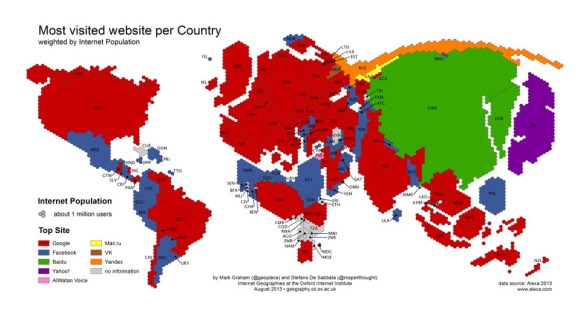
The Most Popular Websites in the World, Country-by-Country | Gizmodo


If you’ve ever wondered what the go-to web page was around the rest of planet, wonder no longer. This map shows the most visited websites around the world, broken down country-by-country.

Most visited website per country

Read: The Most Popular Websites in the World, Country-by-Country | Gizmodo.

Adobe Gets Hacked, Product Source Code And Data For 2.9M Customers Likely Accessed | TechCrunch


Now this is interesting and worrying. Source code being accessed is a very big deal, especially the company being Adobe. Subversive response to the move to subscription-based cloud services perhaps?? Hijacking code to exploit vulnerabilities…insert viruses…gain access to even more data. Very worrisome.

Article in Full from TechCrunch

“Uh oh — Adobe has just disclosed that one of their servers has been hacked.

While their investigations are still ongoing, Adobe has shared a few details on what they believe could have been accessed and obtained in the hack — and it’s a big one.

From what Adobe has shared so far, it sounds like the hackers had access to encrypted data for as many as 2.9 million customers. While Adobe stresses that the data is encrypted and that they “do not believe the attackers removed decrypted credit or debit card numbers”, that data — encrypted or not — is definitely not something they want out in the wild.

Adobe has yet to disclose how that data was encrypted, so it’s currently unclear just how secure it is.

Meanwhile, it also appears that the hackers may have been able to access the source code for at least three of Adobe’s products: Acrobat, ColdFusion, and ColdFusion Builder. This goes hand in hand with a report from Brian Krebs this morning, who noted that he and a fellow researcher had discovered at least 40GB of Adobe source code available on a hacking group’s private server.

Beyond the obvious business implications of having your otherwise locked down source code floating around in the wild, there are potentially massive security concerns here. Once you’ve got the source code for an application in hand, it becomes much easier to dig up the stealthy lil’ security screw ups that might otherwise go unnoticed. Combine this new potential for big zero-day exploits with the many, many millions of Adobe Acrobat (Adobe’s official PDF reader) installs around the world, and this all starts to get pretty worrisome.”

via Adobe Gets Hacked, Product Source Code And Data For 2.9M Customers Likely Accessed | TechCrunch.

HarperCollins partners with Scribd for ebook subscription service | Quill & Quire


HarperCollins has partnered with document-sharing website Scribd on a new ebook subscription service.

Dubbed “Netflix for ebooks,” subscribers pay $8.99 a month for the ability to check out an unlimited number of ebooks – up to 10 titles at time – from the Scribd catalogue, which includes backlists from HarperCollins and several small U.S. presses. The service allows readers to switch between browsers, Android, and Apple devices without losing their place.

HarperCollins CEO Brian Murray told the Associated Press that the partnership will provide the publisher with valuable data about Scribd readers. “This is going to help us make even better publishing and marketing decisions for our authors,” he says.

The international service is now available in Canada, although not all titles are accessible for download.

HarperCollins partners with Scribd for ebook subscription service | Quill & Quire

Second OverDrive “Big Library Read” Project Includes School Libraries | GoodEReader


Earlier this year, digital content distributor OverDrive partnered with publisher Sourcebooks in an experiment aimed at establishing concrete data on how readers respond in terms of book borrows and book sales to digital titles they check out from their libraries. 

Now, OverDrive is partnering with HarperCollins on a second installment of the project, this time using a children’s book and including school libraries in the experiment. In addition, the audiobook of this title will be available as well at no-cost and with multiple checkouts, just like the digital title.

Read: Second OverDrive “Big Library Read” Project Includes School Libraries  | GoodEReader.

Researchers build[ing] ‘Google Earth’ project for the ancient world | theguardian.com


A tool developed by researchers at Southampton University has indexed historic maps, photos and historic documents to provide a simple location search tool for the UK.

The Pelagios 3 project takes data from ancient Latin and Greek sources, which formed the basis of two previous Pelagios projects, and builds on it with documents and maps from Arabic sources, medieval European and Chinese maps, and seafaring charts from the 13th century, cross-linking them into one searchable database. 

Read the full story: Researchers build ‘Google Earth’ project for the ancient world | Technology | theguardian.com.