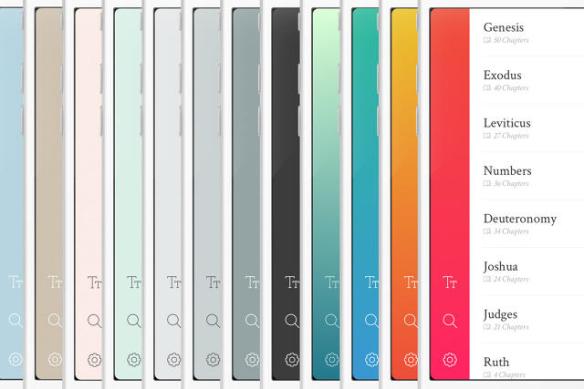
Kory Westerhold and his cofounder, Yahoo Design Director Aaron Martin, give co.Design an exclusive look at their beautiful new bible app. READ MORE: Ex-Apple Designer Rethinks The Bible For A Mobile World | Co.Design | business + design.

Kory Westerhold and his cofounder, Yahoo Design Director Aaron Martin, give co.Design an exclusive look at their beautiful new bible app. READ MORE: Ex-Apple Designer Rethinks The Bible For A Mobile World | Co.Design | business + design.
I tried accessing ShoutFactory! content this morning (Thursday, February 5) but content is not yet playable/accessable on my desktop or iPad. I’m interesting in checking out Twilight Zone, Bushido Man and Dreamscape. An error comes up “Sorry, the requested video is not yet available on this device.” Content may be accessible later this afternoon or there may be an issue with accessing content from Canada. The About Us page states “SHOUT! FACTORY TV is a free-to-the viewer, ad-supported video offering containing full-length television shows, movies, specials, and original content viewable through desktop computers, mobile, tablet, and “over-the’top” devices such as Roku…In addition, Shout! Factory maintains a vast digital distribution network which delivers video and audio content to all the leading digital service providers in North America.”
The big four broadcast networks — ABC, CBS, Fox, and NBC — don’t really have specific brands. They’re nebulous, offering drama, comedy, reality, and whatever else they put on the air. They’re the giant department stores of TV. Cable channels are more like specialty stores. ESPN is for sports fans. Nickelodeon is for kids. TNT knows drama.
The same is now happening with streaming services. We have a “big three” — Netflix, Hulu, and Amazon Prime. We have offshoots of TV networks, like HBO Go and Showtime Anytime.
And now we’re starting to see the rise of specialty streaming services, like one launching from Shout! Factory. Previously known for releasing DVDs of films and TV shows other studios didn’t want to, Shout’s new streaming service carries the same philosophy to the world of online TV. It’s filled with classic shows and movies that are hard to find elsewhere. It’s got more of an eye toward curation than building a platform. It’s built off of others’ software.
And it’s completely free.
READ MORE: A new streaming service just for classic TV and film launches today – and it’s free | Vox
Snip
…For the nearly 8 million people in the US with some degree of vision impairment, the advent of ebooks and e-readers has been both a blessing and a burden. A blessing, because a digital library—everything from academic textbooks, to venerated classics, to romance novels—is never further away than your fingertips. A burden, because the explosion of ebooks has served as a reminder of how inaccessible technology really can be…
READ MORE: E-Book Legal Restrictions Are Screwing Over Blind People | WIRED
The ephemeral messaging apps space dominated by Snapchat keeps growing. Now it seems Facebook is adding to the trend again — in a whole new way. In a question and answer section on Facebook, the company now describes how to set a post you’ve published to expire, a process that allows the message to disappear. READ MORE: Facebook Experiments With Disappearing Post | Mashable.
Mark Cuban doesn’t like the trolls on Twitter. According to the startup investor, star of Shark Tank and owner of the Dallas Mavericks, he has to think twice before tweeting anything, because there are hordes of jerks on the social network who want to pick him apart. That’s why his application Cyber Dust makes everything disappear. READ MORE: Shark Tank’s Mark Cuban Wants To Erase Your Digital Footprint. | readwrite
What kind of stories are locked up in your Messages app? Love stories? Tales of friendships made, and lost, and patched up once again? What about the story of your first funding, or acquisition? Txto.io is ready to remind you of those stories, from start to finish, with a clever little service that lets you print out your text history on a miniature scroll. “Unroll your story,” they promise. READ MORE: TxTo Unrolls Your Story By Printing Out SMS Conversations Onto Scrolls | TechCrunch
Discovering Literature: Romantics and Victorians from British Library Learning on Vimeo.
While Discovering Literature is an important cultural resource that can be enjoyed by all ages, it has been carefully tailored to appeal to GCSE and A-level students. The British Library’s research among teachers showed that original manuscripts, with their edits and revisions, dodgy grammar and messy handwriting, can be a powerful way of engaging pupils. Contextual material can also be a source of inspiration, and the site is packed with items such as letters, diaries, dictionaries, newspapers and illustrations that illuminate the historical, social and political contexts of classic works.
READ MORE: British Library gives teachers tools to inspire | Books | The Observer.
Full Post
Eight years after a group of authors and publishers sued Google for scanning more than 20 million library books without the permission of rights holders, a federal judge has ruled that the web giant’s sweeping book project stayed within the bounds of U.S. copyright law.
On Thursday morning, U.S. Circuit Judge Denny Chin dismissed a lawsuit from the Author Guild, ruling that Google’s book scans constituted fair use under the law. Though Google scanned those 20 million books in full and built a web service, Google Books, that lets anyone search the digital texts, users can only view “snippets” of a book if the right holder hasn’t given approval.
“In my view, Google Books provides significant public benefits,” the ruling reads. “It advances the progress of the arts and sciences, while maintaining respectful consideration for the rights of authors and other creative individuals, and without adversely impacting the rights of copyright holders.”
In a statement sent to WIRED, a Google spokesperson said the company was “absolutely delighted” with the ruling. “As we have long said, Google Books is in compliance with copyright law and acts like a card catalog for the digital age giving users the ability to find books to buy or borrow.”
Michael Boni, a partner with Boni & Zack, the law firm representing the Authors Guild, did not immediately respond to a phone message seeking comment. Nor did the Author’s Guild. But the Guild has told other news outlets it will appeal the decision.
“We disagree with and are disappointed by the court’s decision today. This case presents a fundamental challenge to copyright that merits review by a higher court,” reads a statement sent to GigaOm. “Google made unauthorized digital editions of nearly all of the world’s valuable copyright-protected literature and profits from displaying those works. In our view, such mass digitization and exploitation far exceeds the bounds of the fair use defense.”
The ruling comes two years after Judge Chin rejected a $125 million settlement between Google, the Author’s Guild, and the Association of American Publishers, which was also part of the original lawsuit against the web giant. After complaints over the settlement from outside organizations such as the Internet Archive and Google rivals such as Microsoft, Chin ruled the deal would give Google a de facto monopoly over so-called “orphan books,” scanned texts whose rights holders had not come forward to claim their share of the revenues Google would make from its book scanning endeavor.
A year after this ruling, the publishers agreed to another settlement with Google, and this one was not subject to approval from the court. But Chin allowed the case to continue as a class action, but an appeals court reversed this decision and told Chin to rule on the copyright issue.
Though Google limits how much book text you can view online — and though it doesn’t display ads on pages describing books it does not have rights to, the company, as the court explained, can still use its service to draw people to its websites and make money in other ways. But this commercial gain doesn’t necessarily mean copy infringement. Google Books, the judge ruled, doesn’t “negatively impact the market for books.”
On the contrary, Chin said, Google Books feeds the market for books. “A reasonable factfinder could only find that Google Books enhances the sales of books to the benefit of copyright holders,” the ruling reads. “Google Books provides a way for authors’ works to become noticed, much like traditional in-store book displays.”
via 8 Years Later, Google’s Book Scanning Crusade Ruled ‘Fair Use’ | Wired Business | Wired.com.

You can now take a 3D peek at several famous historical artifacts thanks to a project from the Smithsonian Institution.
Launched on Wednesday, the Smithsonian X 3D Web site serves up a collection of 3D images of artifacts digitally scanned by the museum through a partnership with Autodesk. You canexplore the artifacts in detail by manipulating their images via mouse on your computer or via finger on a supported touch-screen device.
Read: Smithsonian now lets you view artifacts in 3D | Internet & Media – CNET News.
Related: The Smithsonian Is Uploading Its Lost Treasures to the Internet | Gizmodo
We live in an age of touch-screen interfaces, but what will the UIs of the future look like? Will they continue to be made up of ghostly pixels, or will they be made of atoms that you can reach out and touch?
At the MIT Media Lab, the Tangible Media Group believes the future of computing is tactile. Unveiled today, the inFORM is MIT’s new scrying pool for imagining the interfaces of tomorrow. Almost like a table of living clay, the inFORM is a surface that three-dimensionally changes shape, allowing users to not only interact with digital content in meatspace, but even hold hands with a person hundreds of miles away. And that’s only the beginning.
Read more: MIT Invents A Shapeshifting Display You Can Reach Through And Touch | Co.Design | business + design.
Education & Technology
Xbox One News: Xbox One’s DRM policy reversal: an oral history | Engadget and Xbox One won’t play 3D Blu-rays — for now | CNET
Intel Has Acquired Kno, Will Push Further Into The Education Content Market With Interactive Textbooks | TechCrunch
We had a tip about, and have now confirmed, Intel’s latest acquisition: Kno, the education startup that started life as a hardware business and later pivoted into software – specifically via apps that let students read interactive versions of digitized textbooks.
Librarianship
 infophile