‘Everything is Awesome’: Cambridge University Will Get a #Lego Professor | Mashable #academics


Ok, if there can be a Lego Professor there can be a Lego Librarian. I’m sure there is enough money in this trust to setup a Lego Librarianship alongside the Lego Professorship at this new Research Centre!

Everything is awesome, including this hiring news from one of the UK’s most prestigious institutions: Cambridge University is getting a Lego professor.

The university announced on Tuesday the school had accepted £2.5 million from the Lego Foundation to set up a Lego Professorship of Play in Education, Development and Learning, the Cambridge University Reporter wrote.

The foundation also gifted the school an additional £1.5 million to set up a Research Centre on Play in Education, Development, and Learning within its Faculty of Education.

One lucky professor will start the new role on October 1, 2015.

READ MORE: ‘Everything is awesome’: Cambridge University will get a Lego professor | Mashable

This Vintage Children’s Book Leaves Nothing To The Imagination | BuzzFeed #books


This Vintage Children's Book Leaves Nothing To The Imagination

Children have to learn the birds and the bees somehow, and the 1975 book How a Baby Is Made was written to show them EVERY step of the process. In graphic detail. READ MORE: This Vintage Children’s Book Leaves Nothing To The Imagination | BuzzFeed

How Can You Prevent Sexual Assault? Web Comic ‘Game’ Has Advice | CNET + Can #Wearable #Tech Prevent Sexual Assault? | FastCompany


How Can You Prevent Sexual Assault? Web Comic ‘Game’ Has Advice | CNET. With this choose-your-own-adventure online comic [interactive graphic novel], students discover how their decisions can ignite or diffuse uncomfortable sexual situations.

Can Wearable Tech Prevent Sexual Assault? | FastCompany Roar is a startup that’s building a wearable device designed to deter attackers and notify loved ones.

Feast Your Eyes on This Beautiful Linguistic Family Tree | Mental Floss #languages #linguistics


When linguists talk about the historical relationship between languages, they use a tree metaphor. An ancient source (say, Indo-European) has various branches (e.g., Romance, Germanic), which themselves have branches (West Germanic, North Germanic), which feed into specific languages (Swedish, Danish, Norwegian). Lessons on language families are often illustrated with a simple tree diagram that has all the information but lacks imagination. There’s no reason linguistics has to be so visually uninspiring. Minna Sundberg, creator of the webcomic Stand Still. Stay Silent, a story set in a lushly imagined post-apocalyptic Nordic world, has drawn the antidote to the boring linguistic tree diagram.

READ MORE: Feast Your Eyes on This Beautiful Linguistic Family Tree | Mental Floss.

The Future Of #Museums Is Reaching Way Beyond Their Walls | Co.Exist #AMNH


The American Museum of Natural History has always been one of the most popular destinations in New York City. With about 5 million visitors a year, an increase from 3 million in the 1990s, it—along with the nearby Metropolitan Museum of Art—is among the top 10 most-visited museums in the world.

Even with this influx of people coming to its doorstep, however, the museum is now equally focused on drawing a crowd beyond its campus.

“In the old days, a visit to a museum like ours would be a one-off. You come, you visit you go home,” says Futter. “Now people have a relationships with us very often before they get here. They come, and [their visit] is like a giant exclamation point—and then they return home and continue to engage with us wherever they are.”

AMNH today is a sprawling outreach institution that is using apps, social media, and educational programs to slowly grow its reach. READ MORE: The Future Of Museums Is Reaching Way Beyond Their Walls | Co.Exist | ideas + impact.

STEM Curriculum Turned Into An Addictive [iOS] Game | Co.Design #STEM #apps


Levers, pulleys, and wheels—they’re tools that outline some of the most foundational principles in physics. But foundational principles are boring. What’s fun is using a lever to catapult a boulder at a castle, breaking down the bricks one by one to discover a dragon sleeping inside.

That is the premise of Simple Machines, the latest iOS app by the educational game studio Tinybop. In the past, Tinybop has made interactive books on the human body and plant life. They’ve created a fun simulator for kids to build their own robots. But with Simple Machines, they’re taking aim at a very particular part of student curriculum: The first stages of STEM (science, technology, engineering, and math), in which kids commonly learn about six “simple machines”—the lever, pulley, wheel, wedge, inclined plane, and screw.

READ MORE: STEM Curriculum Turned Into An Addictive Game | Co.Design | business + design.

8 STEM Toys for Pint-Sized Einsteins | Mashable #kids #STEM #toys #play


Often times, parents want the toys their children play with to teach STEM skills — recently updated to STREAM, or Science, Technology, Reading, Engineering, Arts and Math.

At the 2015 International American Toy Fair, there was a bevy of toys that were anything but mindless. Better yet, they’re made to get kids interested in one of these educational topics — without slathering on the “learning” part so they will be disinterested.

Here are some of our favorites that will keep kids learning beyond the classroom.

READ MORE: 8 STEM toys for pint-sized Einsteins | Mashable

Learn to Avoid the Most Common Design Mistakes with This Free Course | LifeHacker


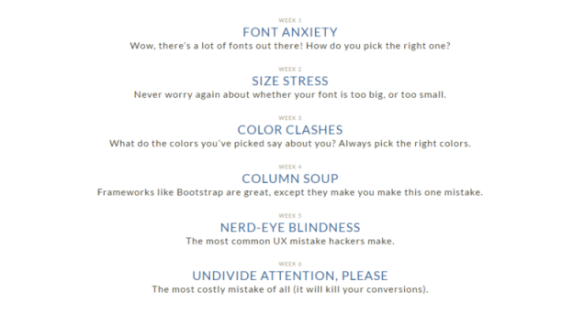
Beginning designers tend to make the same common mistakes. Design Pitfalls is a free course delivered weekly to your email inbox that will teach you how to avoid them.

The course comes from Design for Hackers author and professor David Kadavy. If you sign up, every Tuesday for 6 weeks, you’ll learn about a new pitfall and the tips to prevent it. Here’s what the email course will cover:

Avoid the top mistakes beginning designers make, Kadavy says, and you’ll quickly be doing at least halfway-decent design.

Sign up for the course below or read more about it here. Hurry, though. Class starts May 26th and signup ends on midnight (GMT) May 22nd.

via Learn to Avoid the Most Common Design Mistakes with This Free Course | LifeHacker

125 MOOCs Getting Started in May: Enroll in One Today | Open Culture #MOOCs


MORE: 125 MOOCs Getting Started in May: Enroll in One Today | Open Culture

MinecraftEdu Takes Hold in Schools | School Library Journal #minecraft #education


There aren’t any express objectives or any real way to win in Minecraft. It’s a “sandbox,” in gaming speak—offering free play without a specific goal and currently used by more than 18.5 million players, with some 20,000 more signing up every day. Users may choose between Creative Mode, in which they can build using unlimited resources by themselves or with friends, with no real danger or enemies, and Survival Mode, where they fend off enemies and other players and fight for resources and space. They can trade items and communicate using a chat bar. Modifications (or mods) can add complexity by creating things like economic systems that let players buy and sell resources from in-game characters using an in-game currency system. These downloadable mods can also add computer science concepts and thousands of additional features.

MINECRAFTEDU

Minecraft’s worlds and possibilities are truly endless—and increasingly, so are its educational adaptations for school use. Available on multiple platforms (Apple, Windows, Linux, PlayStation, Xbox, Raspberry Pi, iOS, Android, Windows Phone), the game’s flexibility and collaborative possibilities make it a favorite among devotees of gamification.

“Minecraft is like LEGOs on steroids,” says Eric Sheninger, a senior fellow at the International Center for Leadership in Education. “Learners of all ages work together to ultimately create a product that has value to them,” he adds. “The simple interface provides students in the classroom with endless possibilities to demonstrate creativity, think critically, communicate, collaborate, and solve problems.” A Swedish student research study also showed that collaboration in Minecraft provided a more immersive problem-solving experience than group LEGO building.

via MinecraftEdu Takes Hold in Schools | School Library Journal.