What started more than 60 years ago as a children’s building-block toy has turned into a technological tool, most recently used to design a plastic car fueled by air.
The ability to print retinal cells could lead to new therapies for retinal disorders such as macular degeneration…Researchers at the University of Cambridge used a standard ink-jet printer to form layers of two types of cells taken from the retinas of rats, and showedthat the process did not compromise the cells’ health or ability to survive and grow in culture. Ink-jet printing has been used to deposit cells before, but this is the first time cells from an adult animal’s central nervous system have been printed.
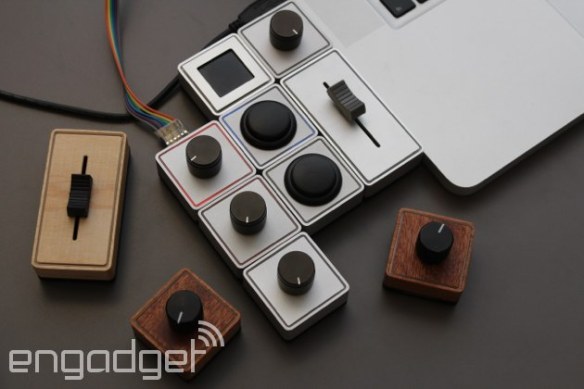
Palette co-founder Calvin Chu has a problem with how people work. “Creative professionals spend so much of their time on the computer, and at the moment, they still use a very generic one-size-fits-all keyboard and mouse interface.” It doesn’t make sense, he says — photographers, gamers, film editors, musicians and accountants all using the same interface? Surely there is a better way. “It should be specialized and made for your needs, and that’s where we came up for the idea for Palette.” Palette is Chu’s answer to a world that’s discarded tactile dials and switches for keyboards, mice and touch screens. It’s a modular collection of buttons, sliders and potentiometers that can be programmed to do almost anything on your PC. We took a look at an early prototype of the customizable controller to reacquaint ourselves with the tactile world.
Dan Shapiro’s Robot Turtles board game Kickstarter showed there is serious appetite for kids’ games that aren’t just fun to play with but also sneakily teach core coding principles. Instead of the $25,000 he was aiming for, Shapiro raised more than $630,000. Geeky moms and dads clearly have money, and will spend it on the right bit of educational kit.
With that kind of Kickstarter community response, it’s pretty likely we’re set to see a wave of educational toys doing cool fun stuff with programming principles. To wit, meet Primo: a physical programming interface that teaches children programming logic while they control the movements of an Arduino-powered robot.
When the Best Books of 2013 are listed, the most important may not make the cut. Thats because the most exciting literary innovation of the year is not a book at all, but a video game for iPad and iPhone. Device 6 is a metaphysical thriller in which the world is made almost entirely from words. Playing it is like reading a book—except, in this book, the words veer off in unexpected directions, rather than progressing in orderly fashion down the page. When Anna, the game’s protagonist, turns a corner in the narrative, the text does too, swerving off to one side at a right angle, forcing the player to rotate the screen.
By making the basic building blocks of batteries out of ink, Harvard materials scientist Jennifer Lewis is laying the groundwork for lithium-ion batteries and other high-performing electronics that can be produced with 3-D printers. Although the technology is still at an early stage, the ability to print batteries and other electronics could make it possible to manufacture new kinds of devices.
Many will tell you that video games are bad for your eyes, but James Blaha doesn’t buy that theory. He’s developing a crowdfunded virtual reality title, Diplopia, that could help restore 3D vision. The Breakout variant trains those with crossed eye problems to coordinate their eyes by manipulating contrast; players score well when their brain merges two images into a complete scene. Regular gameplay could noticeably improve eyesight for adults that previously had little hope of recovering their depth perception, Blaha says. The potential solution is relatively cheap, too — gamers use an Oculus Rift as their display, and they can add a Leap Motion controller for a hands-free experience. If you’re eager to help out, you can pledge $20 to get Diplopia, and $400 will bundle the app with an Oculus Rift headset. Check out a video demo of the therapeutic game after the break.
We’re go out on a limb here and say that the Venn diagram of Engadget fans and Tolkien fans looks something like this. So, we figure you’ll probably want to hear about a brand new Chrome experiment that brings various parts of Middle Earth to life, including the Trollshaw and Dol Guldur. It starts with a pretty simple interactive map, but from there you’re able to dive into several locations and learn about Hobbit lore through text, animations and audio. At the end of each lesson on Tolkien’s fantasy world, you’re challenged to complete a simple mini game that has you causing flowers to bloom or avoiding troll attacks. While the WebGL-powered games are pretty impressive, its the HTML5 audio and animations that are the real eye-candy here — doubly so since they work just as well on a phone or tablet as they do your desktop. As you swipe through slides in the story, camera angles change in coordination with your finger and characters dart across bridges. Honestly, even if you’re part of that tiny sliver in the diagram that can’t stand Tolkien, it’s worth checking out the latest Chrome Experiment, if only to remind yourself of the growing power of the web browser.
A winner of the coveted red dot awards for design concept in 2013, Sign Language Ring is a device that detects sign language motion and “translates” that to voice by emitting audio through a speaker.
Comprising a bracelet and set of detachable rings worn on select fingers, Sign Language Ring was inspired by Buddhist prayer beads, according to its six designers from Asia University. The wearable device can also translate voice to text, transcribing spoken language picked up by a microphone into text that’s displayed on the bracelet’s screen.
Ever wonder what makes the Google the holy grail of productivity and creativity? There’s no magic in the drinking water at the Mountain View, CA company. The tech giant draws from what Google’s chief social evangelist, Gopi Kallayil, calls the nine core principles of innovation.
Kallayil shared his insights at this week’s San Francisco Dreamforce summit. Here are the nine rules that any enterprise, large or small, can adopt to steal Google’s innovative culture.


 infophile
