With its Color Alive line, Crayola was the first company to merge coloring books and apps so kids could bring their on-page creations to life. But Disney Research is taking that idea one step further by letting kids see a coloring book character move in 3D while they’re still coloring it. It’s all made possible by a new augmented reality app that Disney Research has developed that’s able to track and capture real-time images from a mobile device’s camera, and then map them onto any 3D deformable surface. READ MORE: Disney Has Invented 3D Coloring Books | Gizmodo
British people’s secret confessions are being displayed in a train station | Mashable The deepest fears and emotional confessions of strangers are being anonymously displayed at a busy train station in the south of England. “The Waiting Wall” allows commuters travelling through Brighton train station to submit anonymous confessions that are then projected onto a large screen for fellow passengers to read. The display is running from September 21 to September 27 as part of Brighton digital festival.
But today, storytellers find imaginative ways to share their ideas with interactive and visual elements. On modern mediums like Twitter, Vine, YouTube and other mobile applications, storytellers are crafting tales in ways that would have been unfathomable a decade ago. Offline, too, authors have begun rethinking the traditional concept of the book in ways both innovative and unorthodox.
Storytelling In The Digital Media Age | TechCrunch
Recent studies have shown that attention spans for millennials – those who have grown up in a digital world – are 60 percent shorter than previous generations when it comes to media. They’ve essentially emerged from birth staring at smartphones and tablet computers – with endless entertainment options just a screen away. As this attention span continues to shrink, brands must identify new ways to break through the clutter and establish meaningful emotional connections with their audiences.
Though we might not be getting a sequel to The Goonies anytime soon, director Richard Donner has revealed plans for the next best thing: an “immersive” theater experience in which you can be play of the Goonies. In a recent interview with Yahoo! Movies, Donner divulged that the classic 1985 film is about to become a uniquely immersive stage experience on the off-Broadway stage. Immersion theater is “where there’s no seats, the venue is you go into a warehouse and there’s something happening in that warehouse and that’s the play you’ve come to see, only you become part of it and you travel through with actors,” Donner said. READ MORE: Immersive theater experience lets you become one of ‘The Goonies’ | Mashable
Behold MansLaughter, the marriage of virtual reality, murder mystery, choose-your-own-adventure, and the visual style of George Lucas’s famous dystopian film, THX 1138.
Made specifically for Samsung’s virtual reality headset, the Gear VR, MansLaughter is billed as the first-ever VR feature film. The brainchild of filmmaker David Marlett, the movie brings viewers into the world of a cold-blooded killer, letting them choose how they watch the story unfold in a unique way made possible only because of VR. READ MORE: Choose-Your-Own-Adventure Murder Mystery Could Be First VR Feature Film | Fast Company | Business + Innovation.
IF YOU WANT to teach your kid about ecology, sustainability, or the future of interactive education, take them to the New York Hall of Science and head for the giant virtual waterfall.
The massive digital faucet feeds the ecosystems of Connected Worlds, a cutting-edge installation that aims to teach youngsters about environmental science by immersing them in it. It’s an interactive simulation big enough to walk around inside—virtual reality that’s not piped into a headset but projected onto a real physical space.
The above map is the result of a painstaking and admittedly quixotic effort to catalog the country as it has been described in the American road-tripping literature. It includes every place-name reference in 12 books about cross-country travel, from Mark Twain’s Roughing It (1872) to Cheryl Strayed’s Wild (2012), and maps the authors’ routes on top of one another. You can track an individual writer’s descriptions of the landscape as they traveled across it, or you can zoom in to see how different authors have written about the same place at different times. READ MORE: The Obsessively Detailed Map of American Literature’s Most Epic Road Trips | Atlas Obscura.
Beyond Wearables: New Frontiers in Interactive Tech | WIRED
IN THE FINAL months of 2014, wearable technology sparked significant media and consumer attention – not least thanks to the announcement of the Apple Watch. But as wearables move from the margins into the mainstream, it’s time to consider the next wave of interactive technology.
Programmable Clothes Are Going Commercial | Co.Design
Clothes speak volumes about us, conveying messages about wealth, taste, and personal beliefs. So in this age of ubiquitous screens and social sharing, it’s no surprise that textiles have become another platform for electronic communication. But two new efforts are commercializing the technology, creating consumer fashions that allow the wearer to project any electronic text or image she desires.
Somehow Teen Girls Get the Coolest Wearable Out There | WIRED
JEWELBOTS ARE BRACELETS with programmable plastic flowers made for middle-school girls. They’re also the most interesting wearable I’ve seen this year. Their creators describe them as “friendships bracelets that teach girls to code.”
This Jacket Is a Dream Come True and I Need It Now | Jezebel
The BauBax jacket—which CNN quite accurately refers to as “the Swiss Army knife of
travel wear”—which debuted on Kickstarter last week with a goal of raising $20,000. They have since raised over $600,000 because it is a stunningly good idea. The jacket contains 15 pockets and a slew of built-in doodads.
These Strange Clothes Came Out of a Regular Old 3-D Printer | WIRED
Paired with new cellular structures being devised by 3-D printing re
searchers, the material allowed Peleg to create “lace-like textiles” that she could work with
“just like cloth.” She printed them using a Witbox—a $1,800 machine. [Image: Danit Peleg]
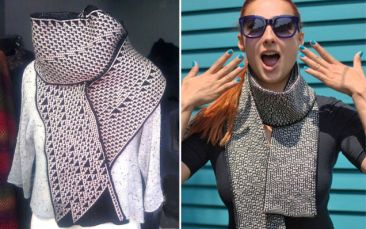
These Mathematical Scarves Are Designed By a Computer Algorithm | Gizmodo It’s still summer, but these mathematical merino scarves designed with a computer algorithm are getting us in the mood for colder temps. They’re called KnitYak: black-and-white merino scarves that each have a snowflake-unique design that’s generated by a computer algorithm.
A Paper-Thin Solar Panel Can Charge Your Phone on the Go | Lifehacker
Solar panels keep getting lighter and tinier—good news for rugged on-the-go types who can charge their devices on the trail with sun-fueled chargers. And this particular solar charger on Kickstarter is so thin, you can slip it in your Lonely Planet while it feeds your phone battery.
Disney’s $1 Billion Bet on a Magical Wristband | WIRED
The MagicBands look like simple, stylish rubber wristbands offered in cheery shades of grey, blue, green, pink, yellow, orange and red. Inside each is an RFID chip and a radio like those in a 2.4-GHz cordless phone. The wristband has enough battery to last two years. It may look unpretentious, but the band connects you to a vast and powerful system of sensors within the park.
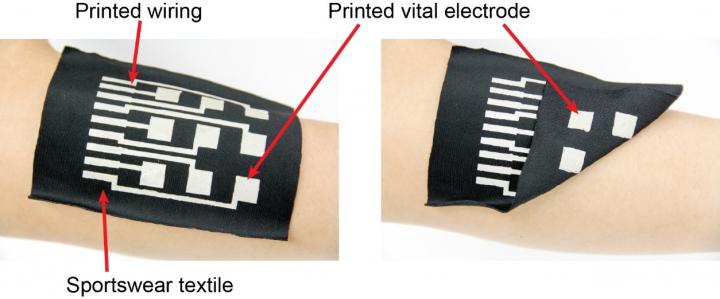
New Process Can Print Stretchy Electronics Onto Your Clothes | TechCrunch
Researchers at the University of Tokyo have created a single-step process to print conductive material on cloth, allowing manufacturers to build stretchable wearables that can test vital signs like heart rate and muscle contraction.
Google’s Project Jacquard Aims To Make “Activewear” A Reality | ReadWriteWeb
What’s really fascinating about Project Jacquard…the clothing itself ought to be an interactive thing. It ought to provide us an opportunity to interact with devices around us. That’s the breakthrough that Project Jacquard is really talking about—now, instead of just passive data collection, your clothing is an opportunity for you to interact with devices.
Sensory Fiction | Felix | VIMEO
Sensory fiction is about new ways of experiencing and creating stories. Traditionally, fiction creates and induces emotions and empathy through words and images. By using a combination of networked sensors and actuators, the Sensory Fiction author is provided with new means of conveying plot, mood, and emotion while still allowing space for the reader’s imagination.
How to Print a Super-Thin Touchscreen Display on Just About Anything | Gizmodo
[T]his award-winning paper is perhaps the coolest we’ve seen: It lays out a new technique for printing cheap, simple touchscreen displays with conventional printers. It’s called PrintScreen, and it’s a system that allows the user to print on nearly a
ny material.
From The Designers Of Fitbit, A Digital Tattoo Implanted Under Your Skin | Co.Design
We asked NewDealDesign, the design consultancy behind projects like the Fitbit line of activity trackers, and Google’s modular Project Ara smartphone, what things might look like when technology and fashion reach beyond the wrist. In response, they created Project Underskin. It’s a concept for a smart digital tattoo which would be implanted in your hand and interact with everything you touch. It can unlock your front door, trade data with a handshake, or even tell you if you have low blood sugar.
Super-interesting! If you are a fan of coding camps and makerspaces this would be a good article to read to get an idea of what’s on the horizon in gaming development, gaming innovations and interactive/social gaming.
DFRobot, a company that has been building robots for the education market since 2008, this week introduced its first attempt at making a robot accessible to all children, with the debut of Vortex – an interactive, programmable robot aimed at kids 6 and up. The Vortex robot pairs with iOS and Android smartphones or tablets over Bluetooth, and lets kids control its movement by tapping the screen in the Vortex app to initiate commands. It also comes four free, pre-programmed games – “bumping fight,” “virtual golf,” “driving,” and “robot soccer,” which can later be customized by the child to create their own play experience. READ MORE: Vortex Is A Toy Robot That Teaches Kids How To Code | TechCrunch.
To anyone who was paying attention to video games in the mid-’90s, the term “FMV game” probably still inspires snorts of derision. The handful of titles that shoehorned simple gameplay on top of highly compressed full-motion video (FMV) usually suffered from low-quality sound and images, poor production values, limited interaction options, and ponderous repetition of a few short video clips through multiple plays. The results ranged from mediocre at the high end to some of the worst games ever made at the low end. By the end of the ’90s, filmed, live-action video clips gave way to polygons and animated, pre-rendered sprites as the gameplay and story-telling engine of choice.
But just as failed ’90s experiments in virtual reality are leading to a resurgence in the form today, the FMV gaming failures of decades past are finally being explored with the technology and game-design advancements of today. Her Story is proof that FMV games don’t have to be awful and that filming actors on a set could be a criminally underexplored form for interactive storytelling. READ MORE: Her Story is a compelling new type of interactive storytelling | Ars Technica.


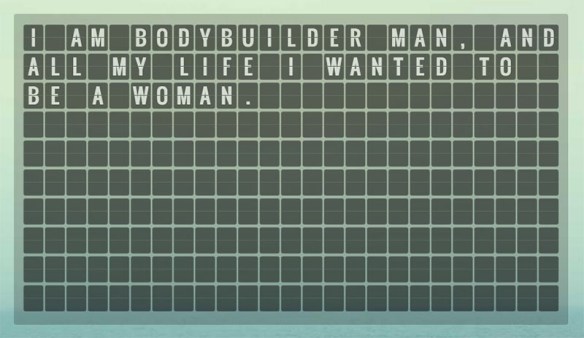 British people’s secret confessions are being displayed in a train station | Mashable



 ve seen: It lays out a new technique for printing cheap, simple touchscreen displays with conventional printers. It’s called PrintScreen, and it’s a system that allows the user to print on nearly a
 infophile