
The Story Behind The Web’s Weirdest, Hardest Riddle | Co.Labs


The Story Behind The Webs Weirdest, Hardest Riddle ⚙ Co.Labs ⚙ code + community

In 2004 a small website appeared that contained a browser-based game called Notpron, which has since been hailed as “the hardest riddle on the Internet.” It consists of a series of 140 puzzles and riddles that get progressively more complex. Completing the game requires knowledge in a diverse range of fields including HTML programming, sound and graphics editing, music apprehension, research skills, and even remote viewing.

Out of the 17 million players that have attempted the game in the last decade only 31 have completed it. That’s just one in every 550,000 players–or, to put it another way, the chances you’ll be hit by lightning once in your lifetime are 41 times greater than they are for you solving Notpron.

To celebrate the games 10th anniversary I asked David Münnich, Notpron’s creator, to go down the rabbit hole of how and why it was created–and what it all means.

READ MORE: The Story Behind The Webs Weirdest, Hardest Riddle ⚙ Co.Labs ⚙ code + community.

The 21 Coolest Internet Of Things Gadgets | Bernard Marr


Readers of new book The Endgame trilogy by James Frey can win $1.8m in gold coins | Mail Online


After looking for £500 gold bars on a Kent beach now comes the real treasure hunt: Readers of new book trilogy can win $1.8m in gold coins

  • Trilogy of books give away $1.8m: $500,000 in gold coins in the first book, $1m in the second and $1.5m for the third
  • Author James Frey was inspired by Kit Williamss 1979 book Masquerade
  • Publishing rights have been sold to 27 countries and there will be 3 films

READ MORE: Readers of new book The Endgame trilogy by James Frey can win $1.8m in gold coins | Mail Online.

AI, Robotics, and the Future of Jobs | Pew Research Centers Internet & American Life Project


The vast majority of respondents to the 2014 Future of the Internet canvassing anticipate that robotics and artificial intelligence will permeate wide segments of daily life by 2025, with huge implications for a range of industries such as health care, transport and logistics, customer service, and home maintenance. But even as they are largely consistent in their predictions for the evolution of technology itself, they are deeply divided on how advances in AI and robotics will impact the economic and employment picture over the next decade.

READ MORE: AI, Robotics, and the Future of Jobs | Pew Research Centers Internet & American Life Project.

Access My Info Tool Lets Telecom Subscribers Know If Theyve Been Spied On | HuffPo


Canadians concerned about their online privacy have a new way to find out whether their telecom provider is collecting information about them — and sharing it with third parties like government entities.

The new tool, developed by some of the countrys top privacy experts, makes it easier for Canadians to force their provider to disclose their practices.

“What were trying to do as researchers is identify what kind of data telecommunications companies in Canada collect, obtain, and process, and disclose to third parties,” said Dr. Christopher Parsons, a fellow at the Munk School of Global Affairs Citizen Lab.

“But we also wanted to make it easier for Canadians individually to engage in the same sort of action.”

Known as “Access My Info,” the web tool helps create a formal letter which, under Canadian privacy law, telecom companies are legally obliged to respond to within 30 days, the website offering the tool says.

Canadians requesting the information fill out a few basic details about themselves and their telecom provider, and can do so confidentially, the website says.

Read More: Access My Info Tool Lets Telecom Subscribers Know If Theyve Been Spied On | HuffPo

The Most Important Insights From Mary Meeker’s 2014 Internet Trends Report | TechCrunch


A must-read that’s chock full of critical knowledge. Kleiner Perkins partner Mary Meeker’s data dumps have become a highly anticipated event in the tech industry, as her research helps everyone else level up.

The only problem is that the 2014 Internet Trends report is 164 slides of dense data, so we’ve broken it down into a digestible summary of the most important facts, including a look at whether we’re in a bubble.

READ: The Most Important Insights From Mary Meeker’s 2014 Internet Trends Report | TechCrunch.

Link to the PDF of the presentation.

$1 Million in 1 Day: Reading Rainbow Kickstarter Earns Pot of Gold | Mashable


You did it, Internet readers. In just half a day, LeVar Burton’s Reading Rainbow campaign to raise $1 million on crowdfunding website Kickstarter has reached its seven-figure goal.

The money from nearly 23,000 donors will be used to bring Burton’s cult TV classic to a new generation of readers by building a web version for families at home, creating a classroom version for teachers and providing free access to it for schools in need.

The online campaign, fueled by buzz generated on social media, surpassed $1 million shortly before 8 p.m. ET on Wednesday. Burton, the creator and host of PBS’ series Reading Rainbow from 1983 to 2006, launched the Kickstarter project earlier in the day.

Read More: $1 Million in 1 Day: Reading Rainbow Kickstarter Earns Pot of Gold | Mashable

And The Winner Of TechCrunch Disrupt NY 2014 Is… Vurb | TechCrunch


And The Winner Of TechCrunch Disrupt NY 2014 Is… Vurb | TechCrunch

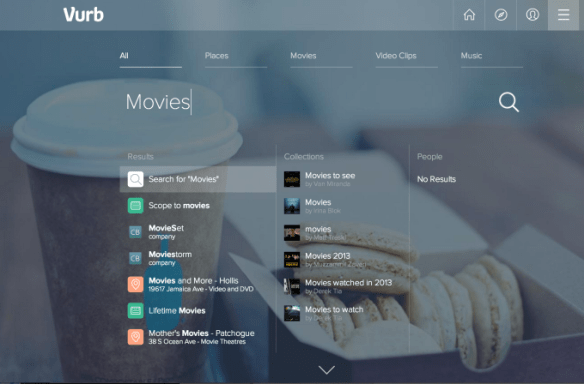
Vurb is a web and mobile contextual search engine. When you type a query in Vurb, you get everything you need without having to leave the search engine. The company is rolling out search for Places, Movies, and Media. It will soon launch search for add People, Startups, and others. For example, if you search for a film, you get a trailer, showtimes, reviews, a link to watch the movie on Netflix, the IMDb score and more.

Read More: And The Winner Of TechCrunch Disrupt NY 2014 Is… Vurb | TechCrunch.

See also: Vurb’s Contextual Search Engine Blows Away Those Stupid Lists Of Links | TechCrunch


For the First Time Ever, Explore Angkor Wat With Google Street View | Travel | Smithsonian


[T]hose interested in exploring the wonder of Angkor don’t need to make a trek to Southeast Asia—and risk contributing to the damage of the site—to enjoy what the ruins have to offer. For the first time ever, Google Maps is granting users an up-close view of Angkor, through Google’s Street View project.

The move is an extension of Google Maps’ mission to make sure that its maps are the most accurate, comprehensive and useful available to users. While to most people, this might materialize in the form of directions—using Google Maps to get you from Point A to Point B— the company doesn’t see this as the limit for the product’s technology.

“Increasingly, if you look at the amount of power we have in our cellphones, the ability for those phones to know your location and customize an experience around you, they are becoming fairly good at making sure that people are able to explore the world around them,” says Manik Gupta, Google Maps Product Manager. “We want to make sure that we have the ability to share all these places with users all over the world.”

Read more: For the First Time Ever, Explore Angkor Wat With Google Street View | Travel | Smithsonian.

The big steal: rise of the plagiarist in the digital age | The Guardian


Thanks to the internet, it has never been easier to steal other people’s work. There’s also a high risk you’ll be found out. So why do it? Rhodri Marsden goes in search of a little originality…via The big steal: rise of the plagiarist in the digital age | Technology | The Guardian.