Bosses May Use Social Media to Discriminate | WSJ.com


Many companies regularly look up job applicants online as part of the hiring process. A new study suggests they may also use what they find to discriminate.

The study, a Carnegie Mellon University experiment involving dummy résumés and social-media profiles, found that between 10% and a third of U.S. firms searched social networks for job applicants’ information early in the hiring process. In those cases, candidates whose public Facebook profiles indicated they were Muslim were less likely to be called for interviews than Christian applicants. The difference was particularly pronounced in parts of the country where more people identify themselves as conservative. In those places, Christian applicants got callbacks 17% of the time, compared with about 2% for Muslims.

The same experiment, conducted from February to July of this year, found that online disclosures about job candidates’ sexuality had no detectable impact on employers’ early interest.

The research is the latest example of how people’s digital trails can have far-reaching and unintended effects, particularly in the job market.

Read the rest of the story: Bosses May Use Social Media to Discriminate | WSJ.com.

Tech Trends 2013: Elements of post digital | Deloitte United States


Pew Social Media Study: 30% Of The U.S. Gets News Via Facebook; Reddit Has The Most News-Hungry Regular Users | TechCrunch


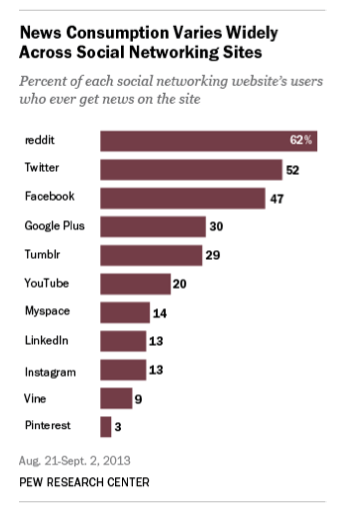
The Pew Research Center is today releasing comparative numbers looking at how U.S. adults use social networking sites to read news (a follow-on from earlier research focusing on two specific sites, Facebook and Twitter).

This is significant for a couple of reasons. Social media sites have become a key component of how many news organizations today are looking to reach consumers as old-media forms like printed editions continue to decline. In turn, social media sites are turning news a way of attracting more eyeballs to improve their own ad-based businesses. That is to say, news and social media are dancing partners that are still working out how to move in the same direction without stepping on each other’s feet, and this survey is one indicator of how well the public is receiving that.

Read more and see all the charts: Pew Social Media Study: 30% Of The U.S. Gets News Via Facebook; Reddit Has The Most News-Hungry Regular Users | TechCrunch.

Pew: News Consumption

The Secrets Of A Memorable Infographic | Co.Design


Human memory is very fallible, but lately cognitive scientists have found that our minds capture much more visual detail in a moment than once believed. A 2008 paper reported that people who saw thousands of images for three seconds each over five hours later identified ones they’d seen over similar alternatives with nearly 90% accuracy. They didn’t just remember that they’d seen a cracked egg, they remembered that its egg white had formed a perfectly round puddle.

In other words, when we do retrieve a memorable image, a surprising amount of information comes with it, like a burr stuck to a sweater. That insight could have big implications for people who use visualizations in their everyday lives–graphic designers, for instance, or anyone on Tumblr. Above all, it suggests that memorability alone might enhance an infographic’s effectiveness. But it also prompts a question: How does an image become memorable in the first place?

Read: The Secrets Of A Memorable Infographic | Co.Design | business + design.

Four Great Reports for Tracking Technology Trends | Ellyssa Kroski | OEDB.org


It’s not enough anymore for libraries to adopt new technologies and practices once they’ve been out for several years. It’s vital nowadays to know what’s on the horizon so that you can plan for it in your library including training staff, building related applications, and offering new services. One of the best ways to keep up with developments in the library, information, and technology fields is to follow and read trend reports.  

Read: Four Great Reports for Tracking Technology Trends | Ellyssa Kroski | OEDB.org.

Recent Research Studies Links


Study: 38 Percent of Toddlers Have Used a Mobile Device | PCMag
According to a recent Common Sense Media research study, 38 percent of kids under two years old have used a mobile device — with a watchful eye from their parents, surely. In 2011, that number reached only 10 percent.

Pediatricians: Limit kids’ media use to 2 hours a day | CNET
American Academy of Pediatrics also tells parents to discourage any screen time for children 2 and younger and keep Internet-connected devices out of kids’ bedrooms.

Report: Piracy Isn’t Killing Content | Gizmodo
Contrary to what the popular press might have us believe, piracy isn’t killing content. At least, that’s what a team of scholars from the London School of Economics has found after conducting a deep analysis of the situation.

Deloitte Survey Finds 18% of U.S. College Students Own Tablets, 14% Own E-Readers | InfoDocket

Online Dating [Infographic], Online Dating & Relationships Report | Pew Research Center; How I Hacked Online Dating | Amy Webb | TED


Online Dating & Relationships | Pew Research Center

Overview
One in ten Americans have used an online dating site or mobile dating app; 66% of these online daters have gone on a date with someone they met through a dating site or app, and 23% have met a spouse or long term partner through these sites. Public attitudes toward online dating have become more positive in recent years, but many users also report negative experiences.

These are among the results of a national survey of dating and relationships in the digital era, the first dedicated study of this subject by the Pew Research Center’s Internet Project since 2005. Key findings include:

  • 11% of internet users (representing 9% of all American adults) say that they have personally used an online dating site. As recently as 2008, just 3% of American adults had used online dating sites.
  • 7% of cell phone apps users (representing 3% of all American adults) say that they have used a dating app on their cell phone.

Taken together, 11% of all American adults are “online daters”—meaning they have used a dating site or mobile dating app. Online dating is especially common among the college-educated and those in their mid-20’s through mid-40’s, and 38% of Americans who are currently single and actively looking for a partner have used online dating at one point or another. See the online report or download the pdf.

Amy Webb: How I hacked online dating | TED.com
Amy Webb was having no luck with online dating. The dates she liked didn’t write her back, and her own profile attracted crickets (and worse). So, as any fan of data would do: she started making a spreadsheet. Hear the story of how she went on to hack her online dating life — with frustrating, funny and life-changing results.

Online Dating [Infographic] | Pew Research Center’s Internet & American Life Project

Dating Digitally: Pew

You may also like:

Tablet and E-reader Ownership Update | Pew Research Center


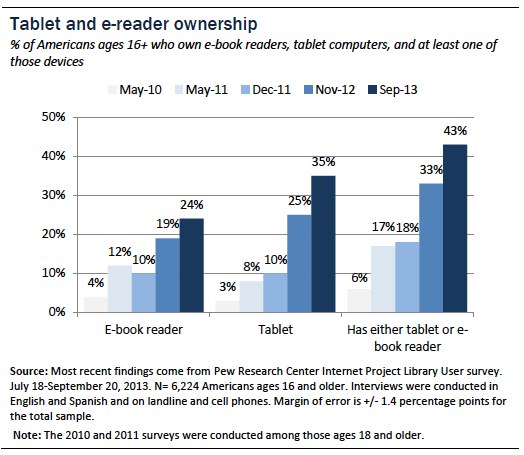
The number of Americans ages 16 and older who own tablet computers has grown to 35%, and the share who have e-reading devices like Kindles and Nooks has grown to 24%. Overall, the number of people who have a tablet or an e-book reader among those 16 and older now stands at 43%.

Up from 25% last year, more than half of those in households earning $75,000 or more now have tablets. Up from 19% last year, 38% of those in upper-income households now have e-readers.

Tablet and E-reader Ownership Update | Pew Research Center's Internet & American Life Project

Read the full report or download the pdf.

via Tablet and E-reader Ownership Update | Pew Research Center’s Internet & American Life Project.

The 15 Countries Where The Most Young People Are Online | Co.Exist


Full Article

What did children do before computers? If the future goes the way of babies with iPads, it’s a question we might be asking ourselves soon. But if you’re between 15 and 24 years old and live in the United States, there’s already a good chance you grew up playing around with MS Paint. According to a new report out from the UN’s International Telecommunication Union (ITU), growing up with the Internet qualifies you as a “digital native,” and some countries have a far higher proportion of them than others.

The results, however, might surprise you.
The 15 Countries Where The Most Young People Are Online | Co.Exist | ideas + impactSource: ITU

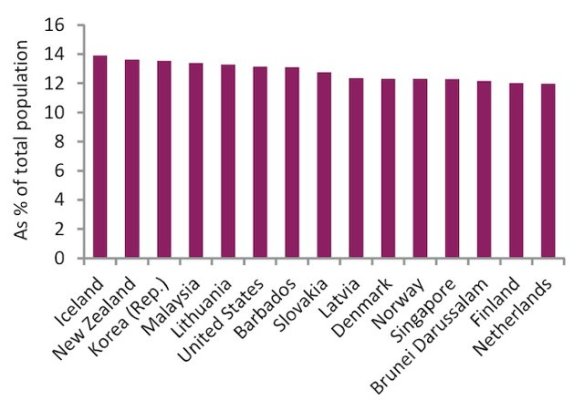
Out of a global population of 7 billion, 363 million of us have grown up “surrounded by and using tools and toys of the digital age.” China and India boast the largest number of these people, but digital natives only make up a relative minority of their respective populations. When it comes to countries with the highest percentages of digital natives, the United States actually comes in sixth place, below Lithuania and Malaysia.

Iceland, however, ranks number one in digital native penetration, with 14% of the Icelandic population having grown up on computers. That makes sense, given that Iceland has the highest percentage of young people in Europe (and a small population). New Zealand makes number two on the list for the same reason. South Korea, meanwhile, ranks third largely because of high Internet use among all youth and its government’s aggressive investment in educational technology: By 2015, all Korean schools will provide cloud-based learning services to students.

Malaysia comes in fourth place on the list, and for striking reasons. Unlike Iceland or New Zealand, Malaysia doesn’t have a particularly high concentration of 15-to-24 year-olds. But like South Korea, the young people who do live in Malaysia have spent more time with the Internet: By 2012, 74.4% of youths had at least five years of Internet experience under their belts. Much of that, explains the report, can be attributed to the fact that the Malaysia has brought so many of its schools online, and by 2000 had already stocked 31% of its primary schools and 54% of its secondary schools with computer facilities.
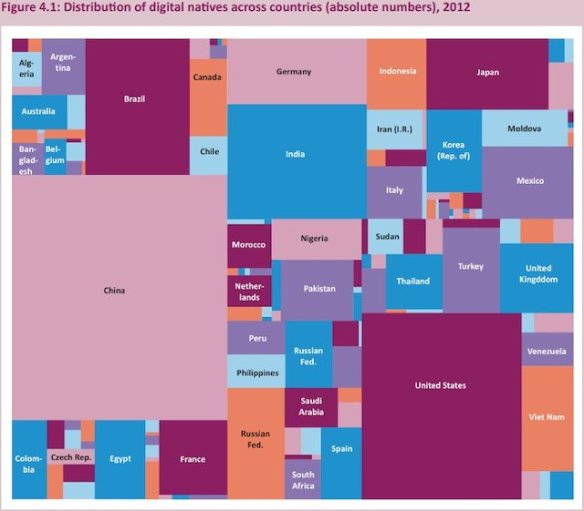
The 15 Countries Where The Most Young People Are Online | Co.Exist | ideas + impactAbsolute numbers of digital natives by country. Source: ITU

Starting in January of this year, Malaysian 21-to-30-year-olds have been able to score $65 rebates on certain smartphones, courtesy of government subsidies. The country’s National Broadband Initiative has set about dramatically lowering costs of accessing the Internet, including launching the 1 Million Netbooks program, which distributes netbooks to low-income families.

The report notes that proportions of digital natives largely stick to levels of economic development. In high-income, developed countries, digital natives with five years of Internet experience or more make up 86% of young Internet users, while in the developing world, digital natives only count as 47% of young Internet users. The global average comes to slightly more: Digital natives make up 56% of all young Internet users–more than 362 million people worldwide.

via The 15 Countries Where The Most Young People Are Online | Co.Exist | ideas + impact.

Why Women Leave Tech Companies, And What To Do About It | Co.Exist


[T]oday, women still leave tech companies at double the rate of men. Even the women who make it past all the hurdles of being a female in the field–the lack of role models, sexism, and so on–don’t stay very long.

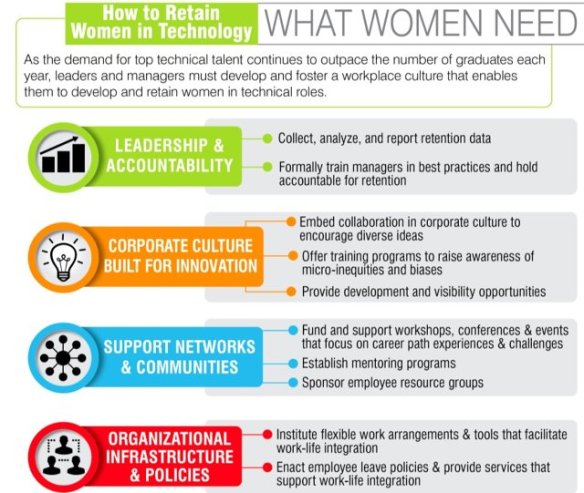
Women Technologists Count, a new report from the Anita Borg Institute (ABI), examines the reasons why women in mid-level roles tend to leave technical career paths to become managers–or decide to leave the industry altogether. ABI offers up pages upon pages of recommendations on how to keep women in technology, but they boil it down to this:

Why Women Leave Tech Companies, And What To Do About It | Co.Exist | ideas + impact

Read the full story: Why Women Leave Tech Companies, And What To Do About It | Co.Exist | ideas + impact.