
You’ve heard it all your life: Being humble, kind, and calm is the “right thing to do.” But if that isn’t enough to convince you, consider this: humility, kindness, and calmness can actually help you get ahead in life. Read more: How Being Humble, Kind, and Calm Will Make Your Life Easier | LifeHacker
Author Archives: infophile
Papyrus Mentioning Jesus’s Wife Is Likely Ancient and Not Fake, Scientists Say | Mashable
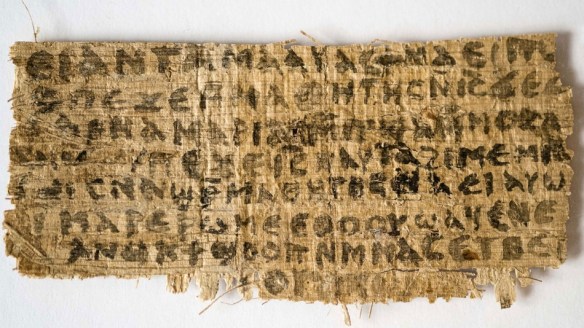
A papyrus fragment that mentions Jesus’s wife is likely ancient, probably dating between the sixth and ninth century, latest research shows.
When Karen L. King, the Hollis Professor of Divinity at Harvard Divinity School, announced the fragment’s existence in September 2012, there was a widespread debate over its authenticity. The fragment, known as the “Gospel of Jesus’s Wife,” probably originated from Egypt. It’s written in Coptic and contains the phrase “Jesus said to them, ‘my wife…,'” never before seen in any ancient text. It also mentions Jesus’s mother and a female disciple, who may be identified as “Mary.”
Now, James Yardley, senior research scientist in the Center for Integrated Science and Engineering at Columbia University, and Alexis Hagadorn, head of conservation at Columbia, used a technique called micro-Raman spectroscopy to determine the papyrus fragment’s age. Furthermore, Malcolm Choat from Macquarie University examined the fragment’s handwriting. Combined, their findings indicate that the papyrus and the ink on it are ancient and not a modern forgery. Read more: Papyrus Mentioning Jesus’s Wife Is Likely Ancient and Not Fake, Scientists Say | Mashable.
A Pyramid in the Middle of Nowhere Built To Track the End of the World | Gizmodo
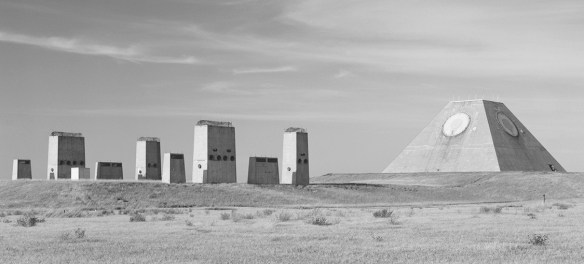
A huge pyramid in the middle of nowhere tracking the end of the world on radar, just an abstract geometric shape beneath the sky without a human being in sight: it could be the opening scene of an apocalyptic science fiction film, but it’s just the U.S. military going about its business, building vast and other-worldly architectural structures that the civilian world only rarely sees.
The Library of Congress has an extraordinary set of images documenting the Stanley R. Mickelsen Safeguard Complex in Cavalier County, North Dakota, showing it in various states of construction and completion. And the photos are awesome. Read more: A Pyramid in the Middle of Nowhere Built To Track the End of the World | Gizmodo
The Untold History of Where Barcodes Come From | Gizmodo
NASA’s About To Release a Mother Lode of Free Software | Gizmodo
If you’ve been thinking about getting started on the rocket project that’s been on your mind for ages, now is a good time to get serious. Next week, NASA will release a massive software catalog with over 1,000 projects. It’s not the first time the space agency’s released code, but it is the first time they’ve made it so easy.
The breadth and variety of the software projects that NASA’s about to give away are difficult to express. It’s not just a bunch of algorithms and star-finding software, though stuff like that is in there. The crazy geniuses that land rovers on Mars are actually releasing code for ultra high-tech NASA stuff like rocket guidance systems and robotics control software. There’s even some artificial intelligence.
And did I mention it’s all free? Read more: NASA’s About To Release a Mother Lode of Free Software | Gizmodo.
See also: NASA Technology Transfer Portal
Handsome Paper Notebooks Come With Digital Backup | Co.Design

“Sync” is a bit of a stretch to describe what Mod truly offers, which is a pre-paid, mail-in scanning service for its notebooks. For $25, you get a blank book (designed to be exactly the same size as an iPad Mini) and a Netflix-like pre-paid envelope. When you’ve filled up the notebook, you mail it back to Mod. They scan all the pages, and within five days all the content is replicated digitally in your Mod account. (You can have the notebook returned to you, but that costs extra; by default, the paper book will be destroyed by the scanning process and recycled.)
Read more: Handsome Paper Notebooks Come With Digital Backup | Co.Design
‘Mind-reading’ technology can reconstruct faces from the viewer’s brain | CNET
Researchers at Yale have developed a method of reconstructing faces locked in the memories of other people. Read more: ‘Mind-reading’ technology can reconstruct faces from the viewer’s brain | CNET.
Dolphin translator chirps out first word | CNET
Scientists working on a two-way dolphin communicator have made a breakthrough — their device may have translated a single whistle in real time. Read more: Dolphin translator chirps out first word | CNET.
Microsoft Will Soon Bring Back The Start Menu In Windows 8.1 | TechCrunch
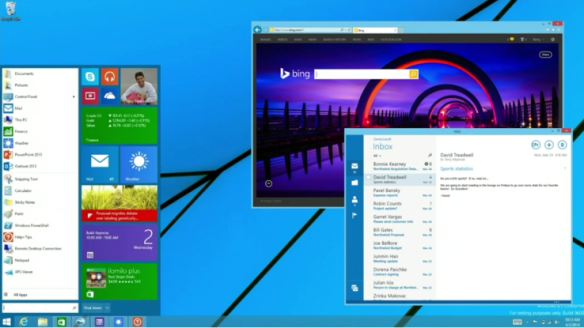
Microsoft’s Terry Myerson today announced that Microsoft is “all-in” with the desktop. Indeed, while he wasn’t quite ready to announce Windows 9, he did show off how Windows 8.1 will soon get a new version of the beloved Start menu back.
When Microsoft removed the Start menu, quite a few of its users were upset, and this move did indeed make Windows 8.1 harder to use for many. The new Start menu will combine live tiles and other Metro-influenced UI elements, as well as most of the features still available in the Windows 7 menu.
In the future, all of Microsoft’s Universal Windows apps will also run in a window. That sounds like the company is backing off a bit from its Metro interface on the desktop.
It’s unclear when exactly Microsoft will launch these features, though. As far as we are aware, it will take another update to Windows 8.1 and it’s unclear when exactly this will happen. Read more: Microsoft Will Soon Bring Back The Start Menu In Windows 8.1 | TechCrunch.
This is great news! I provide volunteer computer coaching at my community library and I groan every time a patron comes in for help with Windows 8 (which is often!). The interface is problematic, so bringing back the start button (and hopefully making the metro interface optional) is a very welcome improvement.
For the First Time Ever, Explore Angkor Wat With Google Street View | Travel | Smithsonian

[T]hose interested in exploring the wonder of Angkor don’t need to make a trek to Southeast Asia—and risk contributing to the damage of the site—to enjoy what the ruins have to offer. For the first time ever, Google Maps is granting users an up-close view of Angkor, through Google’s Street View project.
The move is an extension of Google Maps’ mission to make sure that its maps are the most accurate, comprehensive and useful available to users. While to most people, this might materialize in the form of directions—using Google Maps to get you from Point A to Point B— the company doesn’t see this as the limit for the product’s technology.
“Increasingly, if you look at the amount of power we have in our cellphones, the ability for those phones to know your location and customize an experience around you, they are becoming fairly good at making sure that people are able to explore the world around them,” says Manik Gupta, Google Maps Product Manager. “We want to make sure that we have the ability to share all these places with users all over the world.”
Read more: For the First Time Ever, Explore Angkor Wat With Google Street View | Travel | Smithsonian.
 infophile