Feast Your Eyes on This Beautiful Linguistic Family Tree | Mental Floss #languages #linguistics


When linguists talk about the historical relationship between languages, they use a tree metaphor. An ancient source (say, Indo-European) has various branches (e.g., Romance, Germanic), which themselves have branches (West Germanic, North Germanic), which feed into specific languages (Swedish, Danish, Norwegian). Lessons on language families are often illustrated with a simple tree diagram that has all the information but lacks imagination. There’s no reason linguistics has to be so visually uninspiring. Minna Sundberg, creator of the webcomic Stand Still. Stay Silent, a story set in a lushly imagined post-apocalyptic Nordic world, has drawn the antidote to the boring linguistic tree diagram.

READ MORE: Feast Your Eyes on This Beautiful Linguistic Family Tree | Mental Floss.

Is It Really Possible to Learn to Speed Read? | Gizmodo #reading


Ninety-five percent of college educated individuals read at a rate between 200-400 words per minute according to extensive research done by University of Massachusetts Amherst professor Dr. Keith Rayner. However, there exists a small, but rather vocal subset of people who insist that they can read several times faster than this using various speed reading techniques.

With very little searching, you’ll also find many-a-company claiming that after going through their program or using their app regularly, you can easily read even as many as 1,000 words per minute. Tim Ferriss of Four Hour Work Week fame offers a method for increasing speed in reading for free on his website, claiming with this method, you’ll see an average increase in reading speed of about 386% in just three hours of practice.

So is any of this really possible? READ MORE: Is It Really Possible to Learn to Speed Read? | Gizmodo

The Future Of #Museums Is Reaching Way Beyond Their Walls | Co.Exist #AMNH


The American Museum of Natural History has always been one of the most popular destinations in New York City. With about 5 million visitors a year, an increase from 3 million in the 1990s, it—along with the nearby Metropolitan Museum of Art—is among the top 10 most-visited museums in the world.

Even with this influx of people coming to its doorstep, however, the museum is now equally focused on drawing a crowd beyond its campus.

“In the old days, a visit to a museum like ours would be a one-off. You come, you visit you go home,” says Futter. “Now people have a relationships with us very often before they get here. They come, and [their visit] is like a giant exclamation point—and then they return home and continue to engage with us wherever they are.”

AMNH today is a sprawling outreach institution that is using apps, social media, and educational programs to slowly grow its reach. READ MORE: The Future Of Museums Is Reaching Way Beyond Their Walls | Co.Exist | ideas + impact.

This Little Robot Wants to Be Your Best Friend [Indiegogo] | WIRED #robots #AI #gadgets


WE’VE LONG KNOWN there’s a market out there for robotic buddies. One compelling piece of evidence: The original Furby sold more than 40 million units, and it didn’t really do anything.

17 years later, an A.I. and machine-learning company is making a robot pal that will do way more than its fuzzy predecessor. It’s called Musio, and it houses a pretty impressive A.I. engine developed by a company called AKA.

The robot remembers details from prior conversations, asks follow-up questions based on that info, and can be used as a smart-home controller. But its main goal is to be your friend: Asking you questions, actually listening to your answers, and learning what you’re all about

READ MORE: This Little Robot Wants to Be Your Best Friend | WIRED

How Google Designed An E-Book Font For Any Screen | Co.Design #fonts #typography


In January of 2014, a Pew study showed that nearly a third of American adults had read an e-book in the last year, and 50% of adults owned some kind of tablet or e-reading device. Many of these readers are using the wide variety of Android devices on the market, which can present a problem for those trying to create a standardized experience for e-book readers. Google faced this challenge while designing their new font, Literata, which will replace Droid Serif on Google Play Books. READ MORE: How Google Designed An E-Book Font For Any Screen | Co.Design | business + design.

STEM Curriculum Turned Into An Addictive [iOS] Game | Co.Design #STEM #apps


Levers, pulleys, and wheels—they’re tools that outline some of the most foundational principles in physics. But foundational principles are boring. What’s fun is using a lever to catapult a boulder at a castle, breaking down the bricks one by one to discover a dragon sleeping inside.

That is the premise of Simple Machines, the latest iOS app by the educational game studio Tinybop. In the past, Tinybop has made interactive books on the human body and plant life. They’ve created a fun simulator for kids to build their own robots. But with Simple Machines, they’re taking aim at a very particular part of student curriculum: The first stages of STEM (science, technology, engineering, and math), in which kids commonly learn about six “simple machines”—the lever, pulley, wheel, wedge, inclined plane, and screw.

READ MORE: STEM Curriculum Turned Into An Addictive Game | Co.Design | business + design.

8 STEM Toys for Pint-Sized Einsteins | Mashable #kids #STEM #toys #play


Often times, parents want the toys their children play with to teach STEM skills — recently updated to STREAM, or Science, Technology, Reading, Engineering, Arts and Math.

At the 2015 International American Toy Fair, there was a bevy of toys that were anything but mindless. Better yet, they’re made to get kids interested in one of these educational topics — without slathering on the “learning” part so they will be disinterested.

Here are some of our favorites that will keep kids learning beyond the classroom.

READ MORE: 8 STEM toys for pint-sized Einsteins | Mashable

Learn to Avoid the Most Common Design Mistakes with This Free Course | LifeHacker


Beginning designers tend to make the same common mistakes. Design Pitfalls is a free course delivered weekly to your email inbox that will teach you how to avoid them.

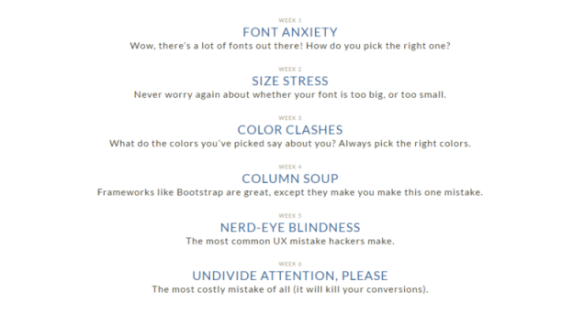
The course comes from Design for Hackers author and professor David Kadavy. If you sign up, every Tuesday for 6 weeks, you’ll learn about a new pitfall and the tips to prevent it. Here’s what the email course will cover:

Avoid the top mistakes beginning designers make, Kadavy says, and you’ll quickly be doing at least halfway-decent design.

Sign up for the course below or read more about it here. Hurry, though. Class starts May 26th and signup ends on midnight (GMT) May 22nd.

via Learn to Avoid the Most Common Design Mistakes with This Free Course | LifeHacker

Learn SQL with Khan Academy’s New Interactive Course | LifeHacker #sql @khanacademy


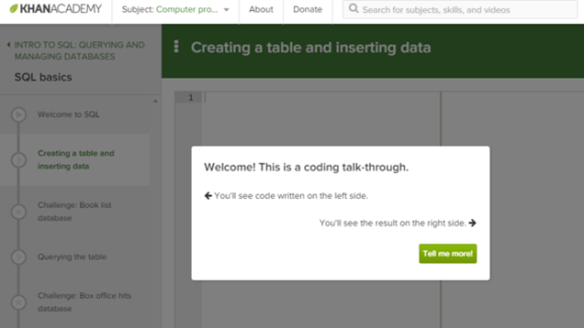
SQL, the popular programming language used to manage data in a relational database, is used in a ton of apps. Khan Academy’s introductory course to SQL will get you started writing SQL in an interactive editor.

READ MORE: Learn SQL with Khan Academy’s New Interactive Course | LifeHacker

Must Read: New ‘Walk-In Comic Book’ Uses Augmented Reality to Show Sexual Assault Survivors as Heroes | Mashable #genderequality #comics #augmentedreality


Watch the video!!

//players.brightcove.net/1130468786001/82aa0c71-8d04-464e-a66f-d6f007663844_default/index.html?videoId=4224007635001

When a young woman in New Delhi, India, was brutally gang-raped on a bus in December 2012, making international headlines, Ram Devineni wasn’t going to stay silent. The filmmaker and artist marched in the streets alongside other protesters, calling for swift justice and systemic change to the all-too-common violence against women that plagues the country.

When he asked a Delhi police officer what he thought about the young woman’s assault, the officer told him, “No good girl walks home alone at night,” implying that she either provoked the rape or, worse, deserved it. His words reflected the misguided, patriarchal view that permeates much of Indian society, silencing women even further with social stigma.

“I realized at that moment that this was not a legal issue, but a cultural problem,” Devineni tells Mashable. “As a filmmaker and as an artist, I wanted to really address this in a cultural context.”

That’s why, two years later, he created and directed the transmedia comic book Priya’s Shakti — a story about the titular Priya, a gang-rape survivor-turned-superhero who partners with a Hindu goddess to fight sexual violence and challenge the patriarchy.

Co-written by Vikas K. Menon with artwork by Dan Goldman, the comic book is the first of its kind to use augmented reality and image recognition, using various media to tell the story of fighting back against sexual assault.

READ MORE: New ‘walk-in comic book’ uses augmented reality to show sexual assault survivors as heroes | Mashable