The Beginner’s Guide to SoundCloud | Mashable


Read: The Beginner’s Guide to SoundCloud | Mashable

You may also like:


Bill Gates Unveiled Windows 30 Years Ago | Gizmodo


No matter what you think of Windows 8, it’s certain that Windows is both iconic and significant in the evolution of personal computing. It’s a series of operating systems, of course, but it’s also been a concept, a way of thinking, an influencer, and a touchstone for 30 years since Bill Gates introduced it on November 10, 1983.

The “Interface Manager” that would become Windows went into development in 1981 and finally had its public release as Windows 1.0 in November 1985. This first stab wasn’t actually a full OS, but more of a “graphical shell” that extended MS-DOS to have a user interface, as it is known today.

But Windows 1.0 had many defining OS features, like a calendar, clock, Microsoft Paint, a text editor, terminal, and clipboard. Windows allowed users to view multiple program windows at once, yup, though they couldn’t overlap at all. The early days of tiles! And 1.0 enabled data transfer between programs. Plus, it came with drivers for things like keyboards and the Microsoft Mouse, which had debuted earlier in 1983.

30 years seems simultaneously like an incredibly long time and a quick blur when you consider how Windows has evolved and spread to dominate between 80% and 90% OS marketshare. Windows 8 made it clear that Microsoft views interactive touch integration as crucial to a PC operating system going forward into the fourth Windows decade. Too bad hyper Ballmer ads won’t be the face of the next era.

Bill Gates Unveiled Windows 30 Years Ago Today | Gizmodo.

Have Your Mac Read A Book To You In Mavericks And iBooks [OS X Tips] | Cult of Mac


Full Post

Have Your Mac Read A Book To You In Mavericks And iBooks [OS X Tips] | Cult of Mac

For those of you who might want to listen to a book via iBooks, one option is to load an iBook on your iPhone or iPad and turn on VoiceOver.

That can change the way your iOS device works, though, so it can be tricky to the uninitiated.

Now that iBooks is on Mavericks, however, you have another option: get your Mac to read your iBook to you.

If you’ve upgraded to Mavericks (and you should, it’s free and optimized for older machines), you have a copy of iBooks on your Mac. Launch it with a double click to the iBooks icon in the Dock or the Applications folder, and then double click one of your iBooks to open it.

Click your mouse in front of where you’d like your MAc to start reading to you, and then head up to the Edit menu. Select the Speech option in the menu, and then choose “Start Speaking.” Your Mac will read to you in the voice that’s chosen in the System Preferences Dictation & Speech preference pane.

Your Mac will keep reading the book until you choose Stop Speaking in the same Edit > Speech menu, though it won’t turn pages when it gets to a new page. If you want to follow along while it reads (a great option for folks with print or other reading disabilities), you’ll need to click the arrow keys or swipe along your trackpad as you go.

If you just want to have your Mac read a selection of text to you, simply click and drag to highlight that section, and then choose Start Speaking from the Edit menu, or right-click and choose Start Speaking from the More option in the contextual menu.

via Have Your Mac Read A Book To You In Mavericks And iBooks [OS X Tips] | Cult of Mac.

The Internet Of Things Will Be Huge—Just Not As Huge As The Hype | ReadWrite


The Internet of Things promises to bring a new level of convenience to our lives. Could it bring trillions of dollars worth of convenience? Not likely, but that’s not stopping a lot of prognosticators out there.

The level of hype around the financial promise of the Internet of Things is truly gargantuan. A May 2013 report from the McKinsey Institute suggests that connecting billions of ordinary devices to the Internet will add between $2.7 trillion and $6.2 trillion a year to the global economy by 2025.

Cisco, which has a big stake in the hardware infrastructure for a thriving Internet of Things, estimates that what it calls “the Internet of Everything” will boost global output by $14.4 trillion over 9 years, or a comparatively sane $1.6 trillion a year. General Electric, by contrast, goes even bigger than McKinsey, and estimates that the “Industrial Internet” will boost global GDP by $15.3 trillion in 2030.

So where is all this money going to come from? Will all the little robots and sensors that will fill our lives with automated goodness also spit out gold coins? Not quite. But the Internet of Things is still going to add a lot of economic value. Even if actual gains only amount to a tenth of the hype, the potential boost to the economy—and human wellbeing in general—will be very significant.

Read the rest of the story: The Internet Of Things Will Be Huge—Just Not As Huge As The Hype | ReadWrite.

News: Education & Technology, Librarianship


Education & Technology

Xbox One News: Xbox One’s DRM policy reversal: an oral history | Engadget and Xbox One won’t play 3D Blu-rays — for now | CNET

Intel Has Acquired Kno, Will Push Further Into The Education Content Market With Interactive Textbooks | TechCrunch
We had a tip about, and have now confirmed, Intel’s latest acquisition: Kno, the education startup that started life as a hardware business and later pivoted into software – specifically via apps that let students read interactive versions of digitized textbooks.

Librarianship

Study: What You Would Be Doing If You Spent Less Time Online | The Atlantic


Most of us have heard our parents or grandparents complain that the digital age has corrupted the youth and taken them away from doing “better things.” Whether or not this is an accurate assessment, no one had ever really figured out how much our computer time cuts into other activities—at least not until now. New research from Scott Wallsten, an economist at the Technology Policy Institute in Washington, D.C., attempts to show exactly what Americans are missing out on because they’re glued to their computer screens.

Wallsten limits his study to “online leisure,” or time spent online doing things like combing social networks, browsing for non-work purposes, instant messaging, etc. (Online games—even though they can take up a lot of leisure time—are excluded because of the way the data Wallsten used are collected by the US Census Bureau. Despite the data’s shortcomings, Wallsten finds that online leisure time still crowds out other activities.)

See the charts and read more: Study: What You Would Be Doing If You Spent Less Time Online – Simone Foxman | The Atlantic.

The 5 Best Free Word Processors | Mashable


We’ve all used Microsoft Word, the most ubiquitous word processor on the market, at one point in our lives. It still proves to be a staple, especially in education, but there are plenty of competitors vying for our word processing loyalty.

If you aren’t a fan of Word, aren’t interested in purchasing a full office suite, or you really just need a new, free word processor, check out the best of the best below.

Includes overviews of:

  1. Google Docs
  2. Textilus – Microsoft Word Edition
  3. TextEdit
  4. Kingsoft Office Writer
  5. Pages

Read: The 5 Best Free Word Processors | Mashable.

If you have OS X my recommendation would be the open source word processor Bean over TextEdit. 

Networked Worlds & Networked Enterprises | Pew Research Center


Networked Worlds & Networked Enterprises
Lee Rainie, Director of the Pew Research Center’s Internet Project, shows how the large, loosely knit social circles of networked individuals expand opportunities for learning, problem solving, decision making, and personal interaction.

The new social operating system of “networked individualism” requires us to develop networking skills and strategies, work on maintaining ties, and balance multiple overlapping networks. The “triple revolution” that has brought on this transformation: the rise of social networking, the capacity of the Internet to empower individuals, and the always-on connectivity of mobile devices.

Drawing on extensive evidence, Rainie examines how the move to networked individualism has driven changes in organizational structure, job performance criteria, and the way people interact in workplaces. He presents a glimpse of the new networked enterprise and way of working.


Data Science: More Than Mining [Infographic] | Visual.ly

Image


Data Science: More Than Mining

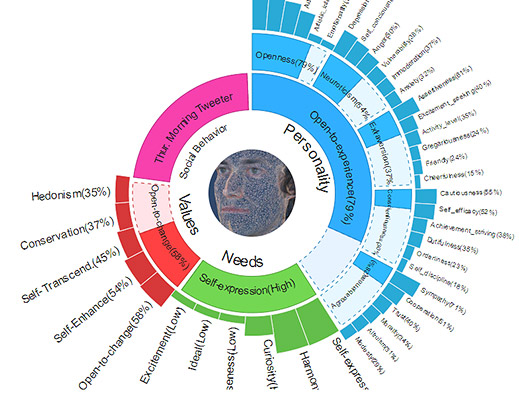
IBM Software Learns Your Personality, Could Tailor Ads Accordingly | MIT Technology Review


Trying to derive a person’s wants and needs—conscious or otherwise—from online browsing and buying habits has become crucial to companies of all kinds.

Now IBM is taking the idea a step further. It is testing technology that guesses at people’s core psychological traits by analyzing what they post on Twitter, with the goal of offering personalized customer service or better-targeted promotional messages.

Read more: IBM Software Learns Your Personality, Could Tailor Ads Accordingly | MIT Technology Review.

IBM Personality Analysis