When writing business documents (aside from emails), most people turn to word-processing software. That’s not the only option. You can do everything — outlines, drafts, revisions, and even layouts, if you’d like — in PowerPoint or similar presentation programs. That’s what I’ve used to write my books, internal documents, sales collateral, and web copy, for several reasons. READ MORE: Why I Write in PowerPoint | Harvard Business Review
Raise your hand if you like sitting through slide-show presentations. How about reading dense, jargony business documents? These are the staples of modern business communication, and yet they’re enjoyed by precisely no one. Enter Nancy Duarte, CEO of Duarte Design. Duarte thinks she can redesign business communication with Slidedocs, a new concept she defines as “a visual document, developed in presentation software, that is intended to be read and referenced instead of projected.” Think of it as a kind of a hybrid between slide-show presentations and prose documents—but one that eliminates the most annoying qualities of each. Duarte’s new book on Slidedocs, which she wrote entirely in PowerPoint, has just been released as a free download on her website. READ MORE: Book Written Entirely In PowerPoint Aims To Reinvent How Businesses Communicate | FastCompany
During these summer months, we’ve been busy rummaging around the internet and adding new courses to our big list of Free Online Courses, which now features 1,150 courses from top universities. Let’s give you the quick overview: The list lets you download audio & video lectures from schools like Stanford, Yale, MIT, Oxford and Harvard. Generally, the courses can be accessed via YouTube, iTunes or university web sites, and you can listen to the lectures anytime, anywhere, on your computer or smart phone. We didn’t do a precise calculation, but there’s probably about 35,000 hours of free audio & video lectures here. Enough to keep you busy for a very long time. READ MORE: A Master List of 1,150 Free Courses From Top Universities: 35,000 Hours of Audio/Video Lectures | Open Culture.
Twelve-year-old Mathew Flores is a bit different from the rest of us. He loves junk mail. Until recently, advertisements were the only reading materials available to the boy. Flores loves reading so much that he approached his mailman in a Salt Lake City suburb on Friday to ask if he could have any junk mail. The strange question prompted the mailman, Ron Lynch, to ask why. READ MORE: Boy Who Couldn’t Afford Books Asks Mailman For Junk Mail To Read; Mailman Responds Spectacularly | HuffPost.
Beyond Wearables: New Frontiers in Interactive Tech | WIRED
IN THE FINAL months of 2014, wearable technology sparked significant media and consumer attention – not least thanks to the announcement of the Apple Watch. But as wearables move from the margins into the mainstream, it’s time to consider the next wave of interactive technology.
Programmable Clothes Are Going Commercial | Co.Design
Clothes speak volumes about us, conveying messages about wealth, taste, and personal beliefs. So in this age of ubiquitous screens and social sharing, it’s no surprise that textiles have become another platform for electronic communication. But two new efforts are commercializing the technology, creating consumer fashions that allow the wearer to project any electronic text or image she desires.
Somehow Teen Girls Get the Coolest Wearable Out There | WIRED
JEWELBOTS ARE BRACELETS with programmable plastic flowers made for middle-school girls. They’re also the most interesting wearable I’ve seen this year. Their creators describe them as “friendships bracelets that teach girls to code.”
This Jacket Is a Dream Come True and I Need It Now | Jezebel
The BauBax jacket—which CNN quite accurately refers to as “the Swiss Army knife of
travel wear”—which debuted on Kickstarter last week with a goal of raising $20,000. They have since raised over $600,000 because it is a stunningly good idea. The jacket contains 15 pockets and a slew of built-in doodads.
These Strange Clothes Came Out of a Regular Old 3-D Printer | WIRED
Paired with new cellular structures being devised by 3-D printing re
searchers, the material allowed Peleg to create “lace-like textiles” that she could work with
“just like cloth.” She printed them using a Witbox—a $1,800 machine. [Image: Danit Peleg]
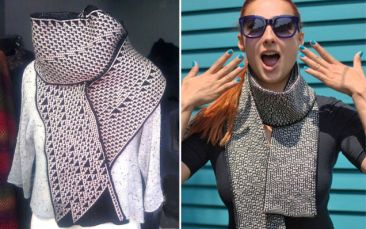
These Mathematical Scarves Are Designed By a Computer Algorithm | Gizmodo It’s still summer, but these mathematical merino scarves designed with a computer algorithm are getting us in the mood for colder temps. They’re called KnitYak: black-and-white merino scarves that each have a snowflake-unique design that’s generated by a computer algorithm.
A Paper-Thin Solar Panel Can Charge Your Phone on the Go | Lifehacker
Solar panels keep getting lighter and tinier—good news for rugged on-the-go types who can charge their devices on the trail with sun-fueled chargers. And this particular solar charger on Kickstarter is so thin, you can slip it in your Lonely Planet while it feeds your phone battery.
Disney’s $1 Billion Bet on a Magical Wristband | WIRED
The MagicBands look like simple, stylish rubber wristbands offered in cheery shades of grey, blue, green, pink, yellow, orange and red. Inside each is an RFID chip and a radio like those in a 2.4-GHz cordless phone. The wristband has enough battery to last two years. It may look unpretentious, but the band connects you to a vast and powerful system of sensors within the park.
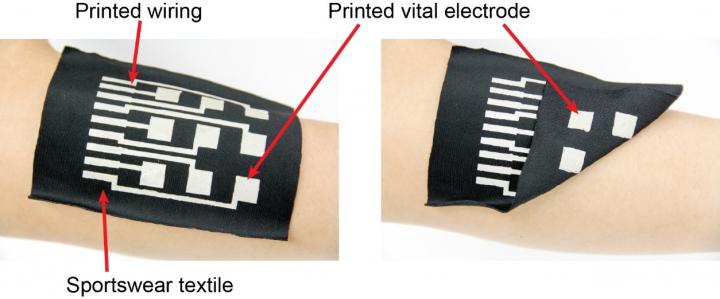
New Process Can Print Stretchy Electronics Onto Your Clothes | TechCrunch
Researchers at the University of Tokyo have created a single-step process to print conductive material on cloth, allowing manufacturers to build stretchable wearables that can test vital signs like heart rate and muscle contraction.
Google’s Project Jacquard Aims To Make “Activewear” A Reality | ReadWriteWeb
What’s really fascinating about Project Jacquard…the clothing itself ought to be an interactive thing. It ought to provide us an opportunity to interact with devices around us. That’s the breakthrough that Project Jacquard is really talking about—now, instead of just passive data collection, your clothing is an opportunity for you to interact with devices.
Sensory Fiction | Felix | VIMEO
Sensory fiction is about new ways of experiencing and creating stories. Traditionally, fiction creates and induces emotions and empathy through words and images. By using a combination of networked sensors and actuators, the Sensory Fiction author is provided with new means of conveying plot, mood, and emotion while still allowing space for the reader’s imagination.
How to Print a Super-Thin Touchscreen Display on Just About Anything | Gizmodo
[T]his award-winning paper is perhaps the coolest we’ve seen: It lays out a new technique for printing cheap, simple touchscreen displays with conventional printers. It’s called PrintScreen, and it’s a system that allows the user to print on nearly a
ny material.
From The Designers Of Fitbit, A Digital Tattoo Implanted Under Your Skin | Co.Design
We asked NewDealDesign, the design consultancy behind projects like the Fitbit line of activity trackers, and Google’s modular Project Ara smartphone, what things might look like when technology and fashion reach beyond the wrist. In response, they created Project Underskin. It’s a concept for a smart digital tattoo which would be implanted in your hand and interact with everything you touch. It can unlock your front door, trade data with a handshake, or even tell you if you have low blood sugar.
Depending how you look at it, the Lost My Name team has either created one artful book or 53,849. The Little Boy/Girl Who Lost His/Her Name, the top-selling picture book in the U.K. last year, is personalized for each recipient. The child’s name doesn’t simply get mentioned a few times—an easy enough publishing gimmick. Rather, the story itself changes; different characters appear for each name. In fulfilling orders for 53,849 children’s names so far, the company has created that many stories—and books.
According to the National Center for College and Career Transitions (NC3T), about 20 percent of careers — and many of the fastest growing areas — directly relate to science, technology, engineering and math.
But by one count, an insufficient number of students today will pursue STEM careers. So how do we convince students that STEM is important even if they don’t think they will pursue a career in a related field? READ MORE: Exposing Every Student To STEM | TechCrunch.
Super-interesting! If you are a fan of coding camps and makerspaces this would be a good article to read to get an idea of what’s on the horizon in gaming development, gaming innovations and interactive/social gaming.
Some of us learn best in the classroom, and some of us … well, we don’t. But we still love to learn, to find out new things about the world and challenge our minds. We just need to find the right place to do it, and the right community to learn with. In this charming talk, author John Green shares the world of learning he found in online video. WATCH: John Green: The nerd’s guide to learning everything online | TED Talk | TED.com.
The letter was signed by 600 [scientists and their supporters] and sent Tuesday to the publisher of Science and to BuzzFeed News. It denounces the elite publisher for sexist columns, an offensive cover photo about trans people, and a snarky tweet from an editor who has since resigned. READ MORE: Read This Letter From Scientists Accusing Top Publisher Of Sexism | BuzzFeed News.




 ve seen: It lays out a new technique for printing cheap, simple touchscreen displays with conventional printers. It’s called PrintScreen, and it’s a system that allows the user to print on nearly a
 infophile