
A Pyramid in the Middle of Nowhere Built To Track the End of the World | Gizmodo


A huge pyramid in the middle of nowhere tracking the end of the world on radar, just an abstract geometric shape beneath the sky without a human being in sight: it could be the opening scene of an apocalyptic science fiction film, but it’s just the U.S. military going about its business, building vast and other-worldly architectural structures that the civilian world only rarely sees.

The Library of Congress has an extraordinary set of images documenting the Stanley R. Mickelsen Safeguard Complex in Cavalier County, North Dakota, showing it in various states of construction and completion. And the photos are awesome. Read more:  A Pyramid in the Middle of Nowhere Built To Track the End of the World | Gizmodo
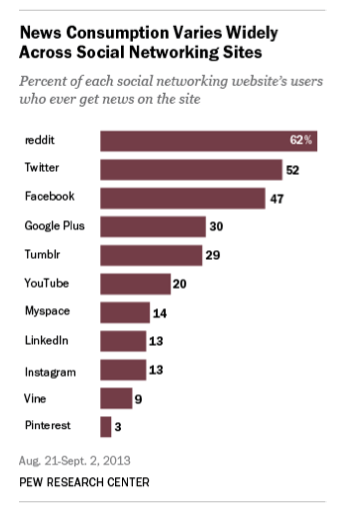
Pew Social Media Study: 30% Of The U.S. Gets News Via Facebook; Reddit Has The Most News-Hungry Regular Users | TechCrunch


The Pew Research Center is today releasing comparative numbers looking at how U.S. adults use social networking sites to read news (a follow-on from earlier research focusing on two specific sites, Facebook and Twitter).

This is significant for a couple of reasons. Social media sites have become a key component of how many news organizations today are looking to reach consumers as old-media forms like printed editions continue to decline. In turn, social media sites are turning news a way of attracting more eyeballs to improve their own ad-based businesses. That is to say, news and social media are dancing partners that are still working out how to move in the same direction without stepping on each other’s feet, and this survey is one indicator of how well the public is receiving that.

Read more and see all the charts: Pew Social Media Study: 30% Of The U.S. Gets News Via Facebook; Reddit Has The Most News-Hungry Regular Users | TechCrunch.

Pew: News Consumption

Why Facebook Would Pay $3 Billion for Snapchat (And Why It Shouldn’t) | Wired.com


Facebook just tried to spend $3 billion on a 20-person company that lets you send disappearing photos. At least, that’s the word from The Wall Street Journal, a rather trustworthy source.

According to the paper, SnapChat rejected the offer. But the amazing thing is that Facebook would offer that much money in the first place. SnapChat has no revenues, and its collection of users — however many there are — is puny when you consider that Facebook reaches over 1.2 billion people around the world. Across the internet, so many people are asking themselves: Why on earth would Facebook offer so much for this tiny company?

Read more: Why Facebook Would Pay $3 Billion for Snapchat (And Why It Shouldn’t) | Wired Business | Wired.com.

Smithsonian now lets you view artifacts in 3D | CNET News


Smithsonian X 3D

You can now take a 3D peek at several famous historical artifacts thanks to a project from the Smithsonian Institution.

Launched on Wednesday, the Smithsonian X 3D Web site serves up a collection of 3D images of artifacts digitally scanned by the museum through a partnership with Autodesk. You canexplore the artifacts in detail by manipulating their images via mouse on your computer or via finger on a supported touch-screen device.

Read: Smithsonian now lets you view artifacts in 3D | Internet & Media – CNET News.

Related: The Smithsonian Is Uploading Its Lost Treasures to the Internet | Gizmodo

News: Education & Technology, Librarianship


Education & Technology

With MakerBot Academy, the 3-D Printing Movement Aims for Schools | AllThingsD
The company announced on Tuesday an initiative to begin seeding its Replicator 3-D printing machines inside of K-12 schools across the U.S. The effort comes in partnership with DonorsChoose.org, a site that allows public school teachers to make online requests for classroom projects, which are then backed by a Kickstarter-like funding drive.

Twitter goes for the masses with new storytelling feature | CNET
Twitter excels in capturing the “moment” as events happen, but it isn’t great at telling a story. With custom timelines, the company hopes to lure a broader audience by giving it coherent narratives rather than just the raw materials.

Librarianship

How Iran Uses Wikipedia To Censor The Internet | BuzzFeed
A new study from the University of Pennsylvania’s Annenberg School claims that Wikipedia might hold the key to understanding how Iran censors, and controls, the internet. The answer, in four words: with a heavy hand.

The Secrets Of A Memorable Infographic | Co.Design


Human memory is very fallible, but lately cognitive scientists have found that our minds capture much more visual detail in a moment than once believed. A 2008 paper reported that people who saw thousands of images for three seconds each over five hours later identified ones they’d seen over similar alternatives with nearly 90% accuracy. They didn’t just remember that they’d seen a cracked egg, they remembered that its egg white had formed a perfectly round puddle.

In other words, when we do retrieve a memorable image, a surprising amount of information comes with it, like a burr stuck to a sweater. That insight could have big implications for people who use visualizations in their everyday lives–graphic designers, for instance, or anyone on Tumblr. Above all, it suggests that memorability alone might enhance an infographic’s effectiveness. But it also prompts a question: How does an image become memorable in the first place?

Read: The Secrets Of A Memorable Infographic | Co.Design | business + design.

Upstagram Is A Flying Raspberry Pi That Publishes Live Pictures On Instagram | TechCrunch


What do Instagram, the Raspberry Pi and the movie “Up” have in common? When you mash all these things together, you get Upstagram, a neat hack that the Hackerloop team just unveiled.

First, the team made a replica of the house in “Up” using paper and foam. It was just big enough to fit a Raspberry Pi and its camera, a battery and a 3G hotspot. The Raspberry Pi, an open source and very cheap mini-computer to tweak, experiment and try new things with, is a hacker’s dream.

Then, the team used about 90 helium balloons to make the house fly above Paris’ landscape. While Instagram is only available on iOS and Android, they reverse-engineered the posting process to transform the Raspberry Pi into an Instagram-taking machine.

Read more: Upstagram Is A Flying Raspberry Pi That Publishes Live Pictures On Instagram | TechCrunch.

A Mountain Range of Shelves Turns This Kids’ Library Into a Playground | Gizmodo


Learning to read is a massive adventure in itself, but discovering the library—a magical place where the stories are plentiful and the books are free—is downright mind-blowing. In an effort to match the fun between the pages, the Mexican branding studio Anagrama transformed the interior of a local heritage site into Niños Conarte, a geometric mountain range of literature.

See all the pics: A Mountain Range of Shelves Turns This Kids’ Library Into a Playground | Gizmodo.

News Links


Launching Later This Week: New York Public Library’s Shelley-Godwin Digital Archive | InfoDocket
The archive will offer digital versions of romantic texts.

Blogging Startup Medium Opens to All | AllThingsD
Medium, the blogging startup created by Twitter co-founder Evan Williams, announced on Friday that it is now open for all to use. Newcomers are required to sign in with a Twitter account, and can only post from Chrome, Firefox and Safari browsers.

Metadata: Pinterest and Getty Images Announce Partnership | InfoDocket
Getty Images and Pinterest partner to learn more about the images you pin.

Apple CEO: We’ve locked up 94% of education tablet market | CNET
Tim Cook calls the company’s share in the education arena unheard of in most businesses.

Nielsen to add web viewers to future TV ratings, with a little help from Facebook | Engadget
After several months of testing within the industry, Nielsen is finally ready to reveal its efforts to bake mobile viewing habits into its TV ratings system.

Authors face censorship decision to publish in China | Melville House

Kraków joins UNESCO Cities of Literature | thenews.pl

Yandex Buys KinoPoisk, ‘Russia’s IMDb’, To Move Into Film Search And Recommendation | TechCrunch

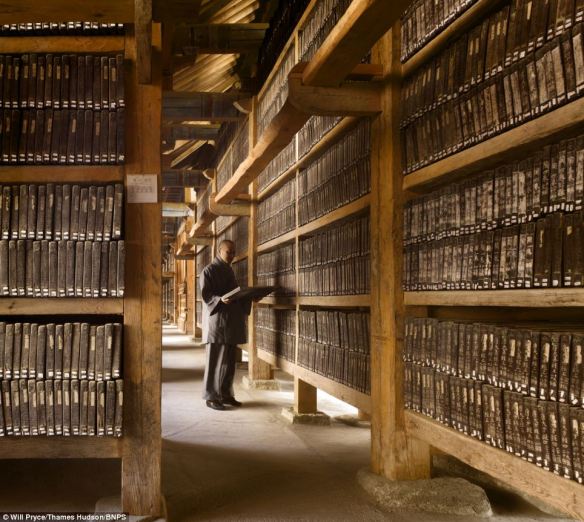
Shhh! World’s most stunning libraries captured in new book that will leave you lost for words | Daily Mail Online


Some stunning photos of libraries you likely have not seen before from Dr. James Campbell’s new book. See more: Shhh! World’s most stunning libraries captured in new book that will leave you lost for words | Daily Mail Online.

British academic Dr James Campbell visited more than 80 libraries in 20 countries for his new book The Library, the first complete history of library buildings ever to be written.

Tripitaka Koreana

The Library: A World History