TNT greenlights ‘The Librarians’ franchise as a series | EW.com


TNT has greenlit 10 episodes for a series based on The Librarians franchise, slated to air in late 2014. The TV movies told the story of a group of extra special librarians who live beneath the Metropolitan Public Library in New York and safeguard mystical relics from forces of evil by slapping them with outrageous overdue fees. The plot is a messy stew of Indiana Jones, National Treasure, and Hell Boy …but the product is less than the sum of its parts. Read more: TNT greenlights ‘The Librarians’ franchise as a series | Inside TV | EW.com.

Last chapter for many Environment Canada libraries | PostMedia | Canada.com


Full Post

Last chapter for many Environment Canada libraries

Books and reports from a Department of Fisheries library at the Maurice Lamontagne Institute in Mont Joli, Que., tossed into a dumpster, according to scientists distributing the photo.

Photograph by: HANDOUT , Postmedia News

Environment Canada has a phone number for its library in Calgary. But a meteorologist answers, and he can’t say what’s become of the books.

It’s a similar story in Edmonton and Quebec City where federal libraries, with shelves loaded with reference books and scientific reports on everything from beluga whales to songbirds, now exist only in name.

Environment Canada lists the libraries on its website but the books are long gone.

“It’s been moved to Saskatoon,” said a woman named Susan who picked up at the phone number for the Edmonton library. In Yellowknife an answering machine said the Environment Canada library “is closed.” And the number listed for the federal conservation and environment library in Winnipeg is no longer in service.

Environment Canada, like the department of Fisheries and Oceans, is closing and consolidating its science libraries to the dismay of some observers who worry valuable books and materials are being lost.

“My sense is that the Environment Canada policy has been to essentially hack one arm off to save the other,” said one scientist, who asked not to be identified for fear of losing his job. He said the big worry is the loss of so-called “grey literature” — material that hasn’t been widely published, with as few as one or two copies in existence — and historical reports on wildlife and the environment that exist nowhere else.

Environment Canada libraries in Winnipeg, Edmonton, Calgary and Yellowknife have closed and the collections have been shipped to Saskatoon. A skeleton staff of one librarian and a couple of co-op students are said to be dealing with the consolidated collection in Saskatoon, which includes 650 boxes stashed in a “caged” storage areas awaiting sorting and cataloguing.

Several Environment Canada libraries in the East — including the ones in Quebec City and Sackville, N.B., have also been shuttered, others have been downsized, and some cases valuable materials has been tossed, scientists say.

Cuts to the federal science library programs have been underway for years but concern and controversy has grown as the books have been cleared off the shelves, with excess and outdated material landing in dumpsters. Peter Wells, an ocean pollution expert at Dalhousie University in Halifax, describes the closing of the DFO libraries as a “national tragedy.” And recent reports have likened it to burning books.

Barbara Clubb, interim executive director of the Canadian Library Association, said the group’s members are concerned. The reports of loss of access to valuable materials are “very, very worrying,” said Clubb.

The government defends the closures saying they are part of an effort to modernize its science libraries.

Environment Canada’s media office said in a statement Thursday that the department is closing and consolidating 12 libraries and reading rooms as part of a “modernization initiative” and “digitization plan.”

And Gail Shea, Minister of Fisheries and Oceans insisted this week that the closing of DFO libraries will save taxpayers’ money and not impact access.

“It is absolutely false to insinuate that any books were burnt,” Gail Shea, Minister of Fisheries and Oceans said in a statement this week.

Seven DFO libraries across Canada, including two that have been amassing books and technical reports on the aquatic realm for more than a century, are being consolidated at two primary locations in Sidney, B.C., and Dartmouth, N.S.

Shea said duplicate materials were offered to other libraries. “They were also offered to the DFO staff on site at the library, then offered to the general public, and finally were recycled in a ‘green’ fashion if there were no takers,” the statement said.

Shea also said “the decision to consolidate our network of libraries was based on value for taxpayers.”

“An average of only five to 12 people who work outside of DFO visit our 11 libraries each year,” she said. “It is not fair to taxpayers to make them pay for libraries that so few people actually use.”

Science historian Jennifer Hubbard at Ryerson University in Toronto said Shea’s argument is misleading because people cannot “just waltz” into federal research libraries. Hubbard, who has worked extensively with the DFO collection, said a security pass is needed to visit the consolidated DFO library in Nova Scotia.

She also said it made “no economic sense” to close the brand new climate-controlled DFO library at the St. Andrews Biological Station in New Brunswick built by the Harper government at a cost of several million federal tax dollars.

Environment Canada media officer Danny Kingsberry said in the statement much work remains to be done as the department consolidates material from five staffed libraries, seven unstaffed reading rooms and material from retiring scientists who “leave their books, journals behind.”

“There are approximately 650 boxes of print material in a storage cage at the National Hydrology Research Centre in Saskatoon, where the Saskatoon library is located,” Kingsberry said.

“The bulk of it is transferred material from consolidated EC libraries and EC Programs that has not yet been reviewed by local library staff,” he said. “This material will be sorted and either added to the collection or not, based on the relevance of each item.”

Both DFO and Environment Canada have online library catalogues and will arrange interlibrary loans, but many federal librarian jobs have been eliminated with the libraries. Kingsberry said the plan is to digitize “rare, historical and ‘one-off’ ” holdings but it is not clear how long that costly job will take.

“What is the plan for digitization and how much is being done,” said Clubb, at the library association. The association is also looking for information on the government plan for ensuring “information professionals” are available to help people find and access material. “You can not get everything you need on Google, by any means,” said Clubb.

Hubbard agrees.

Claims by DFO that “all material has been scanned and made available online is simply untrue,” said Hubbard. She said she has been having trouble locating historic reports about East Coast marine science that were on the selves of DFO libraries that closed.

Hubbard and other researchers say historical data and reports are increasingly valuable given the change underway in the world’s ecosystems.

“DFO is dumping documents, including grey literature that exists in limited quantities, just at a point when fisheries biologists around the world have been turning to historical studies, data, and graphical information to reconstruct the effects of fishing and fisheries policies, and to document environmental change,” said Hubbard.

“The Department of the Environment’s scientists would similarly need to have access to older data and documents for doing historical time series to investigate environmental change in terms of populations, climate, etc, or even — ironically — potentially to critique some of the current scientific narratives of which the Conservative government is suspicious,” she said.

Environment Canada’s collections include reference materials like the 16-volume Handbook of the Birds of the World, historic photographs of glaciers in the Rockies and reports produced by federal scientists over the decades, some found nowhere else.

Insiders at Environment Canada say a lot of material was discarded as a result of the closures of the regional libraries and renovation and downsizing at the department’s reference library in Gatineau, Que. They said the loss includes dozens of boxes full of historical environmental reports and studies from around the world that had been translated for use by Canadians.

“They were immaculate translations,” said one scientist. While the original reports may still exist in foreign libraries, the translations are lost. “If you knew about the obscure Russian papers from the 1930s, the librarian could probably bring it in for you, but you’d have to read Russian.”

mmunro@postmedia.com

Twitter.com/margaretmunro

Librarians as Instructional Designers: Strategies for Engaging Conversations for Learning | The Unquiet Librarian


School, academic, and public librarians often cite collaborative partnerships as one of the greatest challenges of the profession—how do we invite collaboration, how do we nurture and sustain those partnerships, and how might those efforts translate into additional endeavors?  Identifying common goals and cultivating trust are two fundamental building blocks in this process, but libraries and librarians being sensitive to the needs of the community, whether it is an individual, group, or organization, is also paramount.

Read more: Librarians as Instructional Designers: Strategies for Engaging Conversations for Learning | The Unquiet Librarian.

Device & Conquer: SLJ’s 2013 Tech Survey | The Digital Shift


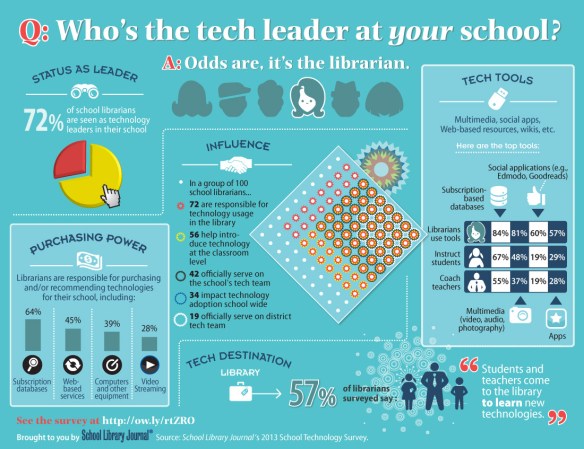
As education technology has evolved, so, too, have the kinds of digital tools that school librarians use with their students, as shown in School Library Journal’s 2013 School Technology Survey. Handheld tablets and devices are coveted items for classroom and instructional use, along with access to online sites and apps that school librarians believe can revolutionize the way they instruct—and the way students learn. More than 750 school librarians responded to SLJ’s survey, representing K–12 public and private schools across the country. According to the data, school librarians make the most of what they have, learning one day and sharing that knowledge the next. They not only make tech tools available for students and teachers, but teach them how to use the tools as well.

Read More: Device & Conquer: SLJ’s 2013 Tech Survey | The Digital Shift.

School Library Journal’s 2013 School Technology Survey


35 Free Live Webinars for Librarians in December | Ellyssa Kroski | OEDB.org


‘Tis the season for online learning, especially in the library field!  December’s calendar is brimming with exciting and free learning opportunities for librarians looking for professional development.  Check out this list of 35 gratis webinars, just in time for the holidays!

Read: 35 Free Live Webinars for Librarians in December | Ellyssa Kroski | OEDB.org.

Book this librarian | The Hindu


Pushpendra Pandya

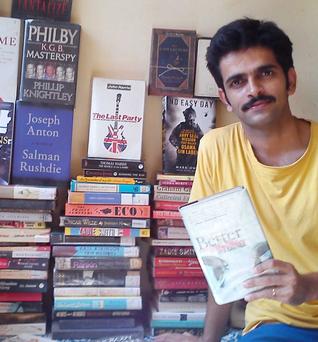
Pushpendra Pandya, a resident of Vasai in Mumbai, works six days a week as a copywriter. On Sundays, though, he hires a cab and travels to different localities in the city, collecting books from those who have either no need for them, or no space to keep them.

Last month he started a crowd-sourced library, and has since built a collection of 1200 titles with help from friends and strangers. The idea for the library came to Pandya in March last year when he started a book sharing arrangement with friends.“Just like we would share notes in college after bunking class to cover up, we started swapping books. I thought it could be taken to a larger audience,” says Pandya, who calls himself an old-fashioned book lover. “In spite of being in such a crowded city, people feel lonely here. You need some company sometimes, and books have been the greatest company for me so far.

Read the rest of the story: Book this librarian | The Hindu.

Mystery of 18th century music book| This Is Guernsey


Mystery book

Full Post

Historians are trying to trace the mysterious author of an 18th century music album that has been discovered in a library archive.

The untitled, leather-bound songbook was found by an archivist sorting through a catalogue of collections in the Watt Library in Greenock, Inverclyde.

The inside cover is signed by a Hugh Cameron and dated 1709 and it also contains poems, a book list and a series of religious writings.

The music, such as A Trumpet Air and Auld Robin Gray, were not written by Cameron but copied from a book of popular Scottish music. Cameron’s book has been described as an early example of a music album – a copy of music that can be performed by the owner at their leisure.

An expert from the Royal Conservatoire of Scotland has studied the unusual find and hopes to find out more about the person who wrote it.

Karen McAulay, music librarian at the Conservatoire, said: “A lot of the pieces in the manuscript have been copied out of one particular book.

“There was a publisher in Glasgow called Aird around that time and they published a series of books with fiddle tunes, mainly from Scotland but some from other countries as well, and when you go through this book you find that quite a lot of the tunes are from that one single volume (of the Aird book).

“These days you can quickly copy down with a photocopier or buy an album, but hundreds of years ago what you did was write your favourite tunes out and that’s exactly what this gentleman has done.”

The book is now going on display in the McLean Museum inside the library alongside other items from the archive, such as the Greenock Autograph Book which contains letters from Charles Dickens and Charles Darwin.

Library archivist Neil Dickson discovered the songbook last month when he was preparing the new display for Inverclyde Council.

He said: “The only reason it was found was because I was cataloguing the records which had previously never been catalogued before. We discovered the songbook and straight away I realised it was something special.

“It’s very unique and I always feel privileged to be doing the job I am and to make discoveries like this, because it’s essentially history that’s been untouched and it’s our job to explore and make it available, and hopefully we can find out more about the book and Hugh Cameron.”

Little else is known about the author and the library hope local people will be interested in the story.

Ms McAulay has researched Mr Cameron but has been unable to pinpoint exactly where he was from.

She said: “My guess is that he was possibly a schoolmaster. I found out that there were several Hugh Camerons who were schoolmasters at that time, one in Perthshire, and it could have been him, but I can’t be sure.

“What I can say is that he wasn’t a Church of Scotland minister because he was not in the minister listings for that time.

“The book is dated 1709 and the handwriting of the signature is very young but the handwriting of the lists of books is more mature so that would have been when the same person was a bit older. It may be something he’s added to over his life or it may be that a relative or someone else also used the book.”

The display is part of a nationwide Explore Your Archive campaign which aims to get people interested in local history.

Mr Dickson said: “Archives are very important, it’s essentially raw history.

“They’re usually the only resources we have for getting a detailed description of people’s life and society from the 17th century onwards.

“By searching through our archives in Inverclyde we’ve found some very, very special items and hopefully they can give people an insight in to the history of the area.”

via Mystery of 18th century music book | This Is Guernsey.

News: Education & Technology, Librarianship


Education & Technology

Xbox One News: Xbox One’s DRM policy reversal: an oral history | Engadget and Xbox One won’t play 3D Blu-rays — for now | CNET

Intel Has Acquired Kno, Will Push Further Into The Education Content Market With Interactive Textbooks | TechCrunch
We had a tip about, and have now confirmed, Intel’s latest acquisition: Kno, the education startup that started life as a hardware business and later pivoted into software – specifically via apps that let students read interactive versions of digitized textbooks.

Librarianship

News: Education & Technology; Libraries & Librarians; Publishing, Books & Film


Education, Technology

Affordable mini Raspberry Pi monitor smashes funding goal | theguardian
HDMIPi Kickstarter project for affordable 9in high-definition monitors for the Raspberry Pi took just 50.5 hours to hit target

Google to Launch ‘Helpouts’ on Monday | The Wall Street Journal
A new video service from Google aims to connect people with teachers, personal trainers, doctors and other experts is expected to launch Monday evening, according to a recent planning email. The new service, called “Helpouts,” has been in quiet testing for months. There are few restrictions on who can sign up to offer services, though Google has been reaching out to professional organizations such as the language-learning company Rosetta Stone to fill in the ranks of experts.

Google Wants The Government’s Data On You | Forbes
Google’s president for the Americas urged government officials Friday to open all municipal data so Google can use it to become everyone’s perfect personal assistant—an invisible entity that knows what you want before you do.

Libraries, Librarians

OCLC and ProQuest work together to automate e-book collection management | OCLC
Collaboration will help library staff keep e-book information current, offer library users quick and easy access to e-books from ebrary and EBL.

State Library of South Australia to create new technology hub to attract more users of its resources | news.com.au
Will embark on an ambitious program of events and create a university-style hub in a bid to arrest a fall of almost 200,000 visitors last financial year.

News: Libraries & Librarians; Education & Technology


Libraries, Librarians

Former Assistant Librarian Fired for Reporting Sex Act In Children’s Section of Town Library | KOB4

Who needs a librarian when you have Google? | Sandusky Register

Tough Report on Job Placement & Salary Information for Librarians | Galleycat

Oklahoma’s Pioneer Library System Launches 24-Hour Vending Library | The Digital Shift

Education, Technology

Academics urge peers to self-publish research | The Bookseller

ResearchGate: “Forget About Revenue Until The Network Is Valuable Enough To Command It” | TechCrunch

Coursera teams up with State Department on series of MOOC-based ‘learning hubs’ around the world | Engadget

Our sources are reliable. | Wikipedia news from The Millions

Web inventor’s open data organisation announces new global network | theguardian. US, Canada, Russia and France among 13 to sign agreements with Open Data Institute co-founded by Sir Tim Berners-Lee

Facebook Admits Teen Use May Be Declining | Mashable

Can You Use Electronic Devices On Airplanes During Takeoff and Landing? Soon, Yes! | TeleRead. Did you know Amazon ran the technical analysis of whether we have to shut down Kindles on planes | Washington Post. One more airline story: Airline Lost Your Luggage? Let Your Phone Find It | Mashable