The Most Important Insights From Mary Meeker’s 2015 Internet Trends Report | TechCrunch #tech


If you want to understand tech, Mary Meeker’s Internet Trends reports are the closest you’ll get to gospel. Today the Kleiner Perkins partner released her hotly anticipated 2015 edition. But at 197 slides, her presentation can be overwhelming. So we’ve broken down Meeker’s knowledge dump to highlight the most critical data points, and added our analysis so you know what you’re looking at.

READ MORE: The Most Important Insights From Mary Meeker’s 2015 Internet Trends Report | TechCrunch

It’s Not Women Who are the Problem in Tech Land | CNET #tech #sexism #genderequality


We are hearing more and more about gender equality issues in the tech industry. I liked this particular article from CNET, as studies are referenced which provide evidence that the more diverse teams are, the more innovative and financially successful the company will be. Overt and subtle biases of sexism toward women and girls are also discussed.   

Silicon Valley’s male-dominated culture could cost the technology industry the thing it values most: innovation. READ MORE: It’s not women who are the problem in tech land | CNET.

You may also like: Women in tech don’t get the same respect as men, survey says | CNET

8 STEM Toys for Pint-Sized Einsteins | Mashable #kids #STEM #toys #play


Often times, parents want the toys their children play with to teach STEM skills — recently updated to STREAM, or Science, Technology, Reading, Engineering, Arts and Math.

At the 2015 International American Toy Fair, there was a bevy of toys that were anything but mindless. Better yet, they’re made to get kids interested in one of these educational topics — without slathering on the “learning” part so they will be disinterested.

Here are some of our favorites that will keep kids learning beyond the classroom.

READ MORE: 8 STEM toys for pint-sized Einsteins | Mashable

Video Game Link to Psychiatric Disorders Suggested by Study | The Guardian #gaming #psychology


People who regularly play action video games could be at increased risk of developing neurological and psychiatric disorders, a study suggests.

The research, published in a Royal Society journal on Wednesday, found that people who played games such as Call of Duty, Grand Theft Auto V and Tomb Raider were more likely to employ navigational strategies associated with decreased grey matter in the hippocampus part of the brain.

Decreased volume in the hippocampus has been associated with disorders such as schizophrenia, post-traumatic stress disorder, depression and Alzheimer’s disease.

The lead study author, Prof Greg West, from the University of Montreal’s department of psychology, said the paper indicated that benefits of video games, such as improved attention and perception, highlighted in previous studies, could come at a price.

READ MORE: Video game link to psychiatric disorders suggested by study | Technology | The Guardian

Learn About the Internet of Things with This Interactive Visualization | LifeHacker #IoT #InternetofThings @infobeautiful


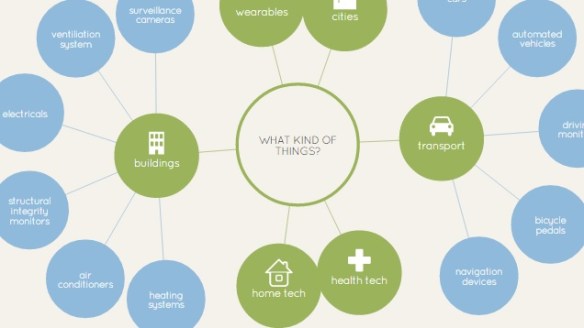
If you’re still trying to wrap your head around what the “Internet of Things” is, this data visualization makes things easy to understand and is fun to explore.

The visualization, from the team at Information is Beautiful, does a great job of explaining what the Internet of Things is, what it can and will affect, who the major players are, and even provides some eye-opening statistics regarding the direction we’re all headed with technology. Additionally, it mentions some of the challenges facing our “always connected” world. You can check it out at the link.

The Internet of Things | Information is Beautiful

via Learn About the Internet of Things with This Interactive Visualization | LifeHacker

Check Out This Coding Toy—For Grownups | ReadWrite @TeamKano #coding #diy #makerspaces #tech


I think its a very smart marketing move for Kano to launch products that are gender and age neutral. I volunteer with my public library’s CoderDojo program, which is for 9 to 17 year olds. One of the participant’s parents has actually stayed to learn as well. Its heartwarming to see parent and child learning new concepts together. Learning to code, makerspaces, hackfests, arduino…these activities are fun and instructive for all ages and can be a family activity too.

Check Out This Coding Toy—For Grownups - ReadWrite

Kickstarted into existence in 2013, with a campaign that blasted through its $100,000 goal with $1.5 million in pledges, Kano now makes Raspberry Pi–based computer kits commercially available to children ages 6 to 14. Inspired by those young users, who founder Alex Klein says have created and shared as many as 5 million lines of code, he wants to spread that enthusiasm to a larger audience.

Engineering kits have been popular among kids and a natural fit in the educational space. Likewise, Kano set out following in the footsteps of companies like Little Bits, Adafruit, and Goldie Blox. But Klein now wants to extend Kano’s reach, taking it into grown-up territory. Simply put, he wants to appeal to everyone’s inner “inventor and tinkerer,” he said.

Klein wants to push into the adult maker market by putting out products that are both gender- and age-neutral. The core design, he hopes, speaks to fundamental human impulses: “Everyone has shared urges to look inside,” he said. “Everyone wants to take control. Everyone wants to make and play.”

Kano’s next stage of evolution will involve some fundamental shifts. The company is expanding its line-up with new add-on kits, and plans to open up Kano Blocks—its game-making arena—and online platform Kano World to community development.

All Kano products run on Kano OS, the open source operating system that sits on top of Raspberry Pi. It boasts high computational powers that let it run fast, boot quickly and offer clear graphical rendering. For developers, this means that they will have ample resources to jump on board and quickly create their own projects. Kano World allows for the Kano community to share their creations and add on to existing projects.

READ MORE: Check Out This Coding Toy—For Grownups | ReadWrite

Say Hello to the Final Oculus Rift—Coming 2016 | Gizmodo #virtualreality #OculusRift


I’ve been fortunate to experience a prototype Oculus Rift…the consumer version looks way cool and much more refined.

Virtual reality is coming—and now, we finally know when. You will actually be able to buy a real, consumer version of the Oculus Rift in the first quarter of next year. You’re looking at it right now. Let me repeat: this is not another prototype. READ MORE: Say Hello to the Final Oculus Rift—Coming 2016 | Gizmodo

C.H.I.P. — The super tiny computer that only costs $9 [@Kickstarter] | Mashable #makerspaces @nextthingco


If you thought the $35 Raspberry Pi 2 was a small and cheap computer, think again. Next Thing Co.’s open-source C.H.I.P. is an even smaller barebones microcomputer that only costs $9.

Like the Raspberry Pi, C.H.I.P. can be used in a variety of ways. Connect the necessary parts — a keyboard, mouse, and a display — to it and it becomes a personal computer. Otherwise, you can hack it into a retro games emulator, or robot, or whatever you can dream up. Next Thing Co. encourages users to learn how to code and make things with C.H.I.P.

Next Thing Co. is currently crowdfunding C.H.I.P. through a Kickstarter campaign. At the time of this writing, the project has successfully reached its $50,000 funding goal with 29 days to go. The first C.H.I.P computers are expected to start shipping in December.

READ MORE: C.H.I.P. — the super tiny computer that only costs $9 | Mashable

Google wants you to download your web search history | Engadget #search


Wondering what you were searching for online a few years ago? You now have a (relatively) easy way to find out. Google has quietly trotted out an option to download your entire search history. So long as you searched using your Google account, you’ll have a permanent record.

via Google wants you to download your web search history | Engadget

MinecraftEdu Takes Hold in Schools | School Library Journal #minecraft #education


There aren’t any express objectives or any real way to win in Minecraft. It’s a “sandbox,” in gaming speak—offering free play without a specific goal and currently used by more than 18.5 million players, with some 20,000 more signing up every day. Users may choose between Creative Mode, in which they can build using unlimited resources by themselves or with friends, with no real danger or enemies, and Survival Mode, where they fend off enemies and other players and fight for resources and space. They can trade items and communicate using a chat bar. Modifications (or mods) can add complexity by creating things like economic systems that let players buy and sell resources from in-game characters using an in-game currency system. These downloadable mods can also add computer science concepts and thousands of additional features.

MINECRAFTEDU

Minecraft’s worlds and possibilities are truly endless—and increasingly, so are its educational adaptations for school use. Available on multiple platforms (Apple, Windows, Linux, PlayStation, Xbox, Raspberry Pi, iOS, Android, Windows Phone), the game’s flexibility and collaborative possibilities make it a favorite among devotees of gamification.

“Minecraft is like LEGOs on steroids,” says Eric Sheninger, a senior fellow at the International Center for Leadership in Education. “Learners of all ages work together to ultimately create a product that has value to them,” he adds. “The simple interface provides students in the classroom with endless possibilities to demonstrate creativity, think critically, communicate, collaborate, and solve problems.” A Swedish student research study also showed that collaboration in Minecraft provided a more immersive problem-solving experience than group LEGO building.

via MinecraftEdu Takes Hold in Schools | School Library Journal.