Could television be the secret weapon that gets more girls into science There is no shortage of initiatives that aim to get girls interested in STEM careers from an early age. From GoldieBlox’s building kits and storybooks to the 8-week summer camp Girls Who Code teaching teens the fundamentals of robotics and web development. That’s because in order to right the lopsided gender balance in science, engineering, and math, research indicates that it’s important to engage girls while they are young and encourage them to continue to pursue STEM careers. And we all know how important diversity is to business, particularly as it becomes more globally connected.
Yet engineering toys and school programs can’t necessarily stem the tide of media images that continue to push the idea the typical scientist, programmer, or engineer is a white guy working alone. That’s why the USC’s Viterbi School of Engineering and the National Academy of Engineering pooled their resources in partnership with the MacGyver Foundation and together they’re crowdsourcing a concept for a new television show starring a strong female scientist —the next MacGyver. READ MORE: Here Are 5 Contenders For A New, Female MacGyver–Will One Help Drive Girls To Engineering? | Co.Create | creativity + culture + commerce.
One of the most intense experiences you’ll ever have is visiting a country that speaks a language different than yours. There’s a host of tools you can use, but Google’s Translate product has leapfrogged just about everything out there over the years.
Its most handy, and impressive, tool is the six-month-old instant translation feature, using the goodies from the acquired Word Lens, that lets you point your camera at something written in another language, say a sign, and it’ll translate into your language with ridiculous accuracy in almost real-time.
Today, that feature is expanding today from seven languages to 27 languages: English, French, German, Italian, Portuguese, Russian, Spanish, Bulgarian, Catalan, Croatian, Czech, Danish, Dutch, Filipino, Finnish, Hungarian, Indonesian, Lithuanian, Norwegian, Polish, Romanian, Slovak, Swedish, Turkish and Ukrainian. The update is rolling out over both iOS and Android.
There have never been more technologies available to collect, examine, and render data. Here are 30 different notable pieces of data visualization software good for any designer’s repertoire. They’re not just powerful; they’re easy to use. In fact, most of these tools feature simple, point-and-click interfaces, and don’t require that you possess any particular coding knowledge or invest in any significant training. Let the software do the hard work for you. Your client will never know. MORE: 30 Simple Tools For Data Visualization | Co.Design | business + design.
Additional data visualization services, such as Creately, Doodle.ly and Viewshare listed on infophile’s Tools webpage.
Remember a few weeks back, when we learned that Google’s artificial neural network was having creepy daydreams, turning buildings into acid trips and landscapes into Magic Eye pictures? Well, prepare to never sleep again, because last week, Google made its “inceptionism” algorithm available to the public, and the nightmarish images are cropping up everywhere.
The “Deep Dream” system essentially feeds an image through a layer of artificial neurons, asking an AI to enhance and build on certain features, such as edges. Over time, pictures can become so distorted that they morph into something entirely different, or just a bunch of colorful, random noise.
Now that the code for the system is publicly available, anyone can upload a photo of their baby and watch it metamorphose into a surrealist cockroach, or whatever. If you need some inspiration, or an excuse to crawl back into bed, pull the covers over your face, and wait for the world to end, just check out the hashtag ‘DeepDream’ on your social media platform of choice. READ MORE: Google’s Dream Robot Is Running Wild Across the Internet | Gizmodo.
In four small schools scattered across San Francisco, a data experiment is under way. That is where AltSchool is testing how technology can help teachers maximize their students’ learning. Founded two years ago by Max Ventilla, a data expert and former head of personalization at Google, AltSchool runs schools filled with data-gathering technology.
Information is captured from the moment each student arrives at school and checks in on an attendance app. For part of the day, students work independently, using iPads and Chromebooks, on “playlists” of activities that teachers have selected to match their personal goals. Data about each student’s progress is captured for teachers’ later review. Classrooms are recorded, and teachers can flag important moments by pressing a button, as you might TiVo your favorite television show.
The idea is that all the data from this network of schools will be woven into a smart centralized operating system that teachers will be able to use to design effective and personalized instruction. There is even a recommendation engine built in. READ MORE: Educating Data | MIT Technology Review.
When writing business documents (aside from emails), most people turn to word-processing software. That’s not the only option. You can do everything — outlines, drafts, revisions, and even layouts, if you’d like — in PowerPoint or similar presentation programs. That’s what I’ve used to write my books, internal documents, sales collateral, and web copy, for several reasons. READ MORE: Why I Write in PowerPoint | Harvard Business Review
Raise your hand if you like sitting through slide-show presentations. How about reading dense, jargony business documents? These are the staples of modern business communication, and yet they’re enjoyed by precisely no one. Enter Nancy Duarte, CEO of Duarte Design. Duarte thinks she can redesign business communication with Slidedocs, a new concept she defines as “a visual document, developed in presentation software, that is intended to be read and referenced instead of projected.” Think of it as a kind of a hybrid between slide-show presentations and prose documents—but one that eliminates the most annoying qualities of each. Duarte’s new book on Slidedocs, which she wrote entirely in PowerPoint, has just been released as a free download on her website. READ MORE: Book Written Entirely In PowerPoint Aims To Reinvent How Businesses Communicate | FastCompany
Beyond Wearables: New Frontiers in Interactive Tech | WIRED
IN THE FINAL months of 2014, wearable technology sparked significant media and consumer attention – not least thanks to the announcement of the Apple Watch. But as wearables move from the margins into the mainstream, it’s time to consider the next wave of interactive technology.
Programmable Clothes Are Going Commercial | Co.Design
Clothes speak volumes about us, conveying messages about wealth, taste, and personal beliefs. So in this age of ubiquitous screens and social sharing, it’s no surprise that textiles have become another platform for electronic communication. But two new efforts are commercializing the technology, creating consumer fashions that allow the wearer to project any electronic text or image she desires.
Somehow Teen Girls Get the Coolest Wearable Out There | WIRED
JEWELBOTS ARE BRACELETS with programmable plastic flowers made for middle-school girls. They’re also the most interesting wearable I’ve seen this year. Their creators describe them as “friendships bracelets that teach girls to code.”
This Jacket Is a Dream Come True and I Need It Now | Jezebel
The BauBax jacket—which CNN quite accurately refers to as “the Swiss Army knife of
travel wear”—which debuted on Kickstarter last week with a goal of raising $20,000. They have since raised over $600,000 because it is a stunningly good idea. The jacket contains 15 pockets and a slew of built-in doodads.
These Strange Clothes Came Out of a Regular Old 3-D Printer | WIRED
Paired with new cellular structures being devised by 3-D printing re
searchers, the material allowed Peleg to create “lace-like textiles” that she could work with
“just like cloth.” She printed them using a Witbox—a $1,800 machine. [Image: Danit Peleg]
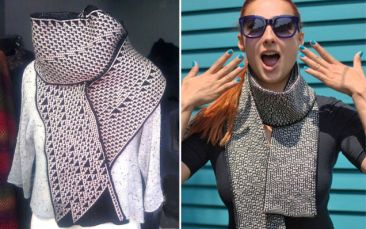
These Mathematical Scarves Are Designed By a Computer Algorithm | Gizmodo It’s still summer, but these mathematical merino scarves designed with a computer algorithm are getting us in the mood for colder temps. They’re called KnitYak: black-and-white merino scarves that each have a snowflake-unique design that’s generated by a computer algorithm.
A Paper-Thin Solar Panel Can Charge Your Phone on the Go | Lifehacker
Solar panels keep getting lighter and tinier—good news for rugged on-the-go types who can charge their devices on the trail with sun-fueled chargers. And this particular solar charger on Kickstarter is so thin, you can slip it in your Lonely Planet while it feeds your phone battery.
Disney’s $1 Billion Bet on a Magical Wristband | WIRED
The MagicBands look like simple, stylish rubber wristbands offered in cheery shades of grey, blue, green, pink, yellow, orange and red. Inside each is an RFID chip and a radio like those in a 2.4-GHz cordless phone. The wristband has enough battery to last two years. It may look unpretentious, but the band connects you to a vast and powerful system of sensors within the park.
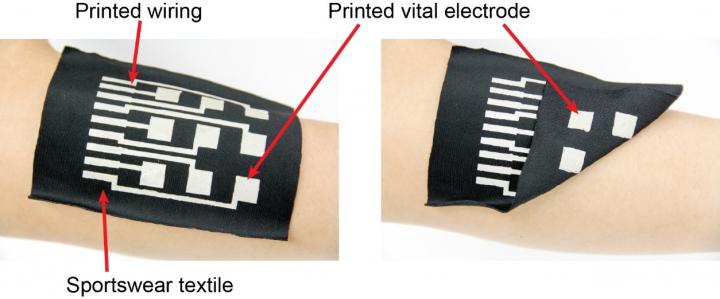
New Process Can Print Stretchy Electronics Onto Your Clothes | TechCrunch
Researchers at the University of Tokyo have created a single-step process to print conductive material on cloth, allowing manufacturers to build stretchable wearables that can test vital signs like heart rate and muscle contraction.
Google’s Project Jacquard Aims To Make “Activewear” A Reality | ReadWriteWeb
What’s really fascinating about Project Jacquard…the clothing itself ought to be an interactive thing. It ought to provide us an opportunity to interact with devices around us. That’s the breakthrough that Project Jacquard is really talking about—now, instead of just passive data collection, your clothing is an opportunity for you to interact with devices.
Sensory Fiction | Felix | VIMEO
Sensory fiction is about new ways of experiencing and creating stories. Traditionally, fiction creates and induces emotions and empathy through words and images. By using a combination of networked sensors and actuators, the Sensory Fiction author is provided with new means of conveying plot, mood, and emotion while still allowing space for the reader’s imagination.
How to Print a Super-Thin Touchscreen Display on Just About Anything | Gizmodo
[T]his award-winning paper is perhaps the coolest we’ve seen: It lays out a new technique for printing cheap, simple touchscreen displays with conventional printers. It’s called PrintScreen, and it’s a system that allows the user to print on nearly a
ny material.
From The Designers Of Fitbit, A Digital Tattoo Implanted Under Your Skin | Co.Design
We asked NewDealDesign, the design consultancy behind projects like the Fitbit line of activity trackers, and Google’s modular Project Ara smartphone, what things might look like when technology and fashion reach beyond the wrist. In response, they created Project Underskin. It’s a concept for a smart digital tattoo which would be implanted in your hand and interact with everything you touch. It can unlock your front door, trade data with a handshake, or even tell you if you have low blood sugar.
Depending how you look at it, the Lost My Name team has either created one artful book or 53,849. The Little Boy/Girl Who Lost His/Her Name, the top-selling picture book in the U.K. last year, is personalized for each recipient. The child’s name doesn’t simply get mentioned a few times—an easy enough publishing gimmick. Rather, the story itself changes; different characters appear for each name. In fulfilling orders for 53,849 children’s names so far, the company has created that many stories—and books.
According to the National Center for College and Career Transitions (NC3T), about 20 percent of careers — and many of the fastest growing areas — directly relate to science, technology, engineering and math.
But by one count, an insufficient number of students today will pursue STEM careers. So how do we convince students that STEM is important even if they don’t think they will pursue a career in a related field? READ MORE: Exposing Every Student To STEM | TechCrunch.





 ve seen: It lays out a new technique for printing cheap, simple touchscreen displays with conventional printers. It’s called PrintScreen, and it’s a system that allows the user to print on nearly a
 infophile