
A perfect GPA isn’t cool. You know what’s cool? Advancing an open source project. To help computer science students prepare for jobs (and boost its own recruiting efforts) Facebook today publicly launched Open Academy. The partnership with premier CS universities sets up a special class where students get college credit for contributing to open source projects.
Tag Archives: online
The Ultimate Guide to the Invisible Web | OEDB.org
Search engines are, in a sense, the heartbeat of the internet; “googling” has become a part of everyday speech and is even recognized by Merriam-Webster as a grammatically correct verb. It’s a common misconception, however, that googling a search term will reveal every site out there that addresses your search. In fact, typical search engines like Google, Yahoo, or Bing actually access only a tiny fraction – estimated at 0.03% – of the internet. The sites that traditional searches yield are part of what’s known as the Surface Web, which is comprised of indexed pages that a search engine’s web crawlers are programmed to retrieve.
So where’s the rest? The vast majority of the Internet lies in the Deep Web, sometimes referred to as the Invisible Web. The actual size of the Deep Web is impossible to measure, but many experts estimate it is about 500 times the size of the web as we know it.
Deep Web pages operate just like any other site online, but they are constructed so that their existence is invisible to Web crawlers. While recent news, such as the bust of the infamous Silk Road drug-dealing site and Edward Snowden’s NSA shenanigans, have spotlighted the Deep Web’s existence, it’s still largely misunderstood.
Read more: The Ultimate Guide to the Invisible Web | OEDB.org.
Eye-opening and informative post. Topics discussed:
- Search Engines and the Surface Web
- How is the Deep Web Invisible to Search Engines?
- How to Access and Search for Invisible Content
- Invisible Web Search Tools
The Beginner’s Guide to SoundCloud | Mashable
Read: The Beginner’s Guide to SoundCloud | Mashable
You may also like:
- The Best Music Download Stores You’re Not Using (but Should) | LifeHacker
- The 25 Best Websites for Music Lovers | Flavorwire
- My long list of Music Discovery resources. | The Modern MLIS
Study: What You Would Be Doing If You Spent Less Time Online | The Atlantic
Most of us have heard our parents or grandparents complain that the digital age has corrupted the youth and taken them away from doing “better things.” Whether or not this is an accurate assessment, no one had ever really figured out how much our computer time cuts into other activities—at least not until now. New research from Scott Wallsten, an economist at the Technology Policy Institute in Washington, D.C., attempts to show exactly what Americans are missing out on because they’re glued to their computer screens.
Wallsten limits his study to “online leisure,” or time spent online doing things like combing social networks, browsing for non-work purposes, instant messaging, etc. (Online games—even though they can take up a lot of leisure time—are excluded because of the way the data Wallsten used are collected by the US Census Bureau. Despite the data’s shortcomings, Wallsten finds that online leisure time still crowds out other activities.)
See the charts and read more: Study: What You Would Be Doing If You Spent Less Time Online – Simone Foxman | The Atlantic.
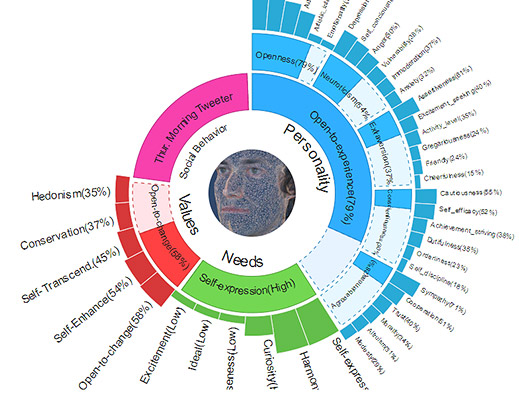
IBM Software Learns Your Personality, Could Tailor Ads Accordingly | MIT Technology Review
Trying to derive a person’s wants and needs—conscious or otherwise—from online browsing and buying habits has become crucial to companies of all kinds.
Now IBM is taking the idea a step further. It is testing technology that guesses at people’s core psychological traits by analyzing what they post on Twitter, with the goal of offering personalized customer service or better-targeted promotional messages.
Read more: IBM Software Learns Your Personality, Could Tailor Ads Accordingly | MIT Technology Review.
30 Marketing Statistics You Shouldn’t Miss [Infographic] | Marketing Technology Blog
Optimind has put together this snapshot of 30 digital marketing statistics to keep in mind with your online marketing and ecommerce presence.

via 30 Marketing Statistics You Shouldn’t Miss [Infographic] | Marketing Technology Blog
Recent Pew Research Links
The New Library Patron from Pew Research Center’s Internet & American Life Project
Lee Rainie, Director of the Pew Research Center’s Internet & American Life Project, will discuss the Project’s new research about library patrons and non-patrons: who they are, what their information needs are, what kind of technology they use, and how libraries can meet the varying needs of their patrons.
Photo and Video Sharing Grow Online | Pew Internet
A new study by the Pew Research Center’s Internet Project shows that 54% of internet users have posted original photos or videos to websites and 47% share photos or videos they found elsewhere online. Also: AFP: Smart phones boost photo, video sharing: study and from TIME: One Stat that Explains Why Instagram Is Adding Ads.
Tablet and E-reader Ownership Update | Pew Internet
The number of Americans ages 16 and older who own tablet computers has grown to 35%, and the share who have e-reading devices like Kindles and Nooks has grown to 24%. Overall, the number of people who have a tablet or an e-book reader among those 16 and older now stands at 43%.
1 in 7 Americans is offline. Why? It’s complicated | Kathryn Zickuhr, Pew Research | CNBC
Pew Data on News Consumption: Millennials Lead the Shift to Web Use | ContentBlogger
Mobile Health in Context: How Information is Woven Into Our Lives from Pew Research Center’s Internet & American Life Project
Adventures in Online Learning [Infographic] | nonprofitcollegesonline.com

Online Dating [Infographic], Online Dating & Relationships Report | Pew Research Center; How I Hacked Online Dating | Amy Webb | TED
Online Dating & Relationships | Pew Research Center
Overview
One in ten Americans have used an online dating site or mobile dating app; 66% of these online daters have gone on a date with someone they met through a dating site or app, and 23% have met a spouse or long term partner through these sites. Public attitudes toward online dating have become more positive in recent years, but many users also report negative experiences.
These are among the results of a national survey of dating and relationships in the digital era, the first dedicated study of this subject by the Pew Research Center’s Internet Project since 2005. Key findings include:
- 11% of internet users (representing 9% of all American adults) say that they have personally used an online dating site. As recently as 2008, just 3% of American adults had used online dating sites.
- 7% of cell phone apps users (representing 3% of all American adults) say that they have used a dating app on their cell phone.
Taken together, 11% of all American adults are “online daters”—meaning they have used a dating site or mobile dating app. Online dating is especially common among the college-educated and those in their mid-20’s through mid-40’s, and 38% of Americans who are currently single and actively looking for a partner have used online dating at one point or another. See the online report or download the pdf.
Amy Webb: How I hacked online dating | TED.com
Amy Webb was having no luck with online dating. The dates she liked didn’t write her back, and her own profile attracted crickets (and worse). So, as any fan of data would do: she started making a spreadsheet. Hear the story of how she went on to hack her online dating life — with frustrating, funny and life-changing results.
Online Dating [Infographic] | Pew Research Center’s Internet & American Life Project

You may also like:
Recent Pew Research Links
25 percent of men watch online porn, and other ‘facts’ about Americans’ online video habits | The Washington Post
Do you spend a lot of time watching videos on YouTube? You’re not alone. The Pew Internet & American Life project released new survey data on how Americans engage with video online Thursday. And the percentage of online adults who watch or download videos has grown from 69 percent of adult Internet users in 2009 to 78 percent today.
Online Video 2013 | Pew Internet
Over the past four years, the percent of American adult internet users who upload or post videos online has doubled from 14% in 2009 to 31% today. That includes 18% of adult internet users who post videos they have created or recorded themselves—many of whom hope their creations go viral. The share of online adults who watch or download videos has also grown from 69% of internet users in 2009 to 78% today, and mobile phones have become a key part of the video viewing and creating experience.
Who’s Not Online and Why | Pew Internet
As of May 2013, 15% of American adults ages 18 and older do not use the internet or email. Asked why they do not use the internet:
- 34% of non-internet users think the internet is just not relevant to them, saying they are not interested, do not want to use it, or have no need for it.
- 32% of non-internet users cite reasons tied to their sense that the internet is not very easy to use. These non-users say it is difficult or frustrating to go online, they are physically unable, or they are worried about other issues such as spam, spyware, and hackers. This figure is considerably higher than in earlier surveys.
- 19% of non-internet users cite the expense of owning a computer or paying for an internet connection.
- 7% of non-users cited a physical lack of availability or access to the internet.
Cell Phone Activities 2013 | Pew Internet
Fully 91% of American adults own a cell phone and many use the devices for much more than phone calls. In our most recent nationally representative survey, we checked in on some of the most popular activities people perform on their cell phones and found:
- 81% of cell phone owners send or receive text messages
- 60% of cell phone owners access the internet
- 52% send or receive email
- 50% download apps
- 49% get directions, recommendations, or other location-based information
- 48% listen to music
- 21% participate in a video call or video chat
- 8% “check in” or share their location
 infophile