
Twelve-year-old Mathew Flores is a bit different from the rest of us. He loves junk mail. Until recently, advertisements were the only reading materials available to the boy. Flores loves reading so much that he approached his mailman in a Salt Lake City suburb on Friday to ask if he could have any junk mail. The strange question prompted the mailman, Ron Lynch, to ask why. READ MORE: Boy Who Couldn’t Afford Books Asks Mailman For Junk Mail To Read; Mailman Responds Spectacularly | HuffPost.
Tag Archives: culture
13 #Ideas in #Fashion and #Interactive #Tech #Wearables
Beyond Wearables: New Frontiers in Interactive Tech | WIRED
IN THE FINAL months of 2014, wearable technology sparked significant media and consumer attention – not least thanks to the announcement of the Apple Watch. But as wearables move from the margins into the mainstream, it’s time to consider the next wave of interactive technology.
Programmable Clothes Are Going Commercial | Co.Design
Clothes speak volumes about us, conveying messages about wealth, taste, and personal beliefs. So in this age of ubiquitous screens and social sharing, it’s no surprise that textiles have become another platform for electronic communication. But two new efforts are commercializing the technology, creating consumer fashions that allow the wearer to project any electronic text or image she desires.
Somehow Teen Girls Get the Coolest Wearable Out There | WIRED
JEWELBOTS ARE BRACELETS with programmable plastic flowers made for middle-school girls. They’re also the most interesting wearable I’ve seen this year. Their creators describe them as “friendships bracelets that teach girls to code.”
This Jacket Is a Dream Come True and I Need It Now | Jezebel
The BauBax jacket—which CNN quite accurately refers to as “the Swiss Army knife of
travel wear”—which debuted on Kickstarter last week with a goal of raising $20,000. They have since raised over $600,000 because it is a stunningly good idea. The jacket contains 15 pockets and a slew of built-in doodads.

These Strange Clothes Came Out of a Regular Old 3-D Printer | WIRED
Paired with new cellular structures being devised by 3-D printing re
searchers, the material allowed Peleg to create “lace-like textiles” that she could work with
“just like cloth.” She printed them using a Witbox—a $1,800 machine. [Image: Danit Peleg]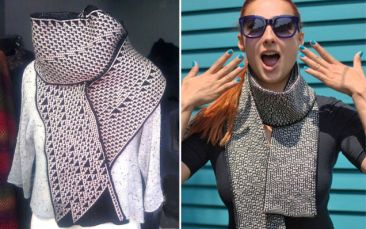
These Mathematical Scarves Are Designed By a Computer Algorithm | Gizmodo
It’s still summer, but these mathematical merino scarves designed with a computer algorithm are getting us in the mood for colder temps. They’re called KnitYak: black-and-white merino scarves that each have a snowflake-unique design that’s generated by a computer algorithm.

A Paper-Thin Solar Panel Can Charge Your Phone on the Go | Lifehacker
Solar panels keep getting lighter and tinier—good news for rugged on-the-go types who can charge their devices on the trail with sun-fueled chargers. And this particular solar charger on Kickstarter is so thin, you can slip it in your Lonely Planet while it feeds your phone battery.
Disney’s $1 Billion Bet on a Magical Wristband | WIRED
The MagicBands look like simple, stylish rubber wristbands offered in cheery shades of grey, blue, green, pink, yellow, orange and red. Inside each is an RFID chip and a radio like those in a 2.4-GHz cordless phone. The wristband has enough battery to last two years. It may look unpretentious, but the band connects you to a vast and powerful system of sensors within the park.
New Process Can Print Stretchy Electronics Onto Your Clothes | TechCrunch
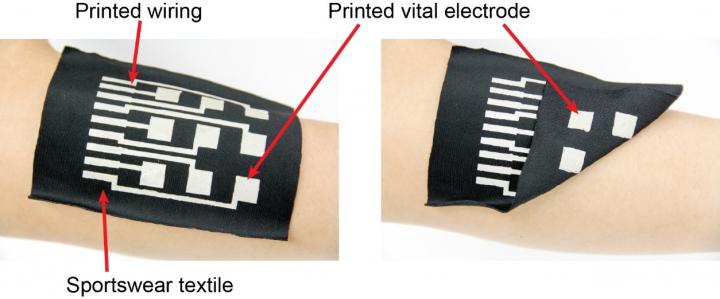
Researchers at the University of Tokyo have created a single-step process to print conductive material on cloth, allowing manufacturers to build stretchable wearables that can test vital signs like heart rate and muscle contraction.
Google’s Project Jacquard Aims To Make “Activewear” A Reality | ReadWriteWeb
What’s really fascinating about Project Jacquard…the clothing itself ought to be an interactive thing. It ought to provide us an opportunity to interact with devices around us. That’s the breakthrough that Project Jacquard is really talking about—now, instead of just passive data collection, your clothing is an opportunity for you to interact with devices.
Sensory Fiction | Felix | VIMEO
Sensory fiction is about new ways of experiencing and creating stories. Traditionally, fiction creates and induces emotions and empathy through words and images. By using a combination of networked sensors and actuators, the Sensory Fiction author is provided with new means of conveying plot, mood, and emotion while still allowing space for the reader’s imagination.
How to Print a Super-Thin Touchscreen Display on Just About Anything | Gizmodo
[T]his award-winning paper is perhaps the coolest we’ ve seen: It lays out a new technique for printing cheap, simple touchscreen displays with conventional printers. It’s called PrintScreen, and it’s a system that allows the user to print on nearly a
ny material.
From The Designers Of Fitbit, A Digital Tattoo Implanted Under Your Skin | Co.Design
We asked NewDealDesign, the design consultancy behind projects like the Fitbit line of activity trackers, and Google’s modular Project Ara smartphone, what things might look like when technology and fashion reach beyond the wrist. In response, they created Project Underskin. It’s a concept for a smart digital tattoo which would be implanted in your hand and interact with everything you touch. It can unlock your front door, trade data with a handshake, or even tell you if you have low blood sugar.

Related
Study: Men who Harass #Women Online Suck at Games (and Life) | Engadget #sexism #gaming #cyberbullying
Researchers think that they’ve worked out why certain men abuse women over the internet: because they suck… at games. According to a study by Michael Kasumovic and Jeff Kuznekoff, the most vocal abusers of women online are the ones most threatened by their presence in the digital sphere. The short explanation for this is because less-skilled men have the most to lose playing games against a woman, thanks to the perceived social stigma of “losing to a girl.” Rather than risk this supposed humiliation, they’d much rather create a toxic environment that’s outright hostile to newcomers. READ MORE: Study: Men who harass women online suck at games (and life) | Engadget
What Happens When You Talk About #Salaries @Google | WIRED #women #genderequality #sexism #tech #compensation #pay
‘What Did You Expect?’ #Women in #Tech Reflect on Ellen Pao’s Exit from Reddit | The Guardian #genderequality #sexism #women #trolls #trolling
Leading women in the tech industry say the Reddit CEO’s resignation shows Silicon Valley still has a woman problem but some feel attitudes are changing fast. READ MORE: ‘What did you expect?’ Women in tech reflect on Ellen Pao’s exit from Reddit | Technology | The Guardian.
A Woman Made A Comic Book About #Abortion And It’s Awesome | HuffPost #comics #graphicnovels #women #books

One woman is on a mission to demystify the realities of abortion — using illustrations. Writer and artist Leah Hayes created an illustrated book, Not Funny Ha-Ha: A Handbook for Something Hard, which takes readers through the thought processes of two women who choose to have abortions — one medical, the other surgical. She hopes the book will chip away at the stigma that often surrounds abortion. READ MORE: A Woman Made A Comic Book About Abortion And It’s Awesome | Huffington Post
9-Year-Old Filipino Boy Got a Scholarship After This Photo Went Viral | Mashable #kindness

I Never Noticed How Racist So Many Children’s #Books Are Until I Started #Reading to My #Kids [Opinion] | Vox #diversity #racism #culture
What happened to Little Black Sambo? As a white girl growing up in West Virginia in the 1970s, I remember it on my childhood bookshelf. It was on my friends’ shelves too. It may also have been in the dentist’s office, along with Highlights for Children and Joseph and His Coat of Many Colors.
It was not on the shelves of the local day care, a center run by an entrepreneurial black woman who saw a business opportunity in the droves of young white mothers who were socialized in the 1950s and ’60s to be housewives and then dumped into the workforce by the 1970s economy.
I remember the story primarily for its description of the tigers chasing one another round and round a tree until they melt into butter, butter that Sambo’s mother uses for a stack of crispy pancakes. In the 35 intervening years, I knew the book had been relegated to the dustbin of racist cultural artifacts, but I didn’t remember it well enough to know why. READ MORE: I never noticed how racist so many children’s books are until I started reading to my kids | Vox.
Battling Bias on the Shop Floor: How #Bookstores Can Support #Diversity | The Guardian #booksellers #genderequality
A bookseller explains how Kamila Shamsie’s call for gender equality in the industry, and the fiery debate it provoked, could lead to greater diversity all around. READ MORE: Battling bias on the shop floor: how bookstores can support diversity | Books | The Guardian
 infophile