Why Aren’t There More #Women in #Tech? | Next Generation #infographics #genderdiversity #STEM #employment #sexism #equality


Women are under-represented in the tech sector. Not only that, but they’re underpaid, often passed for promotions and faced with every day sexism. It’s no wonder women are more likely to leave the industry within a year compared to their male counterparts. MORE: Why Aren’t There More Women in Tech? | Next Generation

This Tool Finds [U.S.] #Colleges with the Highest #Salary for Your Field | LifeHacker #tools #compensation #education #libraryscience 


Library Science and Computer and Information Sciences and Support Services are fields of study included in this comparison tool. Tool only compares U.S. colleges.  

If you have an idea what you’d like to study, but you’re not sure where to go to school, this scorecard from the U.S. Department of Education can help. A few clicks and you can see average salaries for graduates in your field, and what the graduation rates for your school look like. READ MORE: This Tool Finds Colleges with the Highest Salary for Your Field | LifeHacker

5 Ways #Women Can Help Women Succeed in the #Workplace | Mashable #business #genderequality


It’s a tough climb to the c-suite — especially for women. Women make up only 4.6% of CEOs in S&P 500 companies, according to 2015 numbers from advocacy group Catalyst. Women accounted for only 3.3% of CEOs in the top 100 companies in Silicon Valley in 2014, according to numbers from Fenwick. It’s not as though these companies have a small pool of women to choose from. In fact, women make up 45% of the labor force in S&P 500 companies. But that percentage dwindles on each step of the corporate ladder, meaning that there are fewer female candidates in the pipeline when it comes time to name a new manager, board member, or executive. And that’s ultimately bad business for companies.

One Massachusetts Institute of Technology study found that an even gender split increased a company’s revenue by 41%, and a Catalyst study found that companies with more women on their boards performed better when it came to sales, equity, and invested capital. In short: more women at the top can lead to better business. READ MORE: 5 ways women can help women succeed in the workplace | Mashable

What Happens When You Talk About #Salaries @Google | WIRED #women #genderequality #sexism #tech #compensation #pay


READ IT: What Happens When You Talk About Salaries at Google | WIRED.

The Sexiest (And Last?) Job Of The 21st Century | TechCrunch #careers #tech #datascientist


Data scientist, according to a 2012 Harvard Business Review article, is the sexiest job of the 21st century. Given that its authors are Thomas H. Davenport and D.J. Patil, the declaration is hardly surprising. Nonetheless, the IT industry is besotted with the term, and is expecting huge shortages of skilled workers.

A less well-known paper, “The future of employment: how susceptible are jobs to computerization?,” was published less than a year later by two Oxford academics (data scientists, perhaps). The authors, Carl Benedikt Frey and Michael A. Osborne, examine 702 detailed occupations in the U.S. labor market and estimate that about 47 percent of total U.S. employment is at risk from computerization “over some unspecified number of years, perhaps a decade or two.” Nearly 100 occupations, covering a wide range of skills from manual to mental, showed a 95 percent or higher probability of computerization. READ MORE: The Sexiest (And Last?) Job Of The 21st Century | TechCrunch.

The 5 Best #Fonts To Use On Your Resume | HuffPost #resumes


While resume font choice may seem trivial, experts say it’s actually pretty important. A bad font can take the focus off the accomplishments you’ve listed. READ MORE: The 5 Best Fonts To Use On Your Resume | HuffPost

How to Use Your @LinkedIn Profile to Power a Career Transition | HBR #careers


Are you raring to change careers? Break into a whole new line of work that makes you leap out of bed, happy to go to work every day? Parlay personal passions into professional endeavors? Or focus on a different clientele, type of product, or service?

We all know the power of LinkedIn for job hunting and networking. But how do we use it to help change careers—to make sure we’re found by the right recruiters, hiring managers, colleagues—not ones from our past, but from our future careers?

It’s tempting to create an “everything under the sink” profile that makes you look qualified for both the job you have and the one you want or for a variety of new functions, industries, or roles. But that’ll just confuse your readers and send them running—to others’ LinkedIn pages.

Instead, focus your profile on your new career direction, just as you’ve tailored your resume to specific jobs. In both cases, you highlight your most relevant experiences and minimize or omit the rest. READ MORE: How to Use Your LinkedIn Profile to Power a Career Transition | HBR.

Not Taking Risks Is the Riskiest Career Move of All | HBR #careers


Not taking action has costs that can be as consequential as taking risks; it’s simply less natural to calculate and pay attention to the “what-ifs” of inaction. In today’s marketplace, where jobs and job categories are being destroyed and invented at an accelerating rate, I’d argue that the riskiest move one can make is to assume that your industry or job is secure.

READ MORE: Not Taking Risks Is the Riskiest Career Move of All | Harvard Business Review

2014/2015 Results from the DAM Foundation Salary Survey | Dam Foundation #digitalasset


This second iteration of the DAM Foundation salary survey was conducted in 2014 in an effort to build a continuous body of linear data on the demographics, duties, and salaries of Digital Asset Managers. Results include trends in the hiring, retention, and pay of demographic groups in the developing profession of digital asset management. Building on the results of the survey conducted two years previously, the DAM Foundation continues its mission to set standards in digital asset management, and to be the premier source of information to the community of digital asset management professionals. READ MORE: 2014/2015 Results from the DAM Foundation Salary Survey | Dam Foundation

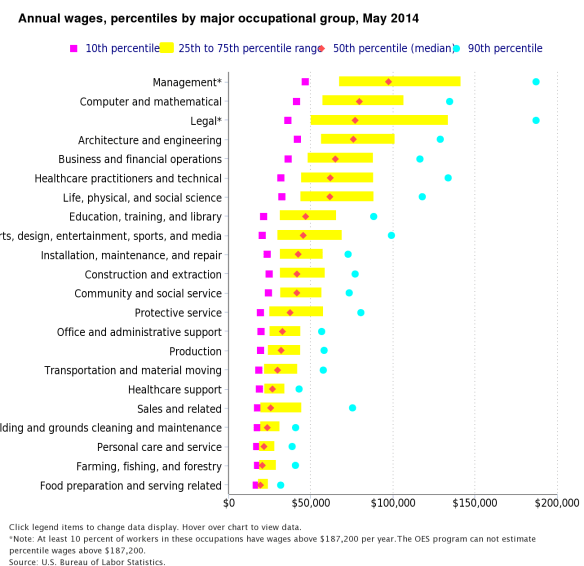
What Every Major Job Category Pays, In One Chart | Vox #employment #MLIS


Of interest to librarians and information services professionals note major job category “Education, training, and library.” See Bureau of Labor Statistics website for interactive charts and chart data.

New data from the Bureau of Labor Statistics lets us see the average pay for every major occupational group and also the distribution of pay at each level for these groups. READ MORE: What every major job category pays, in one chart | Vox