Technology jobs have replaced those in middle management as the positions employers are trying to fill most, new research shows.
A study by job-matching service TheLadders revealed that the fastest-growing jobs shy away from management, and instead require deep educational qualifications and specific skills in the areas of science, technology, engineering and mathematics.
Of the fastest growing job titles over the last five years, seven of the top 10 are technology positions that necessitate specific technical skills for developing software and mining data. Based on their data, the fastest-growing job titles between 2008 and 2013 were:
With MakerBot Academy, the 3-D Printing Movement Aims for Schools | AllThingsD
The company announced on Tuesday an initiative to begin seeding its Replicator 3-D printing machines inside of K-12 schools across the U.S. The effort comes in partnership with DonorsChoose.org, a site that allows public school teachers to make online requests for classroom projects, which are then backed by a Kickstarter-like funding drive.
Twitter goes for the masses with new storytelling feature | CNET
Twitter excels in capturing the “moment” as events happen, but it isn’t great at telling a story. With custom timelines, the company hopes to lure a broader audience by giving it coherent narratives rather than just the raw materials.
How Iran Uses Wikipedia To Censor The Internet | BuzzFeed A new study from the University of Pennsylvania’s Annenberg School claims that Wikipedia might hold the key to understanding how Iran censors, and controls, the internet. The answer, in four words: with a heavy hand.
The LA Times Trolls Innocent Teachers | TechCrunch
The once-respectable LA Times is leveraging its dwindling platform to attack individual teachers under the guise of data transparency. The editorial board won a court case allowing them to use a highly contentious, self-designed algorithm to rank the best and worst teachers in the Los Angeles Unified School District. Neither the suicide of one of the shamed teachers, nor the widespread criticism of the statistical methods have aroused the editorial board’s better judgment.
The most important resource for creating a successful library maker space—whether in a school or public library—is one’s own community, according to librarians Justin Hoenke, Amy Koester, and Michelle Cooper. Strong relationships and community involvement, not big budgets and high-tech gadgetry, are key to reaching children and teens, the trio of makers say.
The experts shared details of their programming for kids and their top maker strategies during “The Community Joins In: Library Maker Spaces,” a midday session of The Digital Shift: Reinventing Libraries (#TDS13) webcast on October 16, moderated by Hoenke, the new teen librarian at the Chattanooga (TN) Public Library and 2013 Library JournalMover & Shaker. And since the event, the trio has created a Pinterest page filled with maker space advice, links, and takeaways.
For those of you who might want to listen to a book via iBooks, one option is to load an iBook on your iPhone or iPad and turn on VoiceOver.
That can change the way your iOS device works, though, so it can be tricky to the uninitiated.
Now that iBooks is on Mavericks, however, you have another option: get your Mac to read your iBook to you.
If you’ve upgraded to Mavericks (and you should, it’s free and optimized for older machines), you have a copy of iBooks on your Mac. Launch it with a double click to the iBooks icon in the Dock or the Applications folder, and then double click one of your iBooks to open it.
Click your mouse in front of where you’d like your MAc to start reading to you, and then head up to the Edit menu. Select the Speech option in the menu, and then choose “Start Speaking.” Your Mac will read to you in the voice that’s chosen in the System Preferences Dictation & Speech preference pane.
Your Mac will keep reading the book until you choose Stop Speaking in the same Edit > Speech menu, though it won’t turn pages when it gets to a new page. If you want to follow along while it reads (a great option for folks with print or other reading disabilities), you’ll need to click the arrow keys or swipe along your trackpad as you go.
If you just want to have your Mac read a selection of text to you, simply click and drag to highlight that section, and then choose Start Speaking from the Edit menu, or right-click and choose Start Speaking from the More option in the contextual menu.
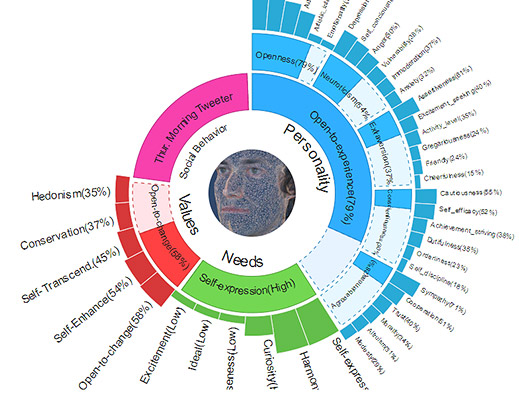
Trying to derive a person’s wants and needs—conscious or otherwise—from online browsing and buying habits has become crucial to companies of all kinds.
Now IBM is taking the idea a step further. It is testing technology that guesses at people’s core psychological traits by analyzing what they post on Twitter, with the goal of offering personalized customer service or better-targeted promotional messages.
Ramona Pringle’s life was like a sitcom — one of those cheesy, too-good-to-be-true shows about finding love and success in the big city.
She had a good job at Frontline; a number of smart, successful friends; and a boyfriend — “a fantastic one!” — whom she planned to marry. Things were perfect.
With a quick roll of the dice, though, everything changed. Her mother was diagnosed with a life-changing illness, and Pringle left her job in New York and moved back home to Toronto to take care of her. A week later, Pringle’s boyfriend broke up with her.
The dream, the city, the perfect life — gone in a flash.
“It was absolute rock bottom,” she says. ” Here I was, back in my childhood bedroom — and it was so quiet. It was so eerily quiet Here I was, back in my childhood bedroom — and it was so quiet. It was so eerily quiet.”
It was the type of situation in which some might turn to alcohol, drugs or even religion to cope. Pringle was looking for some kind — any kind — of answer. But her mother was sick, and she needed to be with her. Leaving wasn’t an option.
“People get these ‘pilgrimage moments,’ you know? When something happens to them and they trek across Europe or India in search of some kind of wisdom,” she says. “I couldn’t do that.”
Instead, she turned to the virtual realm of World of Warcraft (WoW), where she found an unexpected community of support and camaraderie. She was so inspired that she went to work on an interactive documentary, Avatar Secrets, about the lessons she learned. It’s set to be released in the spring of 2014.
A really inspiring story. I think many of us can empathize with her dramatic change in circumstances directing her life down a completely different path. The content above is only half the story…read more following the link: How One Woman Grappled With Grief Through Gaming | Mashable.
How Pinterest Plans to Woo the Rest of the Internet | FastCompany
Unlike social media platforms like Twitter that capture the here and now, Pinterest is for dreaming of what’s ahead, says CEO Ben Silbermann…“People use Pinterest every day to get ready for and excited about something in their future–what they’re going to make for dinner, what they’re going to teach their classroom of students. If we can create a set of connections between things that they’re interested in, we can help them plan for that future.”
Did you hear the one about the 7-year-old boy who opened a Wii on Christmas morning and when his parents finally checked on him, he’d played for 18 hours? Or the one about the 13-year-old girl who accidentally “butt-dialed” an old acquaintance whose number now belonged to a transsexual prostitute, who then launched a vendetta against the girl? Catherine Steiner-Adair, a psychologist whom parents seem to call whenever there’s a digital/psychological crisis at home, has heard all these stories and more, and shares them in “The Big Disconnect: Protecting Childhood and Family Relationships in the Digital Age.”
A new policy statement issued by the American Academy of Pediatrics on October 28 recommends parents control the quantity and content of the media their children consume, keep tech gadgets out of kids’ bedrooms, and model good behavior for kids by limiting their own tech use. Steiner-Adair advises the same limits, and backs these up with examples from the children and families she works with as a counselor. Here are the key lessons “The Big Disconnect” taught me, and the grades I’d give myself for how well I’m handling tech at each age.

![Have Your Mac Read A Book To You In Mavericks And iBooks [OS X Tips] | Cult of Mac](https://infophile.ca/wp-content/uploads/2013/11/mavericks-ibooks-speech-640x484.jpg?w=584)
 infophile