
Why Researching Our Ancestors Has The Power To Change Lives | Fast Company


Back in 2010, when Dana Saxon decided that she wanted to trace her family’s lineage, her expectations were low. “I thought, for people who survived slavery, there’d be little public information,” she says. What happened next “blew her mind”–and led to the creation of Ancestors Unknown, an international nonprofit that is bringing the past to the most impressionable among us: young students.

Saxon discovered that public archives had not completely ignored the existence of the enslaved, who legally were considered the same as property. While putting together the puzzle of her family’s past, she had an epiphany: “There were so many ancestors waiting to be discovered, waiting to be appreciated for what they did to help get us to where we are today,” she says. Knowing that most school curriculums do not include the names and contributions of people from the African Diaspora, she “wanted to find a way to help young people place themselves and their ancestors in the larger context of history.”

READ MORE: Why Researching Our Ancestors Has The Power To Change Lives | Fast Company | Business + Innovation

The Mission of Ancestors Unknown… “To inspire the personal and academic success of students throughout the world by introducing them to their unknown ancestors.”

A.I. XPRIZE: Can A Robot Deliver A TED Talk Worthy Of A Standing Ovation? | International Business Times


Imagine if Samantha from the movie “Her” could deliver a dynamic, engaging and totally human TED Talk. That’s what the nonprofit hopes will be a reality in the near future. TED wants to find out if an artificial intelligence can deliver a talk that wows the audience at a future conference.

During the TEDActive 2014 conference on March 20, Chris Anderson, curator of TED, and Peter Diamandis, founder of the XPRIZE, announced the formation of the A.I. XPRIZE where the winner will receive a lucrative award for delivering a talk that receives a standing ovation. READ MORE

Librarians as Instructional Designers: Strategies for Engaging Conversations for Learning | The Unquiet Librarian


School, academic, and public librarians often cite collaborative partnerships as one of the greatest challenges of the profession—how do we invite collaboration, how do we nurture and sustain those partnerships, and how might those efforts translate into additional endeavors?  Identifying common goals and cultivating trust are two fundamental building blocks in this process, but libraries and librarians being sensitive to the needs of the community, whether it is an individual, group, or organization, is also paramount.

Read more: Librarians as Instructional Designers: Strategies for Engaging Conversations for Learning | The Unquiet Librarian.

Device & Conquer: SLJ’s 2013 Tech Survey | The Digital Shift


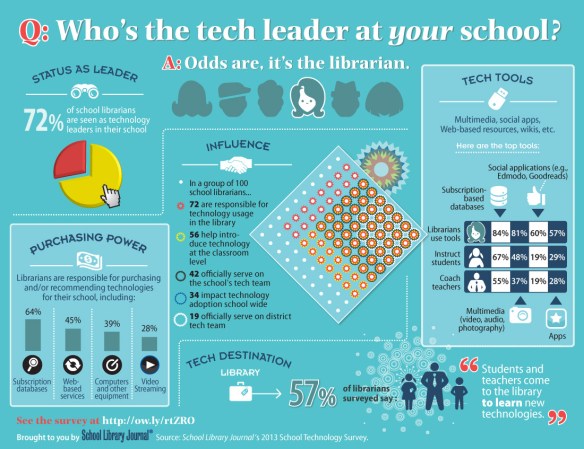
As education technology has evolved, so, too, have the kinds of digital tools that school librarians use with their students, as shown in School Library Journal’s 2013 School Technology Survey. Handheld tablets and devices are coveted items for classroom and instructional use, along with access to online sites and apps that school librarians believe can revolutionize the way they instruct—and the way students learn. More than 750 school librarians responded to SLJ’s survey, representing K–12 public and private schools across the country. According to the data, school librarians make the most of what they have, learning one day and sharing that knowledge the next. They not only make tech tools available for students and teachers, but teach them how to use the tools as well.

Read More: Device & Conquer: SLJ’s 2013 Tech Survey | The Digital Shift.

School Library Journal’s 2013 School Technology Survey


Readworthy: Education & Technology, Librarianship


Education & Technology

Librarianship

Primo Is An Arduino Robot That Teaches Kids Programming Logic Through Play [Kickstarter] | TechCrunch


Dan Shapiro’s Robot Turtles board game Kickstarter showed there is serious appetite for kids’ games that aren’t just fun to play with but also sneakily teach core coding principles. Instead of the $25,000 he was aiming for, Shapiro raised more than $630,000. Geeky moms and dads clearly have money, and will spend it on the right bit of educational kit.

With that kind of Kickstarter community response, it’s pretty likely we’re set to see a wave of educational toys doing cool fun stuff with programming principles. To wit, meet Primo: a physical programming interface that teaches children programming logic while they control the movements of an Arduino-powered robot.

Read: Primo Is An Arduino Robot That Teaches Kids Programming Logic Through Play | TechCrunch.

American Library Association Defends Banned Mexican American Studies Courses | Mashable


Librarians do not approve of Arizona’s battle against Mexican American Studies.

A group of 10 educational organizations, including the American Library Association, filed an amicus brief Monday in support of the lawsuit against Arizona Superintendent of Public Instruction John Huppenthal for quashing a controversial Mexican American Studies curriculum in Tucson. Some 48 teachers from across the country filed a second amicus brief defending the banned courses.

The educators argue that in passing legislation aimed at shutting down a progressive Mexican American Studies program, Arizona Republicans were guided by political goals rather than pedagogical ones.

Read: American Library Association Defends Banned Mexican American Studies Courses | Mashable.

News: Education & Technology, Librarianship


Education & Technology

Librarianship

Are Digital Libraries A ‘Winner-Takes-All’ Market? OverDrive Hopes So | Forbes
“Schools and libraries in all forms are transitioning their spends from providing physical items that are being stored on shelves and branches to digital items — the fastest portion of their growth,” said Steve Potash  in a recent interview. Potash is President and CEO of OverDrive, the Cleveland-based provider of technology for managing and distributing digital content for lending libraries.

Gross: Fifty Shades of Grey goes viral – literally | theguardian
Library copies of the bestselling sadomasochistic romance were found to carry traces of herpes and cocaine.

Are online LIS students doomed? | Hack Library School


Hello fellow hackers! I’m excited to join the Hack Library School team. For my first post, I thought I’d tackle the subject of online MLIS programs, even though this has been discussed on Hack Library School in the past.

You see, recently on Hiring Librarians some hiring managers have criticized online LIS education, stating that they are wary of hiring graduates who have obtained a MLIS degree online. This even prompted a survey on biases against online library school. Library Journal noticed this and followed up with a discussion of the widespread trend of online programs, concluding that, while becoming more common, they still have a way to go before being accepted by the entire library community. Oh no! Does this mean online LIS students won’t be hired after they graduate? Are we doomed? I don’t think so. It’s clear there are still major misconceptions and confusion about how LIS programs work. Of course, each school is different, but online MLIS degrees are every bit as valid as degrees earned in person.

Read the full story: Are online LIS students doomed? | Hack Library School.

Tradecraft Launches A School For Teaching Non-Technical Skills To Tech Workers | TechCrunch


For many companies in Silicon Valley, it’s fairly easy to find, train, and evaluate technical talent — for the most part, it’s easy to determine and quantify how well a person codes. But evaluating and training non-technical personnel is something many struggle with. To help change this, a new school called Tradecraft has emerged to help teach those seeking UX, growth, and sales positions the skills they need to succeed in the tech world.

Tradecraft was founded by Russ Klusas and Misha Chellam, who believe it (or something like it) is necessary to teach necessary skills to non-technical tech workers.

Read: Tradecraft Launches A School For Teaching Non-Technical Skills To Tech Workers | TechCrunch.